
Pradyot Bathuri@pbathuri
13
Events attended
4
Submissions made
1 year of experience
About me
Hello, my name is Pradyot, I am great at making coffee and sitting long sessions being creative on trading algorithms AFTER drinking that Coffee. I have worked on 4 medium-sized algorithm development projects so far, and I am good at in a Python workspace and intuitive at statistical modelling. I am passionate about many subjects intersecting with ML, but right now I am looking at quantum mechanics, parallel programming and its stochastic capability, the extent of its parallelization and applications to model an ML model to pioneer a new model or the research towards it. I also love big old red buildings, especially if it's a library or an old artillery depot, that rustic feeling with an old note of books or gun powder as I explore them mazes of memory is just indescribable.
🤝 Top Collaborators
🤓 Latest Submissions
AssureSearch
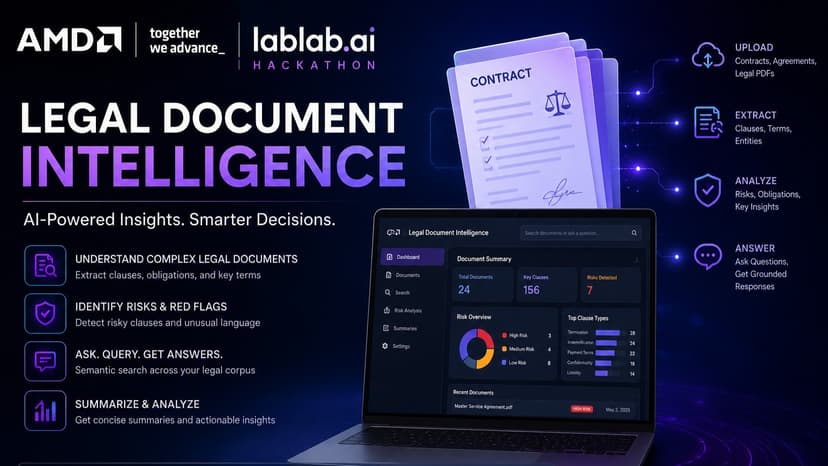
Our project is an AI-powered Legal Document Intelligence platform designed to help users analyze, understand, and interact with complex legal documents using modern agentic AI workflows. The system enables users to upload contracts, agreements, policies, and legal PDFs, then automatically extracts critical clauses, identifies potential risks, summarizes obligations, and supports semantic querying over the entire document corpus. The platform was built to address a major pain point in legal workflows: the time and expertise required to manually review dense legal documentation. Traditional document review processes are expensive, slow, and difficult to scale. Our solution combines retrieval-augmented generation (RAG), structured document parsing, embedding-based semantic search, and multi-step AI reasoning to create a more efficient legal intelligence workflow for startups, businesses, researchers, and independent users. The architecture integrates document ingestion pipelines, OCR and parsing layers, vector search, and LLM-powered reasoning agents. Uploaded documents are chunked intelligently while preserving legal context and clause continuity. The system then indexes the data into a semantic retrieval layer that allows highly contextual querying and grounded responses. Users can ask questions such as: “What are the termination clauses?” “Are there indemnification risks?” “What obligations exist for the client?” “Summarize payment terms and renewal conditions.” The platform also includes clause classification and risk analysis functionality, enabling rapid identification of problematic or unusual language within agreements. Instead of only generating generic summaries, the system produces grounded outputs tied directly to source passages for transparency and auditability. From an infrastructure perspective, the project was designed with high-performance inference workflows in mind.
10 May 2026

RevereTrade
Captain Whiskers is an autonomous trading agent system for agentic commerce demos on Base Sepolia. A Next.js dashboard fronts the experience: users chat in plain English while Google Gemini provides tool-calling to interpret instructions and coordinate execution. Trading connects through the Kraken-oriented path for paper and live-capable flows, with market intelligence (PRISM) providing context for decisions. On-chain, the project emphasizes verifiable agent identity via ERC-8004 registration and reputation feedback, plus risk controls through a RiskRouter and ERC-4626-style capital vault for sandbox accounting. The server is NestJS with PostgreSQL; the repo includes Hardhat contracts, agent-card hosting, and CLI flows for registry verification and hackathon intents. Deployment is documented for split hosting (for example Vercel for the app and Railway for the API) with CORS and environment wiring. The architecture layers model constraints, off-chain validation, and on-chain limits so testnet demos stay safe while illustrating how production-grade agent commerce could be gated. The codebase also sketches extended modules—quantum-inspired portfolio tooling, micropayment patterns, and high-assurance verification—so the story can grow beyond the core hackathon path.
12 Apr 2026
RoboDk based Quantum state simulator
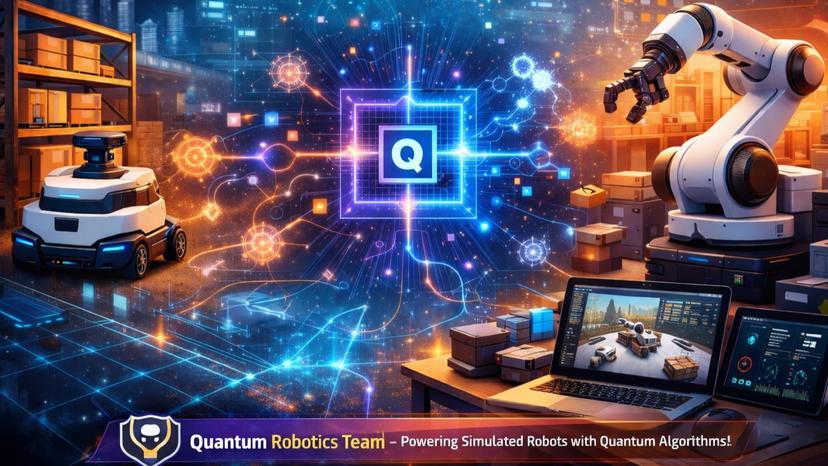
The Quantum‑Enhanced Robotics Simulator (QERS) is a fully‑functional digital testbed for designing, testing and validating robotic systems without physical hardware. Our goal is to narrow the reality gap between simulation and the real world by combining deterministic macro‑physics from engines like PyBullet with a quantum‑stochastic plugin that injects realistic noise via Qiskit. The simulator supports deterministic, stochastic and quantum‑perturbed stepping modes and exposes a FastAPI REST API for running jobs, retrieving metrics and managing assets. A Celery/Redis job system queues and executes simulation runs asynchronously, while the Next.js/Three.js web application provides a real‑time dashboard with a 3D viewport, scene tree, metrics panel and controls to toggle between classical domain randomization and quantum noise. Reality profiles define configurable dynamics, sensor and actuation parameters, enabling multi‑profile evaluation of policies. QERS computes gap metrics such as G<sub>dyn</sub>, G<sub>perc</sub> and G<sub>perf</sub> and includes scripts for benchmarking across profiles and generating reports. Users can import URDFs, run batch simulations and compute performance drops and rank stability. Future phases will add mesh segmentation, an AI‑driven text‑to‑algorithm pipeline for generating planner and controller skeletons, and neural‑augmented simulation informed by real data. By combining quantum computing, domain randomization, residual learning and modern web technologies, QERS demonstrates a practical path to sim‑to‑real transfer and a production‑minded robotics startup.
15 Feb 2026
Captain Whiskers - A Trustless-Quantum-Aware Agent
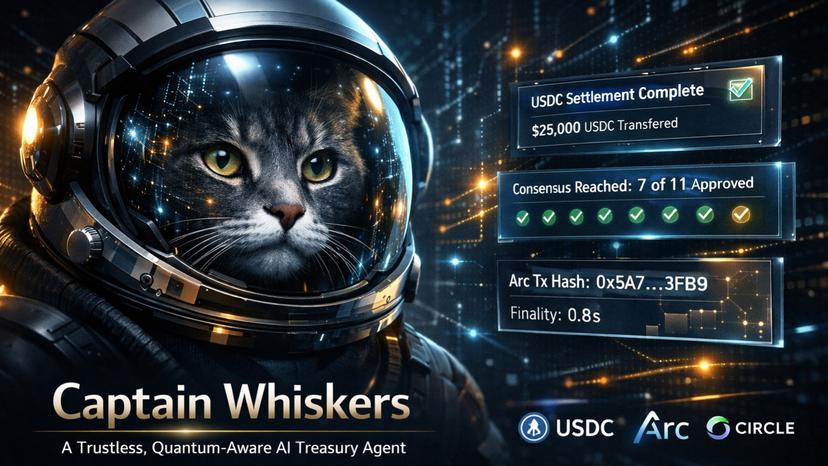
Captain Whiskers demonstrates what it truly means to place real money under the control of an autonomous AI—without sacrificing trust, security, or accountability. As AI agents increasingly make financial decisions, the core challenge is no longer intelligence, but trust. Captain Whiskers solves this by combining Gemini-powered reasoning, quantum-inspired optimisation, and decentralised verification to create a treasury agent that is both autonomous and provably safe. Users interact with the system via a clean, high-performance trading interface inspired by modern platforms like Robinhood and Webull. High-level goals such as risk tolerance, allocation targets, or execution constraints are translated by Gemini into structured financial actions. Portfolio optimisation is performed using quantum algorithms (VQE via Qiskit), modelling multiple portfolio states simultaneously to identify optimal risk-return tradeoffs. Every decision is then passed through a trustless verification layer: an independent network of 11 verifiers evaluates the agent’s logic, risk checks, and cryptographic proofs. Only when a Byzantine Fault Tolerant quorum (7/11) is reached does execution proceed. This ensures decisions are not manipulated or hallucinated, or silently altered. Execution and settlement occur on the Arc testnet using USDC, powered by Circle Developer-Controlled Wallets and Circle Gateway. The system integrates post-quantum cryptography (CRYSTALS-Dilithium) and quantum-grade randomness to remain secure in a future where classical cryptography is failing. By combining Circle’s USDC infrastructure, Arc’s execution layer, and Gemini’s reasoning capabilities, Captain Whiskers showcases a credible future where AI agents can safely manage value at scale, earning trust not through promises, but through math, cryptography, and transparent on-chain proof.
24 Jan 2026


