.png&w=256&q=75)
🤝 Top Collaborators
.png&w=640&q=75)
.png&w=640&q=75)
.png&w=640&q=75)
.png&w=640&q=75)
🤓 Latest Submissions
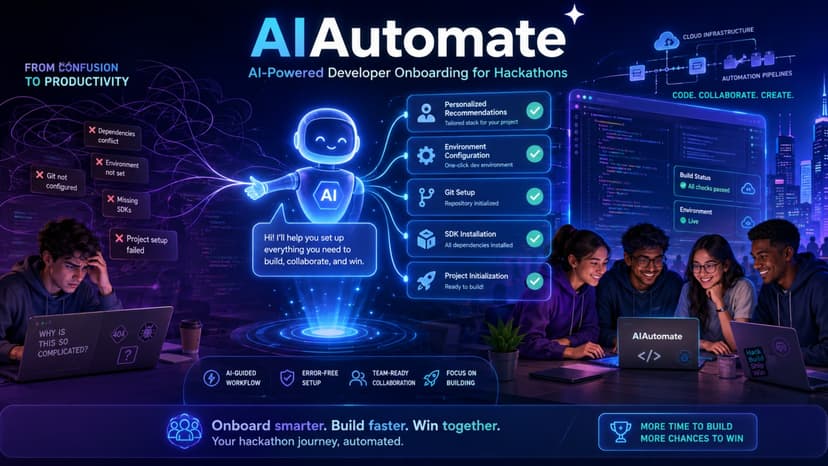
Team AIAutomation Submission
The solution is a hackathon onboarding ecosystem that helps participants move from registration to a working team setup with minimal friction by using a hackathon-specific onboarding page as the main source of truth for setup checklists, team assignment or team-creation instructions, submission rules, teammates, and mentor information, while an AI assistant only steps in when the page is unclear or when users need troubleshooting for issues like missing credits, promo codes, team confusion, or mentor lookup; the flow starts by identifying the participant’s hackathon and routing them to the correct page, then guides them through creating an AMD Developer Cloud account, claiming cloud credits, creating a Fireworks.ai account, redeeming promo credits, generating an API key, connecting that key to the AI builder, and linking GitHub so teams can access a boilerplate repository and collaborate quickly; at the team layer, it helps users find their team, team leader, teammates, Discord handles, GitHub usernames, team channels, repository links, and mentor details when available, and if data is missing or inconsistent it explains the limitation and points users back to the onboarding page or organizer instructions; the architecture should be model agnostic, token efficient, secure, observable, rate-limited, and evaluated for faithfulness, relevance, coherence, groundedness, and toxicity so the system remains reliable throughout the hackathon.
13 Jul 2026
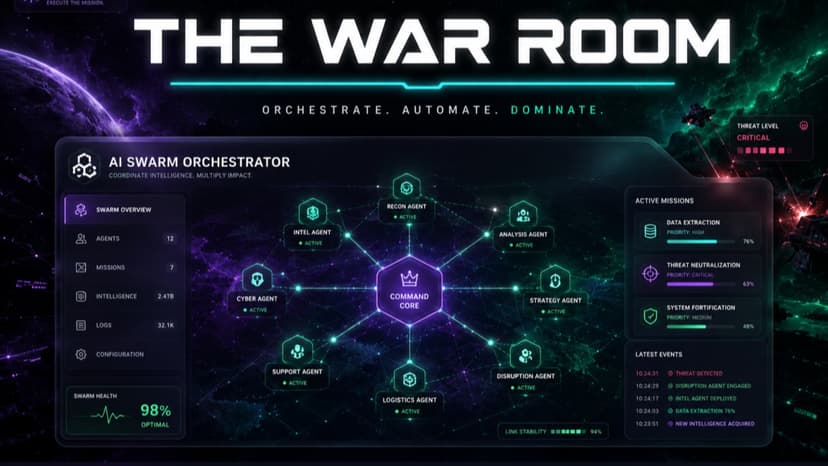
The war room
The War Room is an autonomous, multi-agent incident response platform designed to accelerate cloud service recovery and reduce Mean Time to Resolution (MTTR). When outages or spikes occur, instead of engineers manually checking disparate monitoring systems, The War Room coordinates a synchronized swarm of specialized AI agents. Directed by an Incident Commander (orchestrated with LangGraph), these agents include Metrics (Telemetry), Logs (Code Audits), Change (CI/CD Deployments), and Runbooks (Procedure Retriever) specialists. Unified via the event-driven Band SDK, these agents perform parallel diagnostics, exchange findings over deliberation channels, and submit structured evidence. A mathematical consensus engine computes dynamic confidence scores by weighing domain findings and analyzing deliberation sentiment. If confidence meets security gates, the platform generates a step-by-step interactive remediation plan (e.g., database rollbacks, traffic caching, container scaling). Finally, it compiles a complete markdown postmortem report and automatically commits it to Git via simulated Git-Ops, creating a traceable GitHub postmortem record.
19 Jun 2026
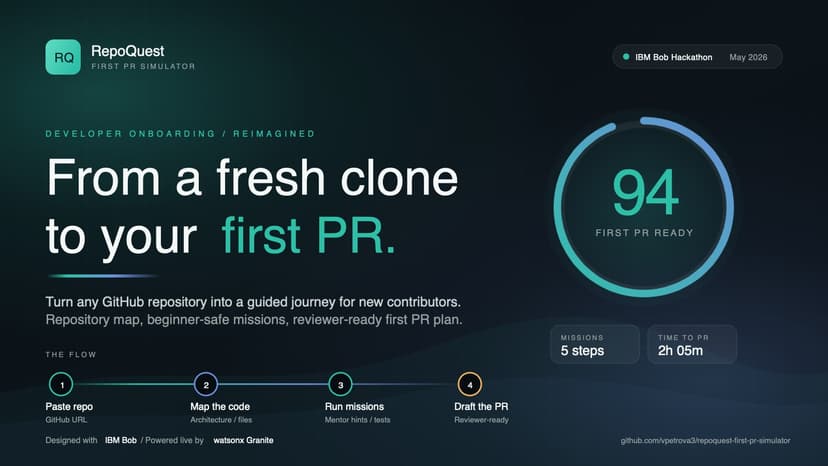
RepoQuest: First PR Simulator
RepoQuest is an AI-powered developer onboarding and first-PR simulator. When a user enters a GitHub repository, RepoQuest analyzes the project structure and turns the codebase into a guided learning journey. Instead of only generating static documentation, it creates a repository overview, architecture map, onboarding missions, mentor-style hints, suggested tests, contribution difficulty scoring, and a first PR readiness report. The goal is to help interns, new engineers, open-source contributors, and hackathon teammates move from “I don’t understand this repo” to “I know where to contribute.” IBM Bob IDE is used as the core development partner for understanding code, refining the product workflow, generating mission logic, improving documentation, and preparing first PR guidance. IBM watsonx.ai with Granite enhances AI-generated outputs, while watsonx Orchestrate supports the workflow as a conversational onboarding coach. RepoQuest reduces onboarding friction, saves mentor time, and helps developers make meaningful contributions with more confidence.
17 May 2026


