🤓 Latest Submissions

Hermes Agent
Hermes Agent is an autonomous AI-powered blockchain assistant built for the Milan AI Week Hackathon 2026. It bridges the gap between complex blockchain operations and everyday users by enabling natural language control of a Hedera blockchain wallet via Telegram. The problem: Managing crypto assets requires multiple apps, technical knowledge, and constant context switching. Users need to interact with exchanges, wallets, and portfolio trackers separately — creating friction and errors. The solution: Hermes Agent lets you simply type "check my balance" or "what is the price of HBAR?" in Telegram and get instant results. No technical knowledge required. How it works: The user sends a natural language message to the Telegram bot. Gemini AI interprets the intent and maps it to the correct CLI command. The Hermes engine executes the command directly against the Hedera testnet via smart contract calls. Results are returned to the user in plain English. Technical stack: The system is built on Python with a modular CLI engine supporting 30+ commands including token swaps, portfolio management, staking, transfers, and transaction history. The AI layer uses Google Gemini API for natural language understanding. The entire system is deployed on Vultr cloud infrastructure for 24/7 availability. Key features include real-time portfolio balance tracking, token price queries, transaction history, autonomous command routing via Gemini AI, and a governance engine that ensures safe execution with per-swap limits and slippage controls. Hermes Agent demonstrates that blockchain interactions do not need to be technical — they just need to be conversational.
19 May 2026
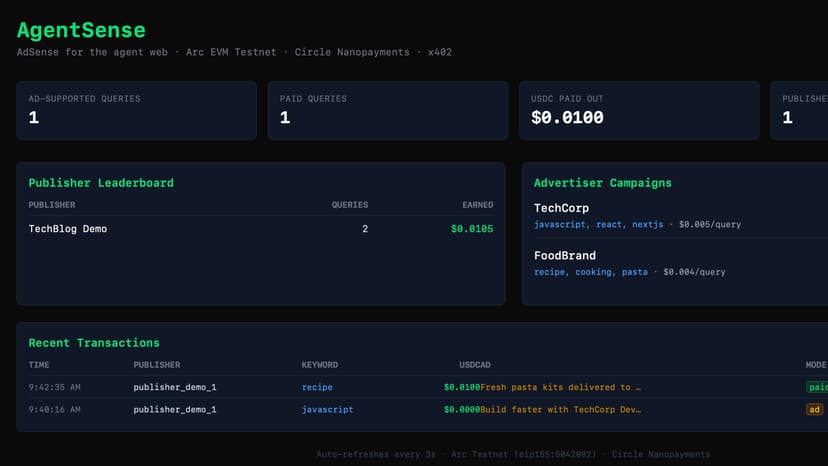
AgentSense — AdSense for the Agent Web
The Problem The internet was built for humans. When a human visits a website, publishers earn through ads or subscriptions. But AI agents are now querying content at massive scale — reading articles, pulling data, consuming APIs — and publishers earn absolutely nothing from this traffic. What AgentSense Does AgentSense is AdSense for the agent web. It gives publishers a monetization layer specifically designed for AI agent traffic, with two models: Option A — Free with Ads: Agent sends a preference header, gets content for free, and a keyword-matched sponsored result is injected into the response. The advertiser pays the publisher directly from their USDC budget via the auction engine. Option B — Pay for Clean Access: Agent pays $0.01 USDC via Circle Nanopayments and x402 protocol on Arc EVM testnet. Publisher receives 70% of the payment. No ads injected. Human visitors always get free access unchanged. How It Works Publishers install a single agentGate() middleware function on their content endpoints. The middleware detects agent requests, issues an HTTP 402 challenge explaining both options, and handles the full payment or ad-injection flow automatically. An auction engine runs keyword matching against active advertiser campaigns in real time. Technology Built on Arc EVM testnet using Circle Developer-Controlled Wallets for agent and publisher wallets, Circle Nanopayments for sub-cent high-frequency transactions, and the x402 protocol for HTTP-native payment negotiation. The platform dashboard tracks both revenue streams — ad-supported queries and paid queries — with real-time on-chain settlement. Why Arc Makes This Possible On Ethereum mainnet, gas fees of $0.50 to $5 per transaction make $0.01 per query economics completely unviable. Arc's sub-cent transaction fees make per-query publisher payments economically sustainable for the first time.
26 Apr 2026


