🤓 Latest Submissions
Perseus Vault — Encrypted Agent Memory for AMD
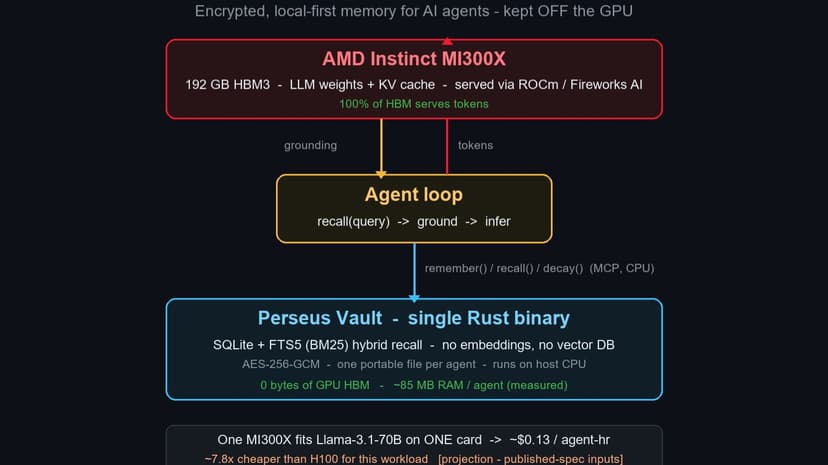
Perseus Vault is encrypted, persistent memory for AI agents. It ships as a single ~8 MB Rust binary exposing 56 MCP tools plus five PyPI adapters — LangChain, LlamaIndex, Haystack, CrewAI, Pydantic AI. This is a shipping product, not a weekend build: v2.20, 35 releases. The money shot: MI300X serving Qwen2.5-72B bf16 on vLLM/ROCm holds 15.3 concurrent agents at $0.143/agent-hour, 658 output tok/s. With the GPU saturated, the memory layer steals only ±0.6% recall (6-run median) — near-zero inference cost. Measured cross-vendor: 11.7× cheaper per agent than 2×H100, 3.0× cheaper than 2×A100 80GB, and benchmarked against 8×A100 40GB too — every row measured, none projected. Keeping memory off the accelerator is AMD's killer advantage for stateful agent fleets. Local-first, no API key required: Gemma 3 4B on a Ryzen 7 9800X3D recalls in 0.21ms at ~13 tok/s for $0. Air-gapped deployments lose nothing. Live demo: https://amd-demo.perseus.observer — teach a fact, recall it in a new session, watch an open-weight LLM answer from memory alone. Code: https://github.com/tcconnally/perseus-amd-act-ii
13 Jul 2026
Band Memory
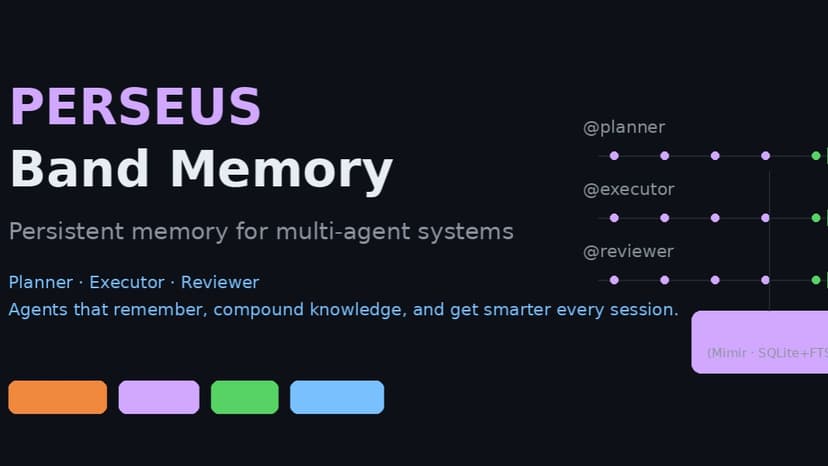
Band Memory gives multi-agent systems persistent, shared memory so they stop starting every task with amnesia. The problem: AI agents coordinated through Band.ai handle complex workflows — planning, executing, reviewing — but when the session ends, everything they learned evaporates. The Planner forgets which architecture decisions worked. The Executor re-discovers conventions it already learned. The Reviewer can't reference past findings. Every task starts from zero. Band Memory wires Mimir — a battle-tested persistent memory engine (Rust, SQLite+FTS5, 23 MCP tools) — directly into Band agents. Three agents (Planner, Executor, Reviewer) coordinate through Band rooms and share a common memory backend. Each agent has custom tools (remember, recall, forget) that persist and retrieve context across sessions. In the demo, Session 1 starts cold: the Planner checks for past auth decisions and finds nothing, creates a plan from scratch, the Executor establishes conventions (bcrypt, JWT patterns), and the Reviewer stores findings. In Session 2, the user asks to add OAuth — the Planner instantly recalls the auth architecture, the Executor pulls up the exact conventions, and the Reviewer cross-references past findings. The team compounds knowledge every run. Built with the Band SDK (LangGraph adapter), Mimir MCP server, and GPT-4o for agent reasoning. The skill file in agents/memory_tools.py can be reused by any Band agent. Zero cloud dependency for memory — Mimir runs locally on SQLite. This is what Band agents are missing: memory that survives the session. Not just structured chat history, but searchable, decaying, confidence-scored knowledge that compounds across every interaction.
19 Jun 2026

