.png&w=256&q=75)
🤝 Top Collaborators
.png&w=640&q=75)
🤓 Latest Submissions
VidCap
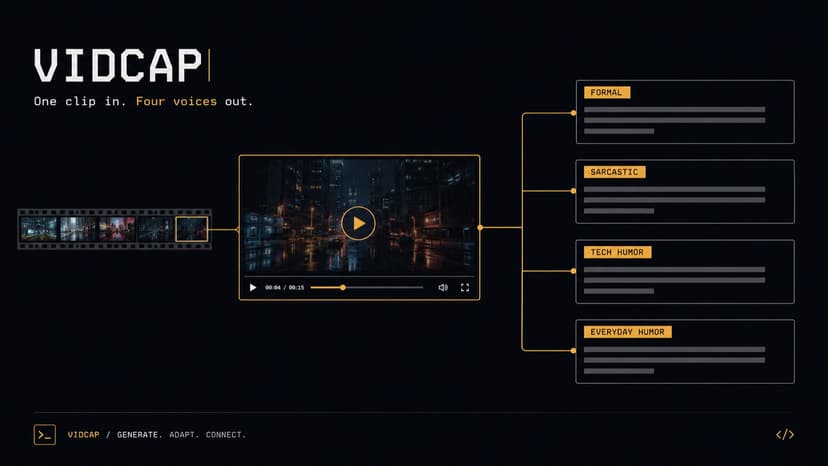
VidCap is a video captioning pipeline built for accuracy and tone distinctness — the two things an LLM judge actually scores. HOW IT WORKS 1. Signal extraction: ffmpeg samples 5–8 frames across the clip (in parallel) and extracts the audio track for optional speech transcription. 2. Grounding: a vision model (Qwen 3.7 Plus on Fireworks AI) writes one rich, neutral fact sheet — beat-by-beat events, setting, subjects, on-screen text — with an explicit "uncertain" list so ambiguity is never stated as fact. This is the only stage that sees the video, so it is the only place hallucination can enter. 3. Styling: four parallel single-style calls (Kimi K2.6), each with its own large persona prompt: voice spec, comedic techniques, length targets, banned vocabulary, and anti-hallucination rules (no invented events, no unverifiable micro-details, no fabricated anecdotes). Parallel execution means four full-budget captions at the latency of one call. 4. Self-QA: before output, a reviewer model re-judges every caption against the fact sheet — a rehearsal of the real LLM judge. Failing styles are repaired in parallel with the reviewer's feedback. ENGINEERING Reasoning is disabled on every call (reasoning_effort "none"), cutting latency 12x to ~15 seconds per clip. Every API call has timeouts, retries with backoff, schema-constrained JSON with lenient recovery, and model fallback chains; missing audio or a failed QA pass degrades gracefully, and one bad clip never kills a batch. Ships as a linux/amd64 Docker container with a CLI, a web UI (paste a video link or upload a file), and a local LLM-judge evaluation harness that scores outputs on accuracy and tone before submission. Every model is an environment variable, so the pipeline can be repointed — e.g. to a dedicated Gemma 4 deployment — with zero code changes.
13 Jul 2026


