🤝 Top Collaborators
🤓 Latest Submissions
JARDO - Your Personal Supervisor for coding agents
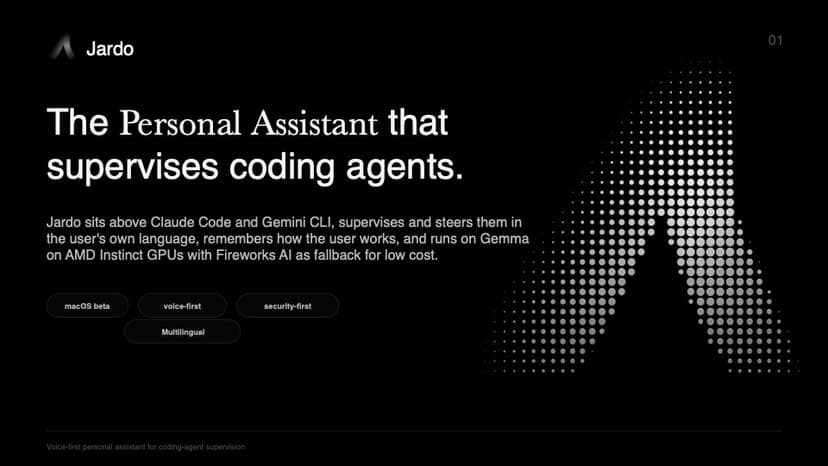
Jardo is a voice-first personal assistant that supervises autonomous coding agents so you can actually delegate to them. It sits above Claude Code and Gemini CLI and conducts them toward your goals, rather than leaving you to babysit a terminal. You state your intent by voice, in your own language, and Jardo takes it from there. It scaffolds the project, initializes git, writes the agent's brief, launches the agent in your real terminal, and then stands watch. Supervision is the core. Jardo reads the terminal like a senior engineer glancing over a teammate's shoulder, understanding both the command and the agent's own reasoning. It builds a live picture of the project from the agent's session memory and git, and judges every action against your stated goal. It approves the normal build, install, edit, and scaffolding work an agent needs, declines only what is genuinely destructive or off-task, and hard-blocks solely the catastrophic and illegal. When the agent stalls, loops, or drifts off course, Jardo does not just wait: it types precise, project-aware guidance back into the terminal to steer it toward completion. Ask "where am I?" at any time and it reports the goal, progress, uncommitted work, and blockers instantly, without an expensive codebase re-scan. Jardo speaks nine languages. Your speech and its replies are localized, while the reasoning core stays in English for accuracy, and Gemma performs the translation. It is engineered for cost and reliability. Inference runs on Gemma on AMD Instinct GPUs via ROCm, with Fireworks AI as an instant fallback. Every request is routed to the cheapest capable model and cached aggressively. Security is first-class: secrets live only in the macOS Keychain, an append-only audit log redacts sensitive data, a global kill-switch halts everything by hotkey, and you can delete your entire profile at any time. It is self-contained, private by default, on-device, and installs with a single command. (Windows Version Soon)
13 Jul 2026
SoundCheck
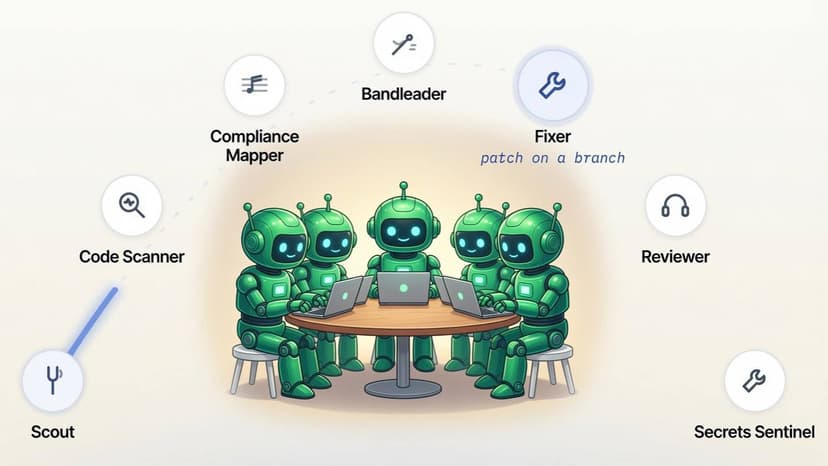
Security and compliance work is a backlog problem: scanners produce noise, fixes are risky, and auditors want evidence no one has time to assemble. Soundcheck turns that backlog into a performance you can watch, govern, and replay. It's built as a band: eight specialist agents that coordinate entirely through Band: memory, messages, and events, never a shared database or queue. A Bandleader plans the run and recruits the players; Scout ingests the repo into an OrgContext; a Code Scanner, Dependency Auditor, and Secrets Sentinel find issues; a Compliance Mapper ties each finding to SOC 2 and ISO 27001 controls; a Fixer proposes a patch on an isolated branch; and a Reviewer, a different model: checks the diff. The agents are genuinely heterogeneous, split across a frontier lane (AI/ML API) and an open-source lane (Featherless), all in one room, and no paid Anthropic or OpenAI keys. You conduct. Nothing ships without you: the Fixer proposes, the Reviewer cross-checks, and you sign off, an approval captured as a real message in the room, part of the permanent record. Only then does a pull request open, never a merge. Because Band is the system of record, the whole run is provenance-complete and replayable. Every finding chains back through the ledger to its evidence; the Master Tape scrubs the run event-by-event; and a one-click audit deliverable exports the seal, the patch, the review, and the full chain, the artifact an auditor actually receives. The experience is a concert hall. On the Stage, whoever's performing steps into the spotlight; you watch handoffs as threads of light and ask the band questions in-room. When the set ends, the Encore gives a retrospective — a scorecard, each agent's bow, unfinished business you can send back in, and the Mic, where each agent narrates its own part aloud, in order. Multi-tenant by account, defensive-only by design, human-approved by default. Built on Band. MIT-licensed, original work.
19 Jun 2026

