🤓 Latest Submissions
Sprint-to-Code Pipeline
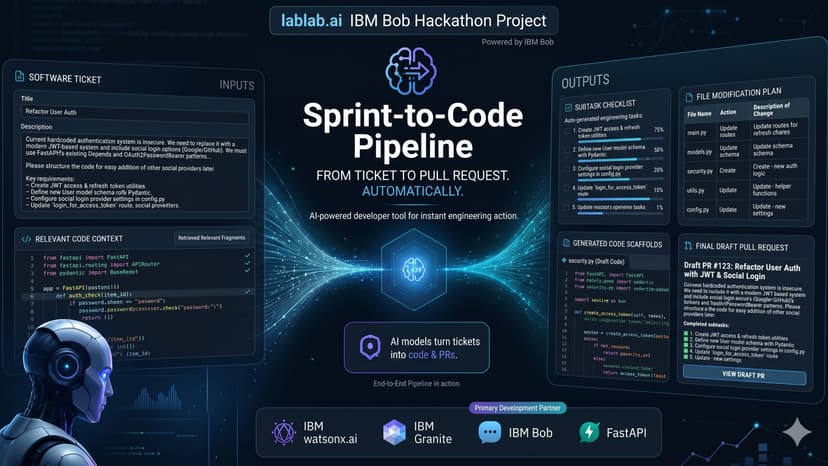
Modern software teams waste hours translating tickets into actionable engineering work - manually hunting through codebases, guessing which files need changing, and writing boilerplate scaffold. This tool eliminates that entirely. Given a ticket title and description, the system generates vector embeddings of the input, semantically searches the target GitHub repository's codebase (pre-indexed via chunk-level embeddings), and retrieves only the files and code blocks with the highest contextual relevance. No full-repo dumps. No irrelevant noise. Just the exact context the model needs. That enriched context -ticket + relevant code - is fed to an LLM which outputs three things: a structured subtask breakdown that maps work to logical engineering units, a file modification plan that names exact files, functions, and the nature of each change, and working code scaffolds pre-wired to the existing codebase conventions, imports, and patterns. The output isn't a chat response. It's a draft GitHub Pull Request - automatically created against the target repo with a structured description, the subtask checklist, and scaffold code committed to a feature branch. Engineers receive a PR that's already 40–60% complete and contextually accurate, not a blank branch and a vague ticket. The system is designed for real codebases: it handles chunking strategies for large files, respects token budget constraints when assembling context, and uses reranking to prioritize the most semantically dense matches before injection. The result is faster sprint execution, fewer "where do I even start" moments, and a tighter loop between product requirements and shipped code.
17 May 2026


