

🤓 Latest Submissions
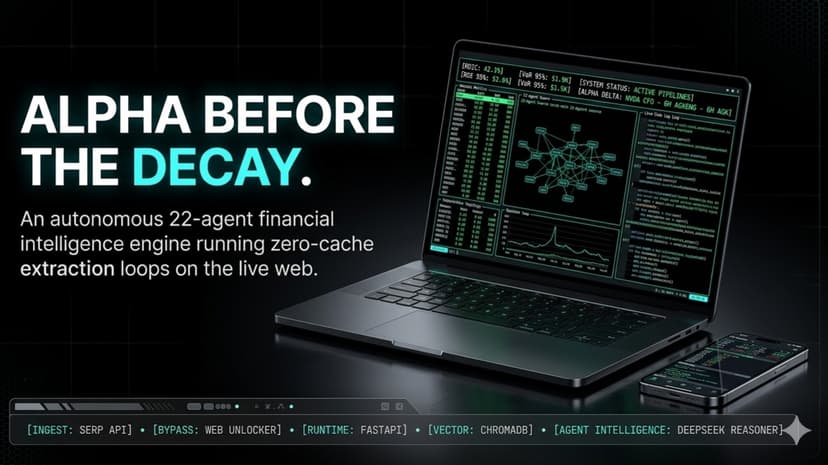
Cortex — Goldman-Grade Financial Intelligence
Cortex bridges the critical information gap in retail and enterprise finance. Traditional infrastructure, including premium terminal seats, relies heavily on cached data structures and stale content loops. If a market-moving event occurs or an executive secretly changes their profile status, the lag before an official filing or public press release creates a blind spot where alpha is systematically lost. Cortex solves this by executing a zero-cache, live-web pipeline updated every five minutes. Powered entirely by Bright Data, Cortex orchestrates four foundational scraping layers simultaneously: the SERP API parallel-runs global news context across major financial publications; the Web Unlocker circumvents paywalls on primary geopolitical and institutional sources; the Scraping Browser manages heavy JavaScript rendering to pull executive shifts from professional networks and sentiment anomalies from high-priority social accounts; and the Web Scraper API structuralizes incoming regulatory SEC filings into clean, predictable JSON. When the pipeline detects a brand-new signal, an asynchronous multi-agent swarm fires 22 specialized nodes. This includes targeted fundamental analysts, alpha calculators tracking historical anomaly win-rates, and a custom Crash Predictor evaluating twelve early-warning systemic metrics. Synthesis is handled via DeepSeek Reasoner, providing a completely transparent, step-by-step chain of thought. Rather than generic summaries, the end output is a robust, 8-part institutional equity note displaying full mathematical formulas (ROIC, DCF, VaR), data validation confidence audits, and clear execution limits with macro stop-losses.
31 May 2026

Memoria — Enterprise Institutional Memory AI
Every enterprise loses knowledge constantly. A senior leader leaves and takes 10 years of context with them. A team makes a decision that contradicts something resolved two years ago in a meeting nobody remembers. The minutes say what was decided — but never why, what alternatives were rejected, or what risks were flagged. Memoria solves institutional amnesia. It processes meeting transcripts through a multi-model Gemini pipeline — using Gemini Flash for intelligent query routing and complexity classification, and Gemini Pro for deep reasoning and structured decision extraction. Every decision is embedded using Gemini's text-embedding-004 model and stored in a ChromaDB vector database, enabling semantic search that finds related decisions by meaning, not just keywords. The system has two modes. Live Meeting Mode processes transcripts in real time, extracting what was decided, why, who proposed it, what alternatives were rejected, and what risks were flagged. Historical Mode absorbs past documents — PDFs, notes, old meeting logs — turning years of buried knowledge into searchable memory. When a team member asks "have we tried this before?" — Memoria retrieves the most semantically relevant past decisions, synthesizes them into a cited answer, and warns if the current direction contradicts a previous lesson learned. The model routing architecture is a core technical differentiator: Flash classifies query complexity first, routing simple lookups to stay on Flash while escalating analytical, multi-step, or comparative questions to Pro. This reduces cost and latency while maintaining quality where it matters. Built for mid-sized enterprises — healthcare networks, financial services firms, manufacturers — where institutional knowledge is a competitive asset and its loss is measurable in dollars. Track: Data & Intelligence. Technologies: Gemini Pro, Gemini Flash, text-embedding-004, Google AI Studio, ChromaDB, FastAPI.
19 May 2026


