.png&w=256&q=75)
🤝 Top Collaborators

.png&w=640&q=75)

.png&w=640&q=75)
🤓 Latest Submissions
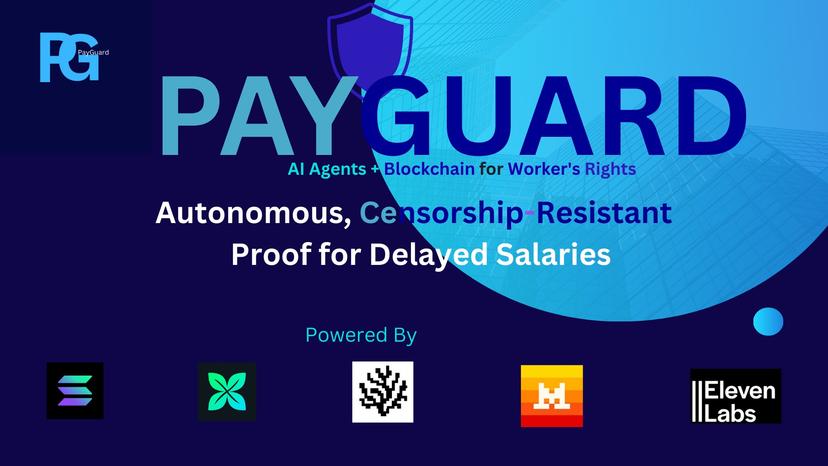
PayGuard
PayGuard is a decentralized application that tackles the critical issue of delayed wages for gig economy workers and private security personnel. It transforms a situation of helplessness into one of verifiable leverage by automatically generating tamper-proof, on-chain evidence the moment a salary is overdue. How it Works: When a payment is delayed, PayGuard immutably records the debt obligation on the Solana blockchain, mints a "Proof of Debt" NFT via Crossmint as undeniable evidence, and autonomously generates and sends professional communications to the employer via Mistral AI and ElevenLabs. The Key Differentiator: Unlike other solutions, PayGuard's integration with the Anchor (Coral v1) framework provides a censorship-resistant, decentralized backbone. This ensures the system remains fully operational even if traditional APIs are restricted, making PayGuard a truly unstoppable protocol for worker's rights.
21 Sep 2025
.png&w=828&q=75)
Resource Allocation Optimizer
he Resource Allocation Optimizer is an innovative AI-driven solution designed to address the challenges of bandwidth allocation in public sector networks, particularly in underserved regions. Public sector connectivity networks often face issues like resource scarcity, suboptimal prioritization, and inefficiencies in service delivery for critical sectors such as healthcare, education, and emergency services. This system leverages the power of Groq's Llama API to analyze incoming service requests and assign numerical priority scores based on urgency, bandwidth requirements, and the nature of the service. These prioritized requests are then processed by a dynamic resource allocation algorithm that distributes available bandwidth in real-time, ensuring that high-priority services receive the resources they need without delays.Key features of the project include: Simulated Environment: A network simulation generates realistic service requests for bandwidth from sectors like healthcare, education, and emergency services. AI-Powered Decision Making: The Groq Llama model analyzes requests and assigns priorities, enabling fast and accurate resource allocation. Dynamic Resource Allocation: The allocation algorithm ensures bandwidth is distributed efficiently, balancing critical needs and overall network availability. Interactive Dashboard: Built using Streamlit, the dashboard visualizes service logs, priorities, and bandwidth usage with real-time updates and dynamic charts, offering transparency and user engagement. This project has immense value in enhancing the efficiency of public sector networks by automating resource management, improving service outcomes, and reducing operational overhead. It is designed with scalability in mind, allowing integration with real-world networks and enabling further customization for specific scenarios.
26 Jan 2025


