🤓 Latest Submissions
Hybrid Routing Agent — Local First, Tokens Last
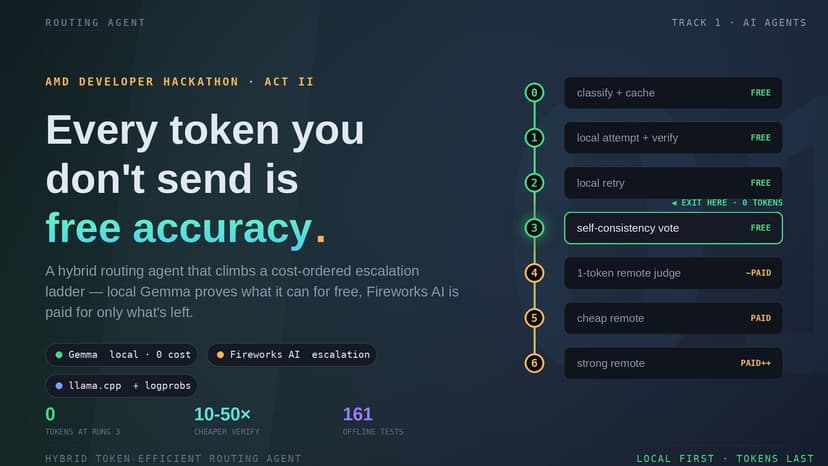
Track 1 scores accuracy first, then ranks survivors by Fireworks tokens spent — and local tokens count as zero. So the winning agent isn't the one with the best model; it's the one that most reliably knows when its free answer is already correct. Every task climbs a cost-ordered escalation ladder and exits at the first trustworthy rung. Rung 0 classifies the task with zero-cost heuristics, plus an exact Python solver for explicit arithmetic (free AND certain). Rungs 1-3 are local Gemma attempts gated by a strict free verifier (numbers must parse, MCQ letters must be among the options, Python must compile, summaries must honor stated length limits) and honest logprob confidence, then self-consistency voting across independent samples. Rung 4 is the cheapest paid call: a remote judge grades the local winner with a single output token — verification costs 10-50x less than generation. Only then come real paid generations: a cheap model with a compressed prompt and the local draft as a hint, then a strong model as last resort, under a hard per-task token budget. Weak-verifier categories (math word problems, code debugging, logical deduction) never ship on local confidence alone — the 1-token judge must approve, and a judge-rejected answer can never win a self-consistency vote. That discipline came from dry-running the judged contract end to end: all eight capability categories answered correctly at a fraction of all-remote token cost. It ships as a single public linux/amd64 Docker image implementing the harness contract — tasks.json in, results.json out, atomic writes after every task, 10-minute budget management — reading FIREWORKS_BASE_URL and ALLOWED_MODELS from the environment at runtime. Plus a live dashboard that visualizes every task climbing the ladder with a token meter, 161 offline tests, and graceful degradation when the model file or API key is absent.
13 Jul 2026
AEGIS: Autonomous Financial-Crime Investigation
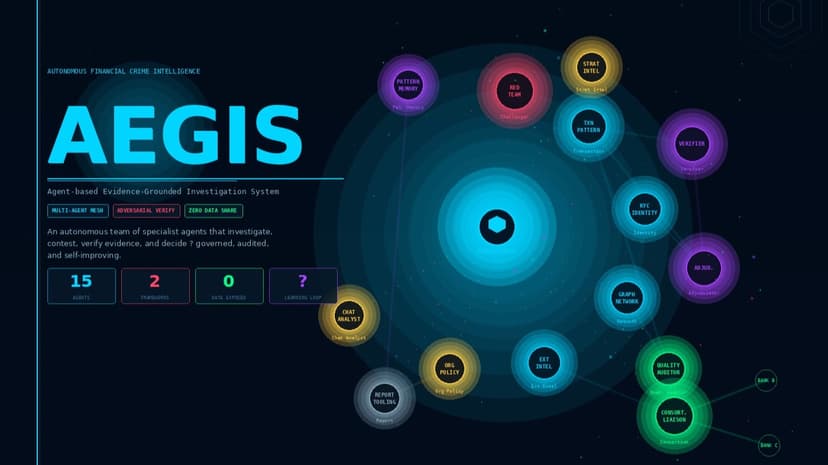
AEGIS (Agent-based Evidence-Grounded Investigation System) is an autonomous AML investigation mesh that replaces single-pass LLM guessing with a coordinated team of 15 specialist agents. When a transaction alert arrives, an Intake & Orchestrator agent opens a Band case room and recruits specialists by alert type. Transaction Pattern, Identity/KYC, Network Graph, and External Intelligence agents post structured evidence to the shared room. A Challenger (Red-Team) agent then argues the innocent explanation — any suspicion that survives a real attempt to break it is far more likely real. A Verifier rejects any claim not backed by a cited evidence reference. The Adjudicator synthesises the deliberation into a verdict, confidence score, and evidence chain, then applies risk-based autonomy: benign cases are auto-cleared and logged; genuinely uncertain cases escalate to a human Compliance Officer. Beyond the single institution, a Consortium Liaison shares abstract pattern descriptors with peer-bank agents via Band — zero raw records ever cross institutional boundaries. A Quality Auditor, Strategic Intelligence agent, Org Policy agent, Pattern Memory agent, and Chat Analyst complete the 15-agent roster, providing post-case auditing, cross-case typology detection, per-bank policy enforcement, institutional memory, and natural-language Q&A grounded in casebook data. Accuracy is measured on the public PaySim / IBM AML dataset — external labels the team did not author — on a fixed held-out slice, giving an honest FP-reduction number versus a single-LLM baseline with identical data access. Built on Band SDK · CrewAI · LangGraph · FastAPI · Qdrant · NetworkX · Featherless AI · AI/ML API · React/Next.js. Live at aegis-g7vl.onrender.com.
19 Jun 2026
NexusIntelAI:One Engine,Three Intelligence Tracks
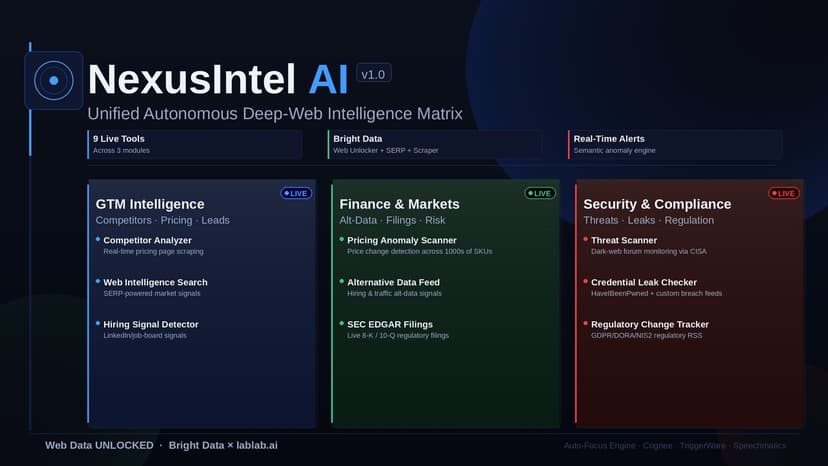
Enterprise intelligence is fragmented. GTM teams scrape competitor pages for pricing moves. Finance teams chase SEC filings and alt-data. Security teams watch CISA advisories and dark-web forums. Three teams, three siloed tools, the same live web — and no shared memory between them. NexusIntel AI collapses all three into a single autonomous engine. A real-time watchlist is fetched continuously through Bright Data Web Unlocker and SERP API. Each fetch is embedded (AI/ML API text-embedding-3-small, with a local HashingVectorizer fallback) and compared to a rolling baseline via cosine similarity. When semantic drift crosses the threshold, the Auto-Focus Engine spawns a LangChain ReAct agent that deep-dives the anomaly with Bright Data tools and emits a structured Critical Insight Brief — title, summary, impact, recommendations, cross-track links. Every brief flows three ways at once. Into a Cognee knowledge graph so insights compound across tracks. Through a TriggerWare.ai webhook so downstream systems (Slack, CRM, ticketing) get pinged on Critical and High events. And over WebSockets to a real-time React dashboard with three colored swim-lanes — GTM blue, Finance green, Security red. The dashboard ships with nine live tools: Competitor Analyzer, Web-Intelligence Search, Hiring Signal Detector, Pricing Anomaly Scanner, Alternative Data Feed, SEC EDGAR Filings, Threat Scanner, Credential Leak Checker, Regulatory Change Tracker. A Speechmatics voice-command bar handles hands-free track switching and briefings. Three pre-built demo scenarios — competitor price cut, data breach, SEC filing — fire the same real backend pipeline end-to-end so judges can see the full loop in one click.
31 May 2026
DevRamp AI
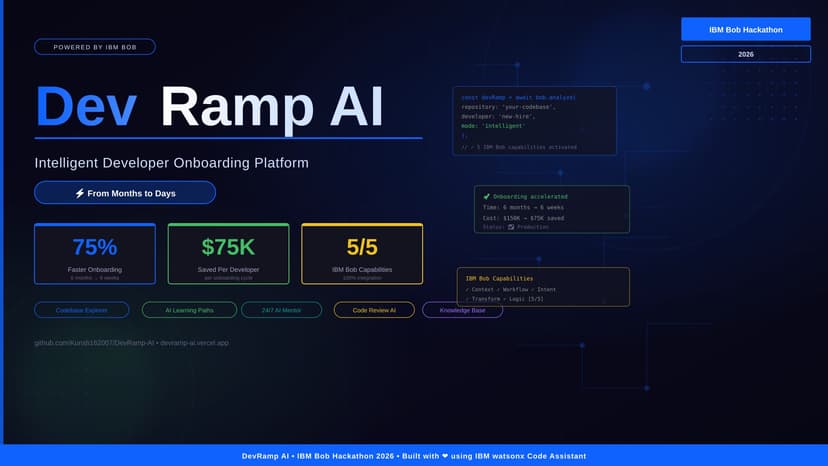
Developer onboarding is one of the most expensive and broken processes in software engineering. New developers take 6–12 months to reach full productivity, costing companies up to $150K per hire — and 20% of first-year developers leave due to poor onboarding experiences. DevRamp AI solves this by leveraging all five core capabilities of IBM watsonx Code Assistant (Bob) to build an intelligent, end-to-end onboarding platform. What it does: DevRamp AI analyzes entire codebases in minutes, generates visual dependency maps, and produces comprehensive documentation automatically. It creates personalized, role-based learning paths that adapt to each developer's skill level and pace. A 24/7 AI Code Mentor answers questions instantly with context-aware responses and real code examples. Progress tracking dashboards give managers visibility into milestones and time saved versus traditional onboarding. IBM Bob Integration (5/5 capabilities used): Repository Context Awareness — codebase structure analysis Multi-Step Workflow Automation — personalized learning path generation Intent Understanding — natural language AI mentor Complex Transformations — automated documentation and API references Logic Explanation — code pattern explanation and security insights Results: 75% faster onboarding (6 months → 6 weeks), 3× faster time to first commit, 50% reduction in senior developer mentoring time, and 40% reduction in early turnover. Tech Stack: React 18 + TypeScript frontend, Node.js + Express backend, Python FastAPI Bob service, PostgreSQL, Redis, and Socket.io — deployed live at devramp-ai.vercel.app. The total addressable market is $2.7T (27M developers globally), with a Year 1 Fortune 500 target of $500M.
17 May 2026

NEXUS — Enterprise AI Command Center
The Problem Enterprise decision-making is broken. When a crisis hits — a key client threatens to leave, a supply chain collapses, an acquisition opportunity appears — companies spend days in fragmented meetings.The average Fortune 500 company takes 6–8 weeks to align on a major strategic response. By then, the window has often closed. The Solution: NEXUS NEXUS is a collaborative multi-agent AI system that deploys six specialized agents simultaneously the moment you describe a business challenge. Each agent thinks independently from its own expert lens. Then a dedicated Guardian agent audits every output for trust and security. Finally, the Orchestrator synthesizes everything into one verified, decisive executive brief — in under 60 seconds. The Six Agents Scout Rapidly extracts facts, maps stakeholders, scores urgency 1–10, and flags critical knowledge gaps before any other agent begins. Analyst Runs financial impact modeling, root cause analysis using the 5 Whys framework, and builds a full risk matrix. Strategist Generates three strategic options — Bold Move, Measured Approach, and Defensive Play — each with upside/downside analysis and a governing principle. Communicator Drafts ready-to-send communications for every stakeholder group: leadership, employees, clients, and public. Includes messaging DON'Ts. Guardian The trust layer. Sits between the four analysis agents and the Orchestrator. Audits every agent output for prompt injection attacks, hallucinations, policy violations, legal risk, and bias. Powered by Veea Lobster Trap for deep prompt inspection and policy enforcement. Assigns a Trust Score (0–100%) to the entire analysis pipeline. If critical violations are detected, it blocks synthesis and alerts the user. Orchestrator Receives Guardian-verified outputs and synthesizes them into one decisive executive brief with ranked action items, risk flags, opportunity flags, ready-to-send communications, and a 30-day success metric.
19 May 2026

NEXUS — Enterprise AI Command Center
The Problem Enterprise decision-making is broken. When a crisis hits — a key client threatens to leave, a supply chain collapses, an acquisition opportunity appears — companies spend days in fragmented meetings.The average Fortune 500 company takes 6–8 weeks to align on a major strategic response. By then, the window has often closed. The Solution: NEXUS NEXUS is a collaborative multi-agent AI system that deploys six specialized agents simultaneously the moment you describe a business challenge. Each agent thinks independently from its own expert lens. Then a dedicated Guardian agent audits every output for trust and security. Finally, the Orchestrator synthesizes everything into one verified, decisive executive brief — in under 60 seconds. The Six Agents Scout Rapidly extracts facts, maps stakeholders, scores urgency 1–10, and flags critical knowledge gaps before any other agent begins. Analyst Runs financial impact modeling, root cause analysis using the 5 Whys framework, and builds a full risk matrix. Strategist Generates three strategic options — Bold Move, Measured Approach, and Defensive Play — each with upside/downside analysis and a governing principle. Communicator Drafts ready-to-send communications for every stakeholder group: leadership, employees, clients, and public. Includes messaging DON'Ts. Guardian The trust layer. Sits between the four analysis agents and the Orchestrator. Audits every agent output for prompt injection attacks, hallucinations, policy violations, legal risk, and bias. Powered by Veea Lobster Trap for deep prompt inspection and policy enforcement. Assigns a Trust Score (0–100%) to the entire analysis pipeline. If critical violations are detected, it blocks synthesis and alerts the user. Orchestrator Receives Guardian-verified outputs and synthesizes them into one decisive executive brief with ranked action items, risk flags, opportunity flags, ready-to-send communications, and a 30-day success metric.
19 May 2026

OmniInspect — AI-Powered Visual Quality Control
OmniInspect is a multimodal AI system that solves one of manufacturing's most persistent problems: visual quality control at scale. Traditional approaches either rely on human inspectors who fatigue and miss defects, or rule-based computer vision systems that take months to configure and break with every product change. OmniInspect uses a 3-agent pipeline powered by Qwen2-VL-7B running on AMD Instinct MI300X: 1. Detection Agent — Analyzes enhanced images for any surface anomaly including cracks, scratches, contamination, holes, and deformation 2. Classification Agent — Classifies defect type, assigns severity (1-5), determines risk level (LOW to CRITICAL), and identifies probable root cause 3. Report Agent — Generates structured JSON reports with actionable recommendations: PASS, QUARANTINE, REJECT, or ESCALATE The AMD MI300X's 205.8GB of HBM3 unified memory is central to the pipeline — it allows full high-resolution images to be processed without downscaling, multiple vision models to be loaded simultaneously, and parallel batch inference across product streams. This is not possible on standard 24GB GPUs. Evaluated on the MVTec Anomaly Detection dataset (5,354 images, 15 industrial categories), OmniInspect achieves 80% accuracy zero-shot — improving from a 65% baseline through contrast and sharpness image enhancement preprocessing. The entire pipeline requires zero training data, zero labelling, and can generalize to any visual inspection domain out of the box. The system ships with a live industrial-grade web dashboard built on FastAPI, where users can drag and drop images and receive complete inspection reports in under 20 seconds.
10 May 2026


