

Kgotso Msiza@kgotsomsiza
🤓 Latest Submissions

Bastion: Accuracy-First Token Router V23
Bastion is an accuracy-first, token-efficient general-purpose AI agent for Track 1. It classifies every request into one of eight capability categories, then uses a three-tier routing policy. Narrow, provably safe forms are handled by deterministic code at zero Fireworks tokens. Eligible factual, sentiment, entity extraction, and code tasks can run on a bundled Qwen3.5-4B model; Bastion accepts a local answer only when generated-token confidence and a category verifier both agree. Everything uncertain, rejected, or truncated escalates through Fireworks. Gemma 4 31B is prioritized for multi-step reasoning, knowledge, and summarization, while Kimi specializes in code and provides failover. For difficult reasoning tasks, the model works through the problem while Bastion submits only the clean final answer. Completion caps, retries, model failover, truncation recovery, and strict output validation keep the batch resilient. Bastion protects accuracy first, then spends tokens only where they add value.
13 Jul 2026
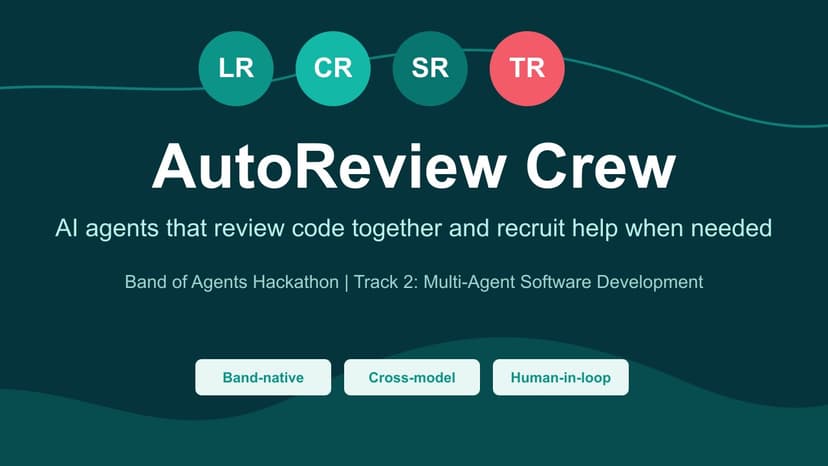
AutoReview Crew
AutoReview Crew turns code review into a visible multi-agent workflow. A human mentions the Lead Reviewer in a Band room, and the Lead coordinates a full pull-request review through Band: it delegates to Correctness and Security specialists, waits for the current round of reports, recruits a Test Reviewer when coverage is required, aggregates every finding, and escalates risky changes to the human owner. The project targets Track 2: Multi-Agent Software Development. It covers automated PR review, merge preparation, test coverage, cross-model code review, and human-in-the-loop escalation. Band is not a wrapper around the workflow; it is the collaboration layer. @mentions route the work, the shared room carries context between agents, Band participant tools let the Lead recruit a specialist mid-review, and room events provide an audit trail of every tool call and decision. The demo run completes in about 51 seconds. The Security Reviewer, running Qwen2.5-72B on Featherless AI, flags a hardcoded Stripe API key, SQL injection, and missing input validation. The Correctness Reviewer, running through AI/ML API, flags division by zero and a mutable default argument. The Lead then recruits the Test Reviewer through Band, receives concrete pytest coverage, and only then sends its final ESCALATE_TO_HUMAN verdict. The crew is cross-model and cross-provider by design: AI/ML API powers the Lead, Correctness, and Test agents, while Featherless AI powers the open-source Security Reviewer. The result is not one chatbot reviewing code, but a team of specialists that coordinate, recruit help when they need it, and know when to hand a risky change back to a human. MIT licensed.
19 Jun 2026


