🤓 Latest Submissions
Agentic Factory: Agnostic AI OS
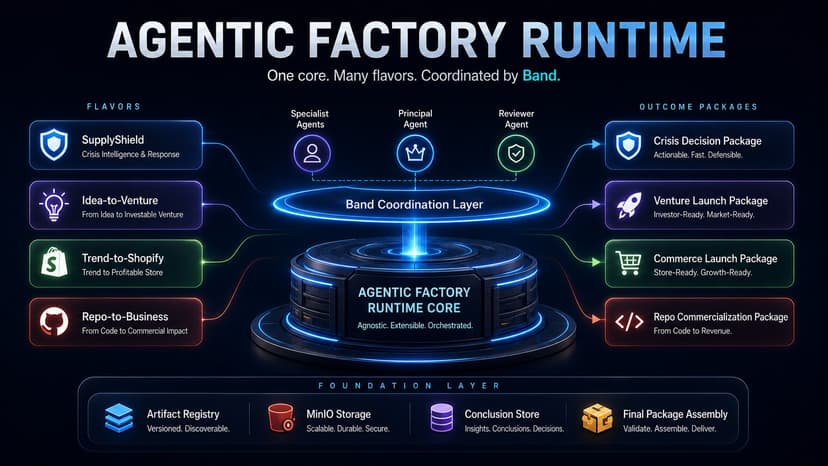
Agentic Factory Runtime is a Band-coordinated multi-agent runtime for turning a single input into structured, enterprise-ready output packages across multiple workflow flavors. Instead of building one chatbot or one linear automation, the project implements a reusable agentic production line. A selected flavor defines what must be produced, while the core runtime manages how the work happens: preflight, agent-team planning, dual provisioning, Band coordination, artifact creation, append-only conclusions, review, validation, and final package assembly. For each run, a Principal Agent analyzes the input and creates an AgentTeamPlan. The runtime then materializes specialized agents such as researchers, risk analysts, builders, reviewers, brand agents, or launch planners. These agents coordinate through Band using clear roles, task handoffs, shared context, task state, and review loops. The runtime does not replace Band with a fake trace; Band is the coordination layer, while the application shows operational state, agent cards, artifacts, conclusions, and the final package. The same core can run different flavors: SupplyShield for supply-chain crisis response, Idea-to-Venture for venture launch packages, Trend-to-Shopify for commerce launch packages, Repo-to-Business for commercialization strategy, and Trend-to-Memecoin as a conceptual brand/community/risk-reviewed package. The business value is repeatable execution for complex enterprise workflows. Teams can move from scattered human coordination to structured agent collaboration, producing decision packages, launch assets, reviews, and validated deliverables faster and with clearer accountability.
19 Jun 2026
BobQuest: IBM Bob Shell as a Real-Time Brain
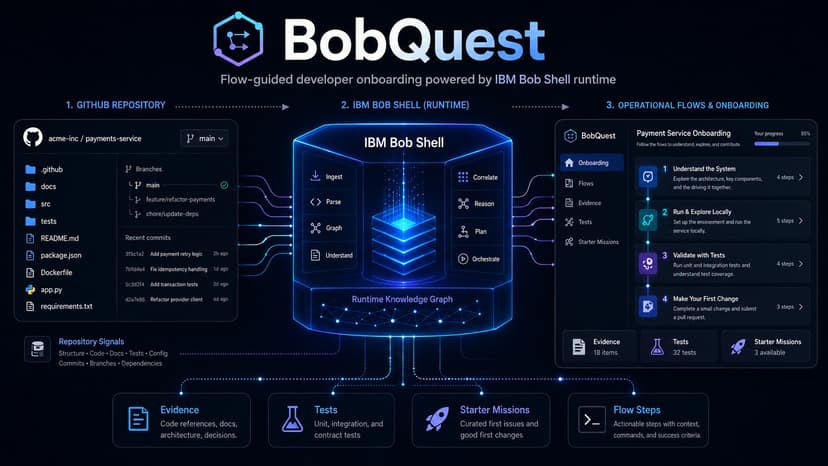
Generic repo explainers summarize code, and generic onboarding tools just show modules, docs, or chatbot answers. BobQuest changes the game by starting directly from repository behavior. It guides developers through operational flows: what happens in the repo, where data moves, where state changes, which files and tests matter, and what starter mission is reasonable first. Crucially, it uses IBM Bob Shell as the runtime brain of the product, not just as a build-time assistant. In the public demo, a user selects an approved GitHub repository. The backend shallow-clones the repo and invokes IBM Bob Shell to actively decompose execution paths into logical steps. Instead of forcing new developers to guess codebase architecture, BobQuest renders an interactive experience where they can navigate live repository flows, inspect trace evidence, and unlock targeted starter missions connected directly to production files. For hackathon safety, a restricted public demo mode limits analysis to pre-approved repositories and controlled runtime usage without requiring a passcode. In a self-hosted deployment, demo mode can be disabled, allowing engineering teams to fully configure IBM credentials for any supported repository. BobQuest also includes optional IBM watsonx.ai / Granite support for narrow reliability and localization tasks, such as recovering malformed JSON before deterministic validation and translating dynamic content while preserving technical names. This optional layer strictly complements, but never replaces, the core real-time processing of IBM Bob Shell. The result is a premium onboarding experience that hides deep, real-time repository analysis behind a clean product surface. Developers leave not just with a summary of the code, but with a practical, flow-guided understanding of how the repository actually lives and breathes.
17 May 2026


