

Hamza Imran@hamza13525223081
7
Events attended
3
Submissions made
Pakistan
1 year of experience
About me
Cybersecurity student & AI engineer building autonomous multi-agent systems and Sovereign Intelligence Grids. Passionate about zero-trust environments, supply chain resilience, and pushing the boundaries of LangGraph orchestration. I leverage AI agents as executioners to rapidly prototype, build, and audit complex tech stacks.
🤝 Top Collaborators
.png&w=640&q=75)
🤓 Latest Submissions
![ZeroToken_Router_[H][I]](/_next/image?url=https%3A%2F%2Fstorage.googleapis.com%2Flablab-static-eu%2Fimages%2Fsubmissions%2Fzswomzipba6hqb18c9p17u99%2Fui3t1u63l69gegv3qf0715xs_imageLink_cnuego22422jnecw7lfu06vo.jpg&w=828&q=75)
ZeroToken_Router_[H][I]
The Challenge: Track 1 demanded an agent that could clear a strict 80% accuracy gate across 8 complex categories while burning the absolute minimum number of Fireworks API tokens. The catch? The agent had to run in a heavily restricted AMD environment (4GB RAM, 2 vCPUs, no GPU) with a strict 10-minute timeout. Our Solution & Architecture: We built a battle-tested, 3-tier hybrid routing architecture designed to squeeze maximum performance out of the constrained hardware while weaponizing the scoring formula. 1. Smart Categorization: The agent intercepts prompts and uses regex-based heuristics to instantly classify tasks (Math, Code, NER, Sentiment, etc.), applying category-specific token limits to prevent context overflow. 2. The Zero-Cost Local Engine: To minimize API costs, simple tasks (like factual QA and Sentiment) are aggressively shunted to a local Qwen2.5-3B-Instruct 4-bit GGUF model running on CPU. Because local tokens aren't penalized by the judging proxy, this handles the bulk of the workload for exactly 0 tokens. To prevent the 2 vCPUs from hanging, local inference is guarded by strict asyncio timeouts and thread-locking. 3. Dynamic Fireworks Fallback: When the local model detects a highly complex problem (like advanced Code or Logic), or if it hits a timeout, the router seamlessly fails over to the Fireworks API. It dynamically parses the ALLOWED_MODELS environment variable and routes the prompt to the most cost-efficient capable model. Our Results: By intelligently offloading easy tasks to a local engine and saving the API strictly for heavy lifting, we achieved an incredible ~100% accuracy rate during testing while radically dropping API token consumption well below the leaderboard averages. We proved that production-grade LLM routing can be fast, mathematically accurate, and remarkably cost-efficient on standard CPU hardware
13 Jul 2026
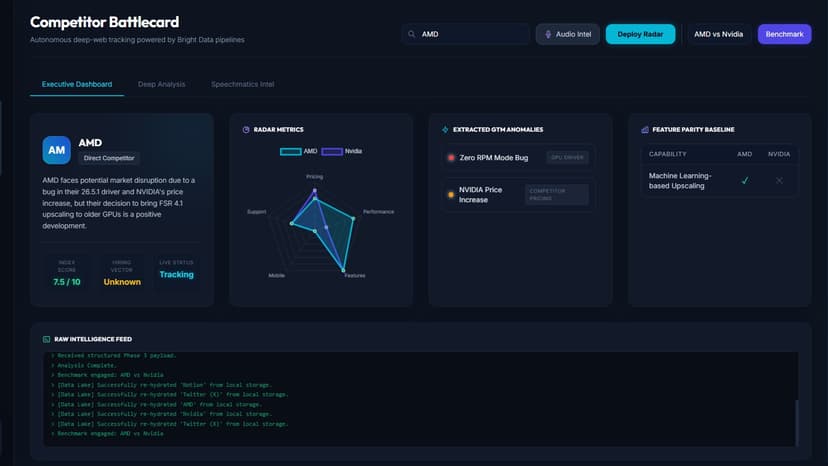
OmniSight: Autonomous Disruption Radar
Inspiration Corporate espionage and competitive strategy are painfully manual. Strategy teams spend days scouring Google for pricing changes, hunting down job postings to guess roadmaps, and listening to hours of earning calls. We realized that by orchestrating the right AI APIs, we could compress 40 hours of manual intelligence gathering into 60 seconds. What it does OmniSight is an enterprise-grade "Disruption Radar." Type in a competitor's name and attach a raw audio file (like a keynote speech). An autonomous AI agent then: Conducts live, parallel web searches for hiring velocity and pricing changes. Deep-scrapes competitor websites to extract raw product data. Diarizes the uploaded audio to extract hidden business drivers. Synthesizes this into a dual-layered Radar Dashboard that benchmarks the competitor. How we built it Bright Data: Used to bypass captchas and scrape live data across three parallel vectors asynchronously. Speechmatics: Used for deep audio intelligence, executing speaker diarization on raw audio files. Cognee: Integrated into the agent runtime to cache competitor profiles in a knowledge graph, giving the agent historical memory. Gemini / Groq LLM: The "brain" that structures the unstructured signals into a strict JSON schema. Challenges Running deep web scrapes and audio transcription sequentially caused 5-minute load times. We solved this by using asyncio.gather to fire all Bright Data and Speechmatics requests simultaneously, cutting load times by 70%, and piping the AI's internal terminal feed directly to the UI.
31 May 2026
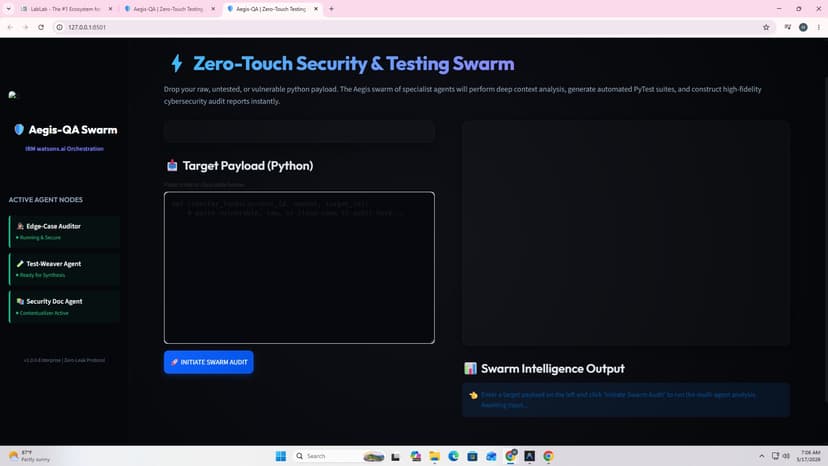
Aegis-QA: Zero-Touch Security & Testing Swarm
Writing unit tests and conducting security audits are the most critical yet time-consuming tasks in software development. Developers spend countless hours writing repetitive boilerplate tests and hunting for edge-case vulnerabilities, draining productivity and delaying deployments. Enter Aegis-QA. Aegis-QA is an enterprise-grade, zero-touch testing and security swarm designed to automate this entirely. Built specifically for the IBM Bob Hackathon, this tool leverages a Multi-Agent architecture to process raw, untested code in seconds. Powered by the IBM watsonx.ai Granite-3-8b-instruct model, Aegis-QA spins up specialized AI nodes: an Edge-Case Auditor to hunt for vulnerabilities (like SQL injections or data leaks) and a Test-Weaver Agent to generate comprehensive, runnable PyTest suites. The entire backend integration, API routing, and Streamlit frontend architecture were iteratively designed and generated using the IBM Bob IDE (Code & Plan modes), proving the massive potential of AI-assisted development. Aegis-QA transforms hours of manual QA and security compliance work into a seamless, 10-second automated pipeline.
17 May 2026


