

Francis Daniel Genese@francis_daniel
4
Events attended
3
Submissions made
Philippines
3+ years of experience
About me
I'm Francis Daniel Genese, a final-year BS Information Technology student at Bataan Peninsula State University. I'm a junior software engineer whose core strength lies in designing systems that work — cohesive architectures, smooth user flows, and engineering decisions that hold up under real-world conditions. I thrive at the intersection of system design and user experience. I think deeply about how data moves, how services communicate, how users interact, and how everything fits together into something that feels seamless — whether it's a layered security architecture, an agentic AI pipeline, or a dual-physics simulation engine. That philosophy has carried me through multiple shipped projects. Bacsal Business Consultancy (January 1 – April 30, 2026), a full-stack CMS I led during my internship, was an exercise in designing a secure, maintainable system non-technical admins could actually navigate. Miwa (May 4–11, 2026), my Discord voice translation overlay, was built around an agentic workflow designed to feel invisible — real-time, speaker-aware, and contextually intelligent. Mirai (May 11–19, 2026), my current hackathon project, tackles making robotics simulation accessible, accurate, and educational all at once. Hackathons have sharpened this instinct — 1st Runner-Up at Byteforward (June 2025) and 2nd Runner-Up at RAITE 2025 (October 2025) taught me to make fast, confident architectural decisions under pressure and deliver something users immediately understand and trust.
🤓 Latest Submissions
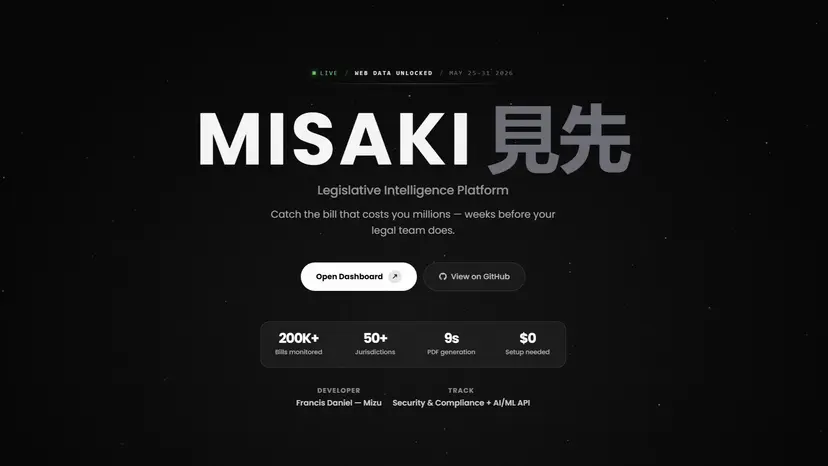
Misaki: AI Legislative Intelligence Platform
Misaki is an AI-powered legislative and regulatory intelligence platform that tells companies which laws will cost them money — before those laws pass. Today, compliance teams discover threatening bills weeks too late, and incumbents like Quorum, FiscalNote, and LexisNexis only tell you that a bill changed — never what it means for your specific company, what it will cost, or what to do about it. A human lawyer still does all of that by hand. Misaki closes that gap. You give it a company profile (auto-built from the web), and it continuously monitors legislation across 50 US states, the EU, and the UK. For every bill it reasons over the full text against your company, highlights the exact triggering clause, scores pass probability, and estimates dollar exposure. Then it acts — autonomously finding specialized law firms, drafting a lobbyist response brief, and building a competitive strategy — before rendering a board-ready PDF in under nine seconds. All live web intelligence flows through the Bright Data MCP Server: Web Unlocker pulls SEC EDGAR filings, the SERP API reads press coverage, the Web Scraper API traces lobbyist money, and the Scraping Browser handles JS-rendered sources. Every reasoning task is routed through the AI/ML API to the optimal model — gpt-4o-mini triages cheaply, gpt-4.1 reasons over full bills, and gpt-4o drafts responses and reads scanned bills via vision OCR. Deployed live on Vercel and Railway, Misaki is 10× cheaper than incumbents — and the only platform that reasons, prices, and acts.
31 May 2026
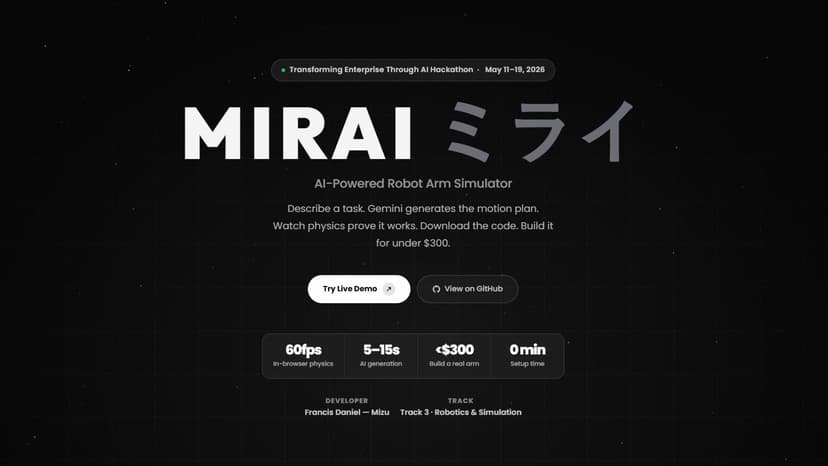
Mirai — AI-Powered Robot Arm Simulator
Mirai (ミライ, "Future") is a browser-first robotics platform that removes every barrier between an idea and a working robot arm — no installation, no coding required. The Problem: Robotics has a steep entry barrier. Expensive hardware, complex toolchains, and specialized programming knowledge stop most people before they start. The Solution: Users design a custom 3D robot arm using a segment editor with live BOM pricing, then describe a task in plain English. Gemini AI generates a structured motion plan grounded against the actual arm geometry and scene. A deterministic verifier checks safety and reachability before any simulation runs. The arm then executes the verified plan at 60fps using Rapier WASM physics in the browser. Key Features: - Natural language to motion plan via Gemini 2.5 Flash with auto pre-flight validation - 60fps in-browser simulation (Rapier WASM) cross-validated against MuJoCo on the server - Servo lifespan prediction and divergence analysis - Community task library with 11 seeded tasks and famous robot preloads (Boston Dynamics, Tesla Optimus, Toyota Research) - One-click export: Arduino .ino, Python .py, URDF, BOM CSV, SHA-256 signed ZIP bundle Mirai bridges idea and real hardware. Any person with a browser and a $300 budget can design, simulate, validate, and build a functional robot arm in minutes.
19 May 2026
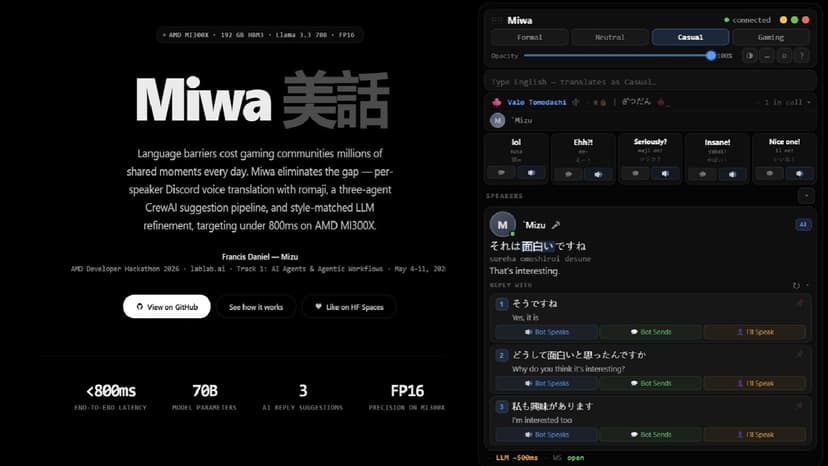
Miwa: Real-Time Japanese Discord Voice Translator
Miwa (美話, “Beautiful Conversation”) is a real-time communication overlay built for Japanese-speaking Discord voice communities. The core problem it solves is conversation breakdown during live gameplay: users currently alt-tab, copy text, and use external translators, which is too slow for real-time coordination. Miwa keeps users inside the game by rendering live translation directly in an always-on-top transparent overlay. The system captures per-speaker Discord audio streams, transcribes speech with openai-whisper, and sends an immediate fast translation packet first, followed by style-refined output from Llama 3.3 70B served with vLLM on AMD MI300X. This two-pass architecture provides instant perceived responsiveness while preserving high translation quality. Romaji is generated for pronunciation support, and users receive contextual AI reply suggestions generated by an agentic pipeline (Analyst, Strategist, Writer) with per-speaker memory retrieval via Qdrant. Miwa also includes practical in-call controls: per-member pipeline toggles, phrasebook shortcuts, quick reactions, and three reply delivery modes (Bot Speaks, Bot Sends, I’ll Speak). TTS pre-synthesis and caching reduce response delay for spoken replies. The stack combines TypeScript/React/Tauri for UI, Node.js for Discord integration, Python/FastAPI for inference orchestration, and AMD cloud GPU infrastructure for low-latency full-model inference. Built solo in 7 days, Miwa demonstrates an end-to-end agentic voice UX system with measurable latency engineering, infrastructure tradeoffs, and production-oriented interaction design for multilingual gaming communities.
10 May 2026


