.png&w=256&q=75)
🤝 Top Collaborators
.png&w=640&q=75)
🤓 Latest Submissions
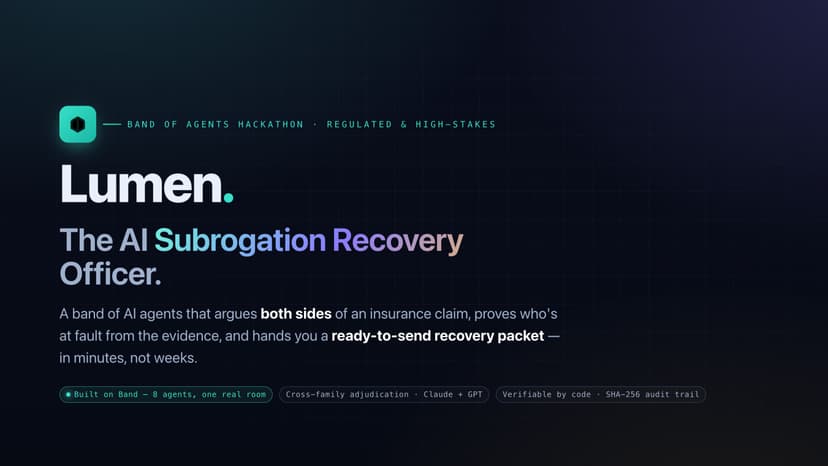
Lumen — AI Subrogation Recovery Officer
The problem: Insurers leave an estimated $15–20B/year uncollected because subrogation — recovering money from the at-fault party's insurer after a claim is paid — is slow, document-heavy, and manual. Viable cases get dropped. What Lumen does: Lumen acts like an AI recovery department. Upload evidence (police reports, photos, repair invoices, medical bills, EDR data) and it produces a recovery packet: comparative-fault %, recoverable amount, and a demand letter where every claim is tied to a fact or statute. It also knows when not to pursue a case and declines weak claims. Built on Band: Lumen isn't one model in a loop. It's 8 specialized agents collaborating in a single Band room, discovering each other, dividing work by legal issue, debating conclusions, and escalating uncertainty to humans. Built with the real Band Agent API using @mentions and shared room context. The agents: Court Clerk, Intake Parser, Evidence Aggregator, Recovery Counsel, Opposing-Carrier Red Team, two Independent Adjudicators, Source-Alignment Verifier, and Demand-Letter Drafter. Adversarial roles are cross-model (Claude vs GPT) to reduce correlated mistakes. Trust is in the code: Five verification gates run between turns: Fact, Citation, Math, Source-Alignment, and Letter-Reconciliation. Every run generates a SHA-256 tamper-evident audit hash. Anything "not in evidence" is escalated. In testing, independent adjudicators (88% and 95.5%) converged on the same outcome, while the verifier automatically caught a red-team factual misrepresentation. What makes it different: Most claims technology helps decide whether to pay a claim. Lumen focuses on recovering money already paid, delivering a recoverable dollar amount and a sendable demand letter backed by a rigorous verification framework. Try it: Open the live demo, select a sample case (Red-light T-bone or Rear-end), and click Run to watch the agents deliberate in real time.
19 Jun 2026

