.png&w=256&q=75)
🤓 Latest Submissions
HireFlow Agents
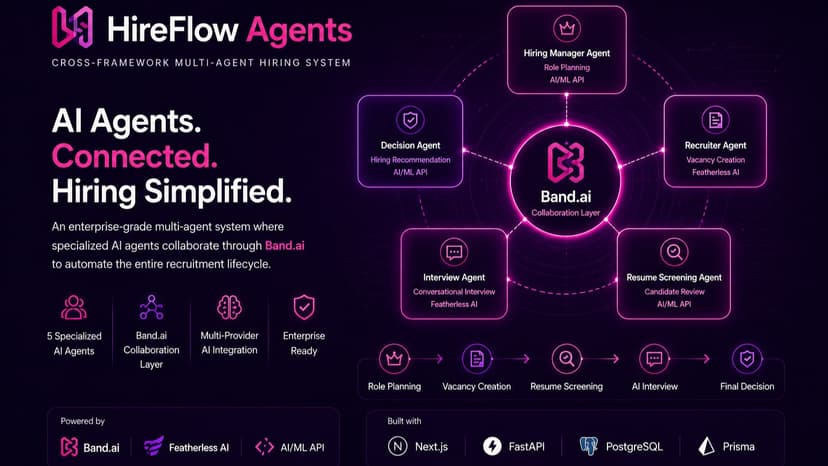
HireFlow Agents is a cross-framework multi-agent hiring platform that demonstrates how specialized AI agents collaborate across multiple AI providers to automate recruitment workflows. Traditional hiring requires recruiters, hiring managers, interviewers, and decision-makers to constantly exchange information, leading to delays and inconsistent evaluations. HireFlow Agents transforms this process into a coordinated AI-driven workflow. The platform uses Band.ai as the collaboration layer, allowing agents to exchange context, perform handoffs, and coordinate decisions in real time. Five specialized agents work together throughout the hiring lifecycle: • Hiring Manager Agent – defines role requirements and hiring objectives. • Recruiter Agent – generates job descriptions and recruitment content. • Resume Screening Agent – evaluates candidate qualifications. • Interview Agent – conducts conversational AI interviews and gathers candidate insights. • Decision Agent – generates the final hiring recommendation. To demonstrate cross-framework interoperability, the platform integrates multiple AI providers. Band.ai powers workflow orchestration and communication. Featherless AI powers the Recruiter Agent and Interview Agent. AI/ML API powers the Hiring Manager, Resume Screening, and Decision Agents. The platform includes three key interfaces. The Agent Control Center provides visibility into agent status, workflow execution, and provider usage. The Command Center visualizes agent collaboration and hiring metrics. The AI Interview Room enables conversational candidate interviews with live agent participation. Built with Next.js, FastAPI, PostgreSQL, and Prisma, HireFlow Agents demonstrates how collaborative AI systems can automate recruitment workflows while remaining transparent, scalable, and extensible. A live demo is available, and test login credentials are provided in the GitHub README for judges.
19 Jun 2026
Autonomous Cybercrime Intelligence Platform
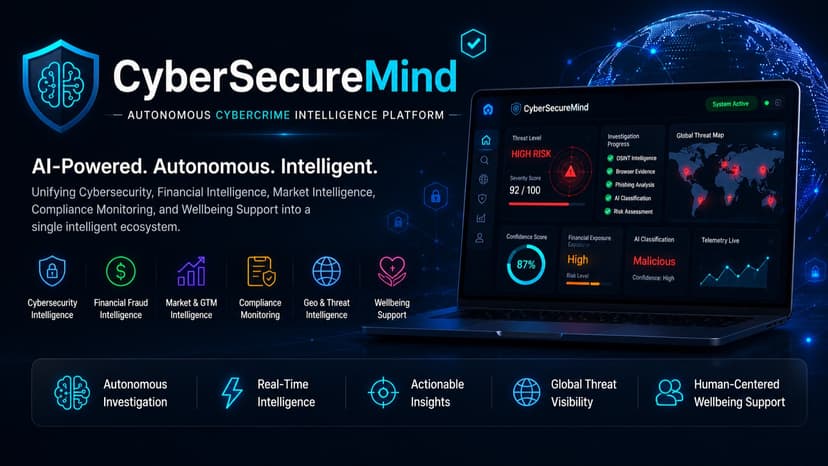
CyberSecureMind is an autonomous cybercrime intelligence platform designed to help individuals, organizations, financial institutions, and cybersecurity teams rapidly identify, analyze, and understand digital threats. Modern cybercrime investigations are fragmented across multiple tools, data sources, and intelligence providers. Analysts often need to manually gather open-source intelligence, inspect suspicious websites, evaluate fraud indicators, assess financial exposure, review threat actor behavior, and interpret large volumes of information before making a decision. This process is time-consuming, expensive, and difficult to scale. CyberSecureMind addresses this challenge through a unified AI-driven intelligence ecosystem. The platform orchestrates a multi-agent investigation pipeline that automatically gathers evidence, analyzes risk, and generates actionable intelligence from a single URL or domain. The system combines multiple intelligence layers including Cybersecurity Intelligence, Financial Fraud Intelligence, Market and GTM Intelligence, Compliance Monitoring, Geospatial Intelligence, and AI-powered Threat Classification. Open-source intelligence is collected through Bright Data SERP API, while website evidence and behavioral indicators are gathered using Bright Data Browser API. AI and machine learning models then process the collected evidence to classify threats, assess severity, estimate confidence levels, and generate executive-level intelligence reports. CyberSecureMind provides a visual investigation environment that includes threat progression analysis, confidence scoring, financial exposure assessment, global threat telemetry, geospatial mapping, and intelligence dashboards. The platform transforms raw threat data into structured insights that support faster decision-making and incident response. CyberSecureMind introduces an AI Cyber Wellbeing Assistant that provides guidance and emotional support for victims of cybercrime.
31 May 2026
.png&w=828&q=75)
AI Health Diagnosis app
This project is an AI-powered web application that helps users describe symptoms and receive AI-generated health guidance in real time.The system combines: a frontend user interface, a Flask backend server, AI processing using the Gemini API, and cloud deployment on a Vultr Virtual Machine. This project shows how AI, cloud computing, and web technologies can work together to create accessible healthcare support systems. The frontend collects user symptom descriptions, provides a clean healthcare-oriented interface, sends user input to the backend. The backend is responsible for returning generated responses to the frontend.
19 May 2026


