🤓 Latest Submissions
Agentic InferenceRoute
The traditional web services handle quick stateless requests measured in milliseconds, but LLM inference workloads require routing decisions that understand the current state of each model server — queue depth, memory utilization, loaded adapters, and ability to handle requests of different criticality levels. InferRoute adds a Featherless-powered classifier in front of that routing layer, and a band.ai cost-control agent watching the budget knob continuously.In Istio it fully conformant with GIE v1.0.1 and promotes GIE support to beta — separating platform admin concerns from AI/ML team concerns through InferencePool (platform admin resource) and InferenceObjective (AI/ML owner resource). InferRoute rides exactly that wave, adding a Featherless intelligence layer and band.ai budget governance on top of the freshest K8s-native inference primitive. It's not a toy demo — it maps directly to the production problem of routing requests based on KV-cache utilization, pending queue depth, and prefix affinity to minimize time-to-first-token, with cost control that enterprises actually need
19 Jun 2026
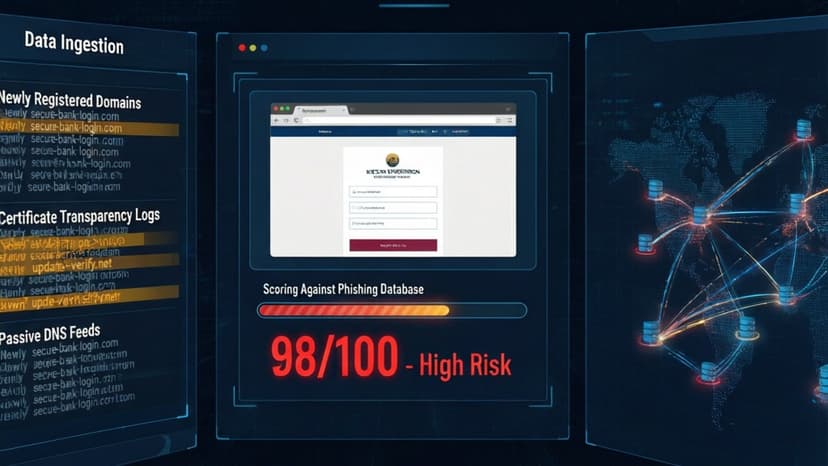
Adversarial Infrastructure Analyzer
Every phishing campaign, every business email compromise, every credential-harvesting operation begins the same way: an attacker registers a domain. That moment of registration is the earliest possible signal, and it happens in public. Certificate transparency logs record it. WHOIS feeds publish it. Passive DNS aggregators pick it up within minutes. The entire adversarial infrastructure lifecycle — from registration through weaponization to first victim — plays out across sources that are open, crawlable, and continuous. The core insight is that adversarial infrastructure has a predictable birth cycle — a domain gets registered, gets a TLS cert, gets DNS configured, and only then gets pointed at victims. The window between registration and first use is where you want to catch it, before any SIEM sees a packet. The pipeline works by watching the public signals of that birth cycle in real time.
31 May 2026
Close loop health
B2B SaaS, services, and subscription companies lose 20-40% of annual revenue to churn that was preventable. The brutal part: in post-mortems, the warning signs were always there — a champion stopped replying in week 3, support tickets got terser in week 5, the QBR got rescheduled twice in week 7. By the time Customer Success heard "we're not renewing" in week 11, the internal decision had been made weeks earlier. The reason this keeps happening isn't laziness. A CSM managing 40-80 accounts cannot read every Slack-shared email thread, listen to every support call, watch every usage dashboard, and notice that procurement at one account just started LinkedIn-stalking a competitor. The signals exist; the human bandwidth doesn't. ClosedLoop is the agent system that watches everything, reasons about what it sees, and either acts or escalates with the save-play already drafted.
19 May 2026

AI WAFS web application firewall
What Would Blow Our Minds ● A guardrail system that stops prompt injection without blocking legitimate use ● AI that reasons about adversarial intent like a security expert ● Something that adapts to new attack patterns automatically ● Multi-layered defence that validates inputs, outputs, and behaviour ● A system that makes AI agents safe to deploy on the public internet ● Defence that explains WHY something was blocked in human-understandable terms Why This Matters Now AI agents are being deployed in production with access to sensitive data and critical actions: ● Prompt injection is the SQL injection of the AI era ● AI agents can take real-world actions - making attacks more dangerous ● Traditional security tools weren't designed for natural language inputs ● New attack techniques emerge faster than manual defences can adapt ● Organisations need guardrails before widespread AI deployment creates security incidents AI can be used to detect and defend against AI-specific attacks using adversarial reasoning andintent analysis.
19 May 2026

Dependency risk analyzer
A single unpatched lodash or log4j can cascade across thousands of enterprise clients. Most teams only discover these issues after a breach or a failed audit. Most teams only discover these issues after a breach or a failed audit. A security tool that runs inside IBM Bob to continuously scan every manifest file in a B2B codebase, cross-reference packages against CVE databases, and block risky builds — all without leaving the IDE or terminal.It demonstrates nearly every IBM Bob capability in a single coherent flow, addresses a real pain point every enterprise judge will recognize, and produces a live demo where Bob visibly prevents a security incident in real time. The combination of IDE-native UX + terminal automation + MCP integrations shows the full SDLC story Bob is designed for. Instead of running separate security tools and compliance audits, everything lives in one IBM Bob-powered dashboard.
17 May 2026


