
🤝 Top Collaborators


🤓 Latest Submissions

AgentForge — Natural Language Agent Builder
Enterprise agent development on IBM watsonx Orchestrate is broken. Developers spend hours writing Python tool functions by hand, crafting ADK YAML from scratch, wiring MCP server connections manually, and debugging deployment errors — before they even touch the actual business logic. Most teams simply do not have time for this overhead. AgentForge solves this with a single sentence. You type: "Agent that pulls invoices from Gmail and posts them to SAP" — and AgentForge, powered entirely by IBM Bob, builds and deploys a fully working agent in roughly 90 seconds. Bob handles the complete pipeline automatically. First, it parses your intent and generates a structured agent spec. Then it writes all Python tool functions with correct type annotations and docstrings for Orchestrate compatibility. Next it generates the full ADK YAML configuration, validated against the Orchestrate schema. Then it configures all required MCP server connections based on what the tools need. Before deployment, Bob runs a dry-run test suite, catches any errors, self-corrects, and re-tests. Finally, the agent is deployed live into your watsonx Orchestrate chat environment — ready to use. No manual YAML. No hand-written tools. No debugging at midnight. IBM Bob is not a helper in this project — Bob is the core engine. All six Bob modes are used naturally across the pipeline: reasoning through intent, generating repository-aware code, producing valid configuration, inferring dependencies, self-correcting on test failures, and executing multi-step deployment. The full Bob session export shows every task and decision point, providing a complete audit trail for judges. The business value is real: a process that took expert developers six to eight hours now takes 90 seconds — and becomes accessible to anyone, not just those who have memorized ADK schemas. AgentForge is the natural language layer that enterprise agent development has been missing.
17 May 2026
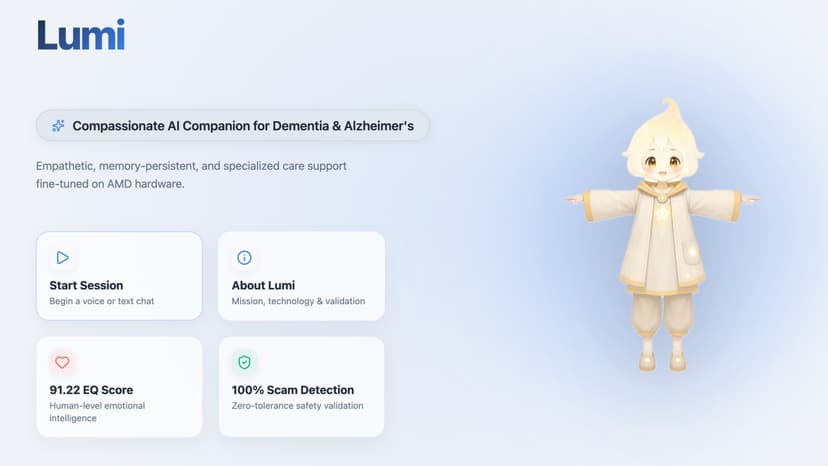
Lumi, AI voice helper for elderly with dementia
Lumi is a domain fine-tuned AI voice companion for dementia and Alzheimer's care. Built on AMD MI300X using QLoRA and GRPO reinforcement learning, Lumi handles confusion, repetition, and emotional fragility the way a trained caregiver would — not a generic chatbot. 55 million people live with dementia worldwide. Families cannot provide 24/7 care — and existing AI companions fail them. They reset every session, correct temporal confusion (which is clinically harmful), and leave patients vulnerable to scams costing $3 billion annually in elder fraud. Lumi is the first AI companion purpose-built for this population. Fine-tuned on AMD MI300X using QLoRA and GRPO reinforcement learning — the same technique behind DeepSeek-R1 — Lumi was trained on 8,540 dementia-specific samples processed through our EQ-Matrix framework, covering scenarios across severity levels, emotional states, and scam patterns. Persistent memory via ChromaDB injects prior session context into every new conversation — patients never repeat themselves. A structured output format fires the opening spoken line to TTS before the full response is generated, achieving time-to-first-audio under 1.5 seconds. A binary scam deflection classifier intercepts fraud attempts gently, without alarming the patient. On EQ-Bench 3, Lumi ranked 7th out of 46 models with a Rubric Score of 14.55 — confirming genuine emotional intelligence gains, not just surface fluency. The entire pipeline runs locally on AMD MI300X with ROCm and vLLM. No data leaves the device. No proprietary APIs. Fully private, fully open hardware.
10 May 2026

