
🤝 Top Collaborators
.png&w=640&q=75)

🤓 Latest Submissions
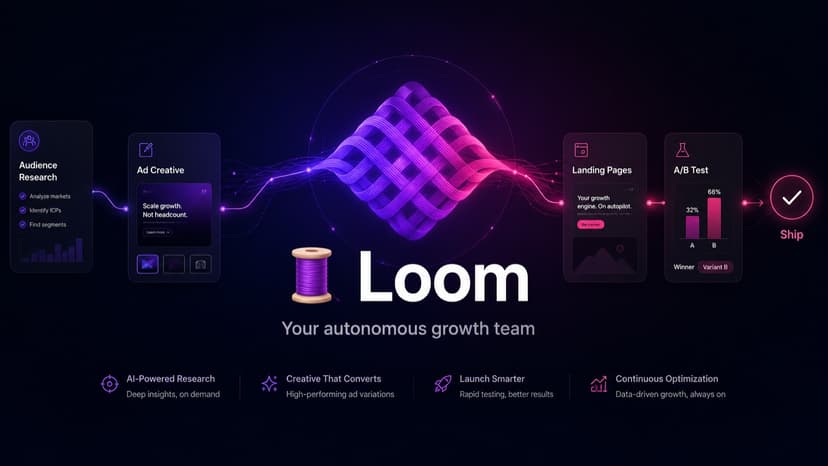
Loom - The Autonomous Growth-Marketer
Every founder hits the same wall: you can build the product, but launching it means audience research, copywriting, ad creative, landing pages, and A/B testing — days of work across four specialists most early teams can't afford to hire. Growth becomes the bottleneck that kills good products before anyone sees them. Loom collapses that entire loop into one autonomous agent. Give it a product URL and a goal, and it goes to work like a full growth team: it researches your audience and their real pain points, writes headline and ad copy, generates ad visuals, designs multiple landing-page variants, drafts a Sora-ready video ad brief, simulates how distinct audience personas react in an A/B test, lays out a launch timeline, and hands you a single prioritized recommendation on exactly what to ship — and why. The magic is the closed loop. Most AI marketing tools stop at drafting text. Loom goes further — create, test, decide. It doesn't just generate assets; it pressure-tests them against a simulated audience and returns a real decision, the judgment layer growth teams actually get paid for. Paste a URL, get a launch. Under the hood, Loom runs on Google Gemma served through Fireworks AI on AMD Instinct GPUs, with additional generation work prototyped on AMD Developer Cloud — infrastructure that lets Loom fan out dozens of copy, creative, and strategy variants cheaply and in parallel, exactly the workload agentic marketing demands at scale. Go-to-market automation is a massive, high-value B2B market, and "agentic marketing" is one of the most actively funded categories in AI right now. Loom is a working prototype today — research, copy, creative, audience simulation, and the ship recommendation are all live — with a clear path toward native ad-image and video generation and one-click publishing to your channels. The growth team that never sleeps, in one paste.
13 Jul 2026
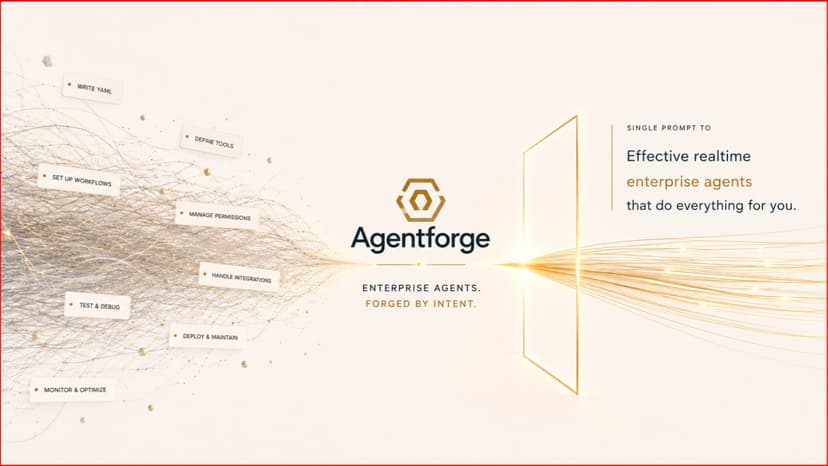
AgentForge — Natural Language Agent Builder
Enterprise agent development on IBM watsonx Orchestrate is broken. Developers spend hours writing Python tool functions by hand, crafting ADK YAML from scratch, wiring MCP server connections manually, and debugging deployment errors — before they even touch the actual business logic. Most teams simply do not have time for this overhead. AgentForge solves this with a single sentence. You type: "Agent that pulls invoices from Gmail and posts them to SAP" — and AgentForge, powered entirely by IBM Bob, builds and deploys a fully working agent in roughly 90 seconds. Bob handles the complete pipeline automatically. First, it parses your intent and generates a structured agent spec. Then it writes all Python tool functions with correct type annotations and docstrings for Orchestrate compatibility. Next it generates the full ADK YAML configuration, validated against the Orchestrate schema. Then it configures all required MCP server connections based on what the tools need. Before deployment, Bob runs a dry-run test suite, catches any errors, self-corrects, and re-tests. Finally, the agent is deployed live into your watsonx Orchestrate chat environment — ready to use. No manual YAML. No hand-written tools. No debugging at midnight. IBM Bob is not a helper in this project — Bob is the core engine. All six Bob modes are used naturally across the pipeline: reasoning through intent, generating repository-aware code, producing valid configuration, inferring dependencies, self-correcting on test failures, and executing multi-step deployment. The full Bob session export shows every task and decision point, providing a complete audit trail for judges. The business value is real: a process that took expert developers six to eight hours now takes 90 seconds — and becomes accessible to anyone, not just those who have memorized ADK schemas. AgentForge is the natural language layer that enterprise agent development has been missing.
17 May 2026


