Chetan Bavdhankar@chetan_bavdhankar792
2
Events attended
2
Submissions made
8+ years of experience
About me
I am an AI engineer and full-stack developer specializing in intelligent systems and multi-agent architectures. His recent GitHub projects demonstrate expertise in Python backend development, JavaScript frontends, and LLM integration. He builds flexible AI systems supporting OpenAI, Gemini, and Ollama, prioritizing architecture that enables cost optimization and deployment flexibility. His portfolio spans research automation (ArxivGnosis), travel optimization with constraint satisfaction (Hodophile), security platforms (Aegis), and computer vision (Segmentation). Known for bridging AI research and production systems, Chetan demonstrates sustained momentum in developing sophisticated, integrated solutions.
🤝 Top Collaborators
.png&w=640&q=75)


🤓 Latest Submissions
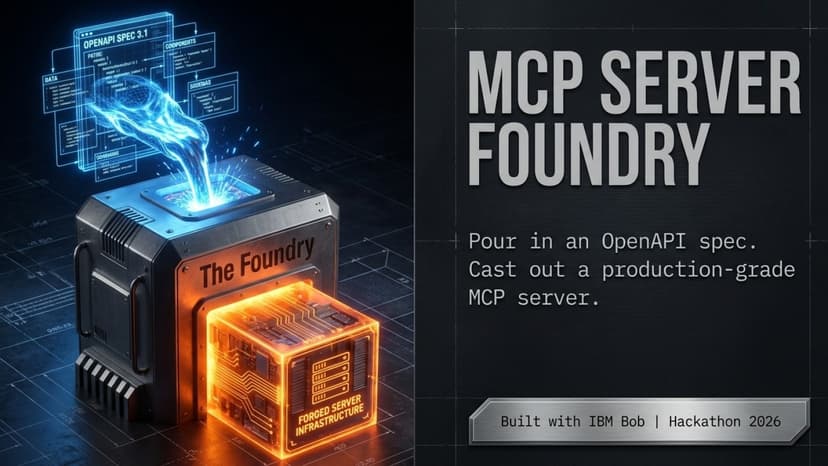
MCP Server Foundry
MCP Server Foundry is an end-to-end orchestration platform that instantly transforms raw, local CSV and Excel datasets into fully interactive, queryable AI agents. Featuring a premium Streamlit interface, the platform completely automates the backend engineering pipeline. Upon file upload, it dynamically infers data schemas to auto-generate OpenAPI specifications, utilizing autonomous IBM Bob LLM agents to forge custom Model Context Protocol (MCP) servers. Powered by a completely LLM-agnostic reasoning loop via LiteLLM, MCP Server Foundry gives users the flexibility to connect any local model (such as Ollama Qwen) or leading cloud provider (including Gemini 3.1 Pro and Claude 3) directly to their localized data. This secure, auto-generated neural link entirely eliminates the need for manual backend API development, data engineering, or complex pipeline configuration.
17 May 2026

Agentic Reproducibility Engine
Research papers often claim reproducibility while leaving critical evidence scattered across PDFs, arXiv records, DOI metadata, GitHub repositories, datasets, and informal implementation notes. The Agentic Reproducibility Engine turns that messy audit process into a visible multi-agent workflow. Users submit a paper or paper reference through a static web interface. The backend runs a sequence of specialized agents that plan the audit, extract claims and artifacts, retrieve external evidence, score reproducibility risk, design a replication plan, generate code/data follow-up commands, and critique unsupported assumptions before writing the final report. The UI streams the work live so judges can inspect agent artifacts, tool calls, resolver outcomes, verifier objections, and final provenance. The target deployment uses a Hugging Face Static Space as the public frontend and an AMD Developer Cloud instance as the backend. The AMD host serves Qwen/Qwen3.5-27B through vLLM on ROCm and runs the FastAPI agent API. The system is designed to fail closed: if arXiv, DOI, GitHub, or dataset evidence cannot be verified, the report records that gap and degrades the decision rather than inventing placeholder evidence. The project includes a public GitHub repo, self-serve AMD/Hugging Face deployment kit, deterministic eval harness, static frontend, API backend, live evidence resolver tools, and an audit trace format for reproducibility evidence.
10 May 2026


