
Keisha Theanny@chessman
4
Events attended
3
Submissions made
Indonesia
1 year of experience
About me
My name is Keisha Putri Theanny. Creative-minded and technically driven aspiring software engineer with a passion for building thoughtful, user-centered digital experiences. With a background rooted in both programming and design, I enjoy bridging logic and aesthetics to craft intuitive and functional solutions. I am deeply curious, eager to expand my skills across full-stack development and product design, and continually seek opportunities to learn through hands-on projects. Adaptable, self-motivated, and collaborative by nature, I thrive in dynamic environments that challenge me to think critically and create with purpose
🤝 Top Collaborators


🤓 Latest Submissions
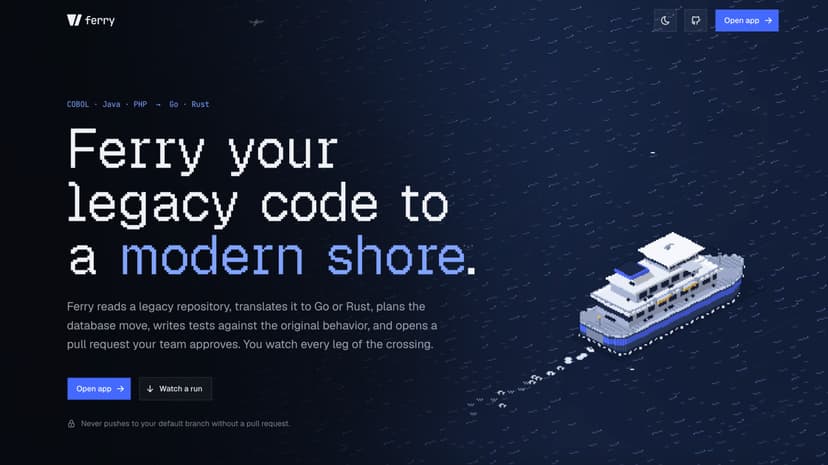
Ferry: Agentic Legacy Modernization
Ferry is an AI-assisted legacy modernization platform that helps teams move old systems into modern codebases with more visibility and control. Instead of handing an entire migration to one model, Ferry coordinates a Band room of specialized agents that each own a clear part of the process: planning, source analysis, business logic extraction, target code generation, database migration, test generation, review, final approval, and GitHub pull request creation. A user points Ferry at a legacy COBOL, Java, or PHP repository. Ferry analyzes the project, translates the application to Go or Rust, prepares MySQL MyISAM to InnoDB migration plans when needed, writes tests against the original behavior, and produces migration artifacts the team can review. The workflow ends in a GitHub pull request, so teams can inspect the diff, tests, and migration plan before anything is merged.
19 Jun 2026

ConsumerIQ: Validate Demand Before You Build
ConsumerIQ is a demand validation engine for founders launching physical consumer products. The most expensive founder mistake isn't building badly. It's building something the market never asked for. Studies at CB Insight shows that roughly 43% of founders worldwide fail because their product has no market need, meaning no one actually wants to buy it. Inventory, supplier deposits, packaging, and launch ad budgets all get committed long before a single sale is proven. ConsumerIQ catches that risk before a dollar is spent on production. Founders submit a product concept, category, target market, and audience through a guided onboarding form. ConsumerIQ then maps the category to relevant marketplace and social data sources and scrapes real signals like competitor listings, reviews, complaints, pricing, SERP results, and social trends, using Bright Data's marketplace datasets, SERP API, and scraping browser across Amazon, Walmart, Etsy, and social platforms. The signals feed a hybrid AI pipeline. A local GPU stack runs Llama 3.2 3B for ReAct agent loops, fastembed MiniLM-L12 for embeddings, and Qwen 3.5 0.8B for CJK to EN translation and compliance preprocessing, with higher-order data synthesis to the dashboard powered by the Qwen3.5-27B-Claude-4.6-Opus-Reasoning-Distilled model served via featherless.ai. Signals persist in Postgres with pgvector and a Cognee knowledge graph for semantic memory. A Go ingest service, FastAPI admin layer, Redis queues, and Celery workers (split into inference and scraping pools) orchestrate the end-to-end pipeline behind an NGINX gateway. The output is a founder-ready dashboard across four sections (Market, Demand, Competitors, Launch) plus an interactive agent chat for follow-up questions. The final deliverable is a clear verdict: Build, Pivot, Stop, or Refine. One input. Real market data. One clear decision, built for founders who need an answer, not another dashboard.
31 May 2026
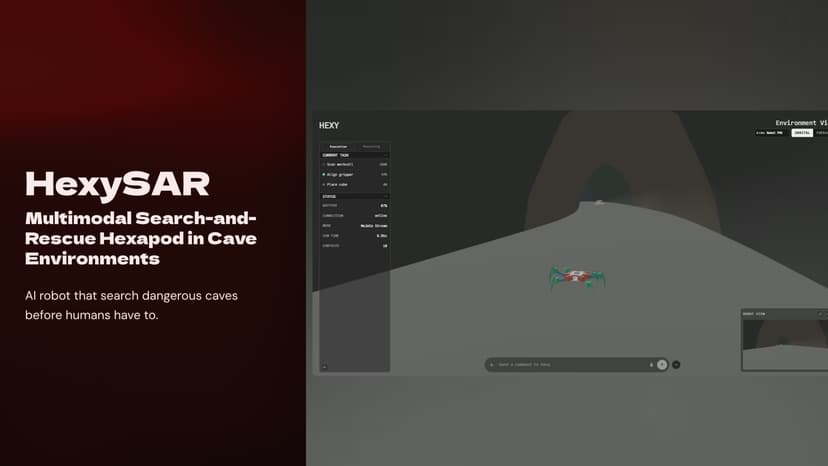
HexySAR: an AI-powered hexapod for SAR missions
HexySAR is an AI-powered autonomous hexapod designed for search-and-rescue missions in dangerous cave environments. Cave rescue operations are often slow, risky, and resource-intensive because human rescuers must enter unstable, dark, and unknown terrain with limited visibility and high physical danger. HexySAR addresses this by sending an autonomous robot first. The system combines robotic simulation, multimodal AI, and a web-based control interface. Hexy can explore cave-like environments, walk toward detected targets, respond to voice cues, and assist in identifying possible survivor locations. Its AI pipeline integrates visual detection, audio understanding, and reasoning to support autonomous decision-making. The robot is trained and tested in MuJoCo-based simulation, with reinforcement learning used for locomotion and synthetic cave data used for survivor detection. To make the system more deployable, we also implemented model quantization, reducing VRAM requirements from around 16GB to approximately 2GB. This makes HexySAR more realistic for edge or SBC-class robot deployment, rather than being limited to high-end workstations. The goal of HexySAR is simple which is to send AI first, reduce human risk, and help rescue teams make faster, safer decisions.
10 May 2026


