
aubin ETIENNE@aubin
6
Events attended
5
Submissions made
1 year of experience
About me
Entrepreneur et chercheur indépendant en intelligence artificielle, je travaille sur la conception d’architectures cognitives alignées, modulaires et robustes, à la frontière entre IA, mathématiques, systèmes complexes et automatisation. Je développe Obsidia, un moteur cognitif expérimental fondé sur la cohérence, la stabilisation des trajectoires et la gouvernance du sens, avec une approche structure-first : avant les modèles, les invariants. Mon travail explore notamment la calibration humain-IA, les systèmes multi-agents, la mémoire fractale, la récursivité contrôlée et les mécanismes de décision sous contrainte. En parallèle, j’applique ces principes à des cas concrets : agents autonomes, automatisation intelligente, analyse de systèmes complexes, et outils IA orientés terrain. Je privilégie une démarche test & learn, rigoureuse mais pragmatique, mêlant recherche fondamentale et implémentation réelle. Je participe aux hackathons LabLab pour confronter mes idées à d’autres approches, prototyper rapidement, et explorer des formes d’IA plus fiables, interprétables et réellement utiles.
🤓 Latest Submissions
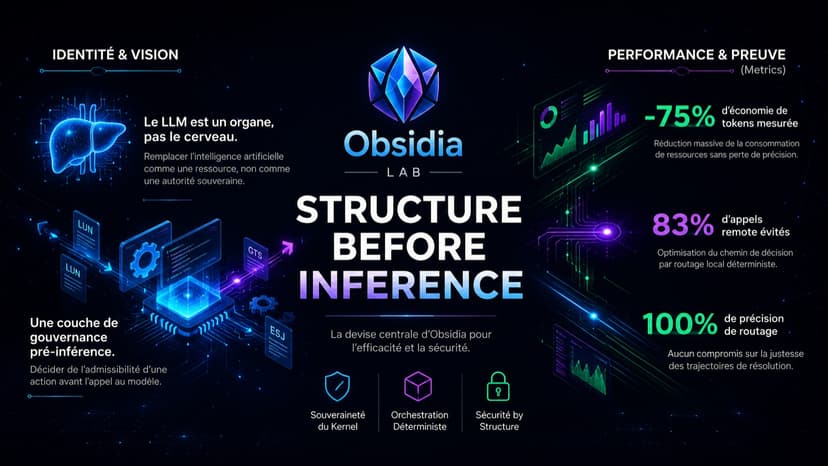
Obsidia Router: Structure Before Inference
Obsidia is a governed AI runtime built around one principle: Structure Before Inference. Most AI systems begin by deciding which model to call. Obsidia first decides whether a model is needed at all. Each request is translated into a UnifiedInputIR, converted into an Active Plan, matched against a Capability Resolver, and evaluated by deterministic governance gates before inference. The runtime follows this escalation path: Natural input → UnifiedInputIR → Active Plan → Capability Resolver → Gates → deterministic local solvers → readonly memory → optional readonly Brody endpoint → local Qwen inference → KX108_ONLY decision → canonical receipt → readonly replay. This architecture separates interpretation, planning, governance, inference, decision authority, and proof. Unsafe, destructive, incomplete, or locally solvable requests can be denied, held, clarified, or resolved before reaching a language model. When inference is required, a Qwen2.5-3B-Instruct Q4_K_M model is invoked as an organ of the system, not as its final authority. Every result remains governed by KX108_ONLY. The runtime records the selected capability, escalation level, gate verdict, invoked organ, model usage, mutations, external calls, latency, final status, and decision authority inside a canonical execution envelope. A SHA-256 receipt is generated, and readonly replay verifies the deterministic path without recalling the model or modifying memory. The Track 3 runtime passed 359/359 tests, including 5/5 Qwen tests. A 12-task demonstration batch produced 12/12 valid receipt hashes and 12/12 successful replays, with zero Fireworks calls, zero remote tokens, zero memory writes, zero world actions, and zero kernel mutations. Private Brody, Obsidure, Lean, Sigma, OIE, and domain components are not presented as executed. They remain private, route-only, unavailable, or bridge-required. Obsidia’s core idea is simple: the language model is an organ, not the brain, and never the final authority.
13 Jul 2026

X-108 Structural Safety for Agentic Commerce
Autonomous agents optimize for speed, but in finance speed combined with irreversibility becomes a systemic risk vector. X-108 introduces structural safety at execution level by transforming latency into a validation filter. Every irreversible action passes through a mandatory HOLD phase before release. During this interval, coherence thresholds and validation checks determine whether the action remains consistent with defined constraints. The system is demonstrated through a functional Streamlit interface with controlled ALLOW and BLOCK scenarios, including cases such as premature execution and low-confidence signals. X-108 provides observable, reproducible and testable safety enforcement for agentic commerce and programmable financial environments.
28 Feb 2026

Bank Safety Lab Autonomous Decision Robot
Bank Safety Lab is a simulation-first autonomous decision robot designed for banking transaction environments. It continuously observes financial metrics, detects risk signals and makes structured decisions: AUTHORIZE, ANALYZE or BLOCK. Unlike traditional automation scripts, this system emphasizes transparency and decision traceability. Each action is supported by metrics, real-time charts and exportable audit logs. The interface allows users to simulate batches of transactions and evaluate performance and ROI impact. This prototype demonstrates how autonomous robotic systems can operate in sensitive financial environments while remaining interpretable and measurable. It bridges AI-driven automation and structured governance, showing how robotics and decision intelligence can safely coexist in critical infrastructure contexts.
15 Feb 2026
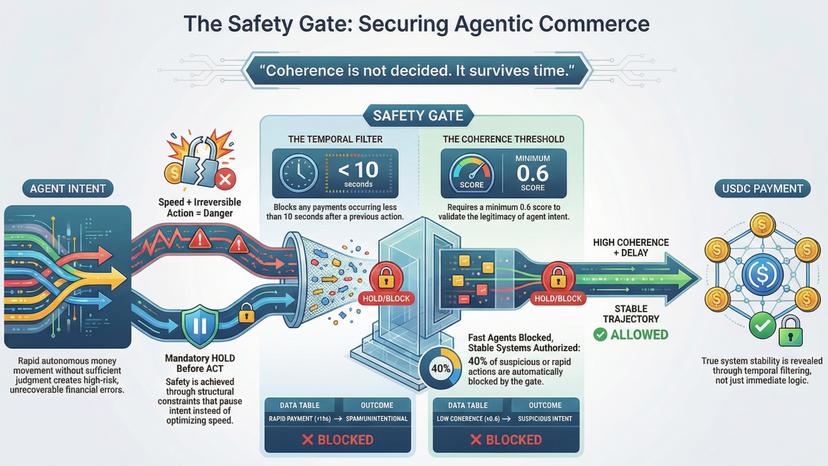
X-108 -Temporal Safety Layer for Agentic Commerce
Autonomous agents in commerce operate in environments where actions are often irreversible: payments, orders, pricing changes, and contractual commitments. Speed is usually optimized, but in these contexts, speed becomes a structural risk. X-108 introduces a simple but fundamental idea: time itself is a security primitive. Before any irreversible action, the system must pass through a temporal HOLD state that tests stability across time, not intent or intelligence. X-108 is not an AI model, not a policy, and not a moral rule. It is a middleware layer that sits between cognition and action and enforces a HOLD → ACT transition only when a trajectory remains coherent under temporal constraints. Fast, unstable agents are structurally blocked. Stable systems naturally converge toward execution. We validated this principle not only on agentic systems, but also on non-intelligent mechanical systems, showing that HOLD emerges from structure itself, not from intelligence. X-108 is model-agnostic, non-bypassable, and applicable to any agentic commerce stack where responsibility and safety matter.
24 Jan 2026


