.png&w=256&q=75)
🤓 Latest Submissions
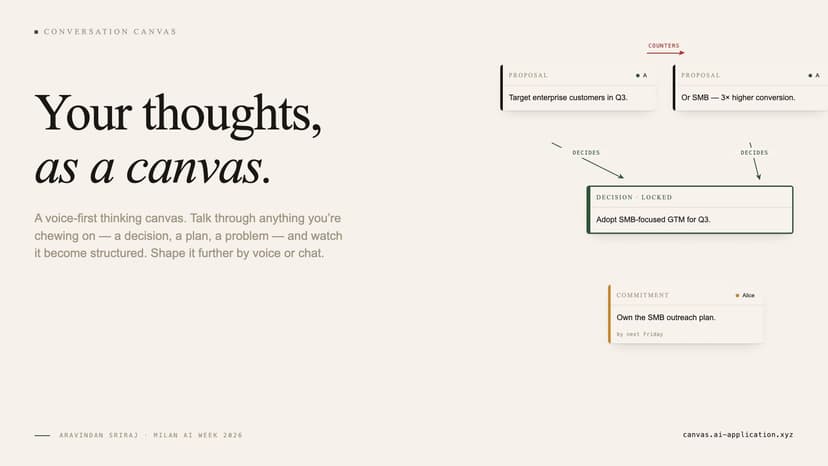
Conversation Canvas
Conversation Canvas is a real-time, voice-first thinking canvas. Talk through anything you're chewing on — a decision, a plan, a problem you're working out — and the canvas catches what matters as you speak. Most voice tools fall into three buckets: voice memos give you audio nobody re-listens to; transcripts give you walls of text nobody reads twice; chat-with-an-AI gives you a scrolling log that loses the structure of the actual reasoning. Conversation Canvas gives you a typed, navigable graph — drawn live, editable by voice or chat, and waiting where you left it next week. The product runs two AI surfaces over the same 28-action vocabulary. The voice orchestrator listens passively and emits cards autonomously every ~3 seconds. The chat agent is an interactive multi-step reasoner — you can type "delete the question if it's been answered, otherwise add a deadline" and it will read the canvas, plan, and act in sequence (up to four reasoning steps per turn). Both share a long-term memory that persists across sessions: re-open a canvas tomorrow and the system still remembers what you talked through. Beyond the five thinking-card types, the canvas understands everything you'd draw on a whiteboard: sticky notes, geometric shapes (rectangle, ellipse, triangle, diamond, star, heart, check-box, and 12 more), free-form arrows, priority matrices, budget allocators, alignment, deletion, recolor — anything you'd do with the mouse, you can do by asking, in voice or text. Stack: Speechmatics for real-time speech-to-text; Gemini 3 Flash via Vercel AI SDK for the orchestrator and chat agent; Gemini 3.1 Flash Lite for async memory compression; tldraw v3 for the canvas; Next.js 16 + custom WS server for live sync; Clerk for production auth; Neon Postgres for persistence ; deployed on a Vultr VM at https://canvas.ai-application.xyz with Let's Encrypt TLS.
19 May 2026