.png&w=256&q=75)
🤝 Top Collaborators
.png&w=640&q=75)
🤓 Latest Submissions
ReleaseGuardian
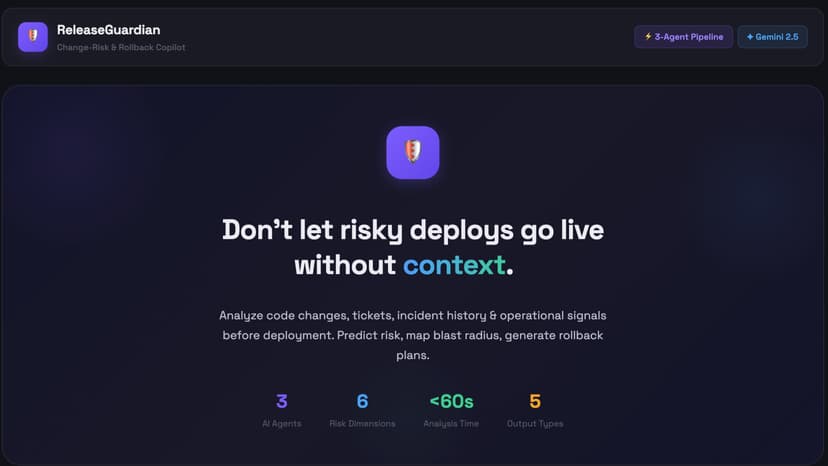
Every production outage starts the same way. Someone deployed code without full context. The PR was in GitHub, the ticket was in Jira, the runbook in Confluence, past incidents buried in a folder nobody checks, and system health on a Grafana dashboard. Nobody reads all of it. The deploy decision gets made by one engineer who skimmed the PR, saw CI was green, and hit merge. 70% of production incidents are caused by changes. Teams then spend 30 to 60 minutes scrambling to gather the same context they should have reviewed before deploying. The data always existed - it just was never connected at decision time. ReleaseGuardian fixes this with a three-agent pipeline powered by Google Gemini. Agent 1 - Context Builder (Gemini Flash): Ingests raw artifacts - PR diffs, Jira tickets, service runbooks, past incident reports, and dashboard screenshots. Produces a structured release profile covering services touched, dependencies, affected user flows, risky code patterns, and similar past incidents. Agent 2 - Risk Analyst (Gemini Pro): Scores risk across six evidence-backed dimensions - code change scope, dependency risk, historical pattern match, test coverage, operational readiness, and current system health. Maps the blast radius showing which services, users, and teams are in the danger zone. Predicts the most likely failure modes with probabilities and severity. Agent 3 - Recovery Planner (Gemini Flash): Generates a complete recovery package - pre-deploy checklist, step-by-step rollback plan with trigger criteria and time estimates, monitoring thresholds you can paste into Grafana, and ready-to-send Slack messages, manager emails, and on-call handoff notes. Five inputs. Three agents. Five outputs. Under 60 seconds. No more disconnected context. No more scrambling after the fact. Built with React, FastAPI, and Google Gemini (Flash + Pro).
19 May 2026
RepoMedic - AI Technical Debt Copilot
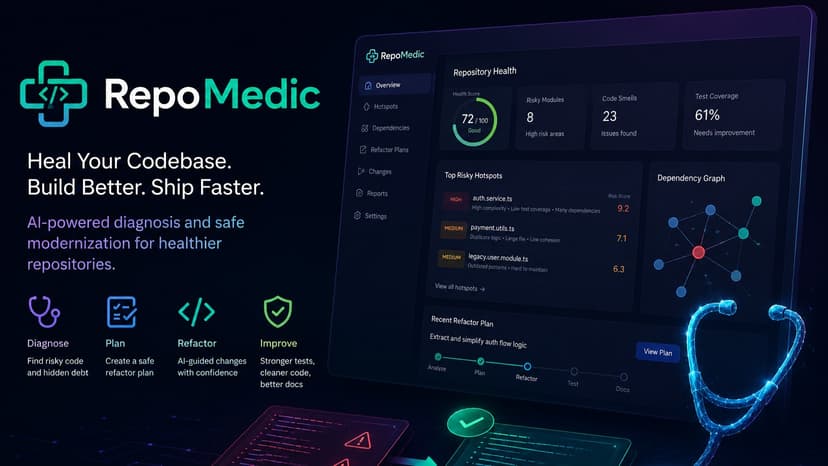
RepoMedic is an AI-powered technical debt diagnosis and modernization copilot built with IBM Bob for the IBM Bob Hackathon 2026. RepoMedic connects to any GitHub repository and transforms technical debt from a vague worry into a structured modernization workflow. How it works: 1. Diagnose — IBM Bob Ask mode scans the entire codebase, finding security vulnerabilities, duplicated logic, architecture violations, and dead code. 2. Prioritize — Ranks every issue by severity, business risk, and ROI so teams know what to fix first. 3. Plan — IBM Bob Plan mode generates a safe step-by-step modernization roadmap with file dependencies, edge cases, and test requirements. 4. Modernize — IBM Bob Code mode implements targeted refactors, generates unit tests, and updates documentation. What IBM Bob found in our sample repository: - 12 security vulnerabilities (score 0/100) - 7 code duplication locations across 3 files - 7 architecture violations - 3 dead code functions (28% of utils.js) - Overall health score: 2.1/10 What IBM Bob fixed: - Extracted pricing logic into a centralized service (services/pricing.js) - Generated 21 unit tests with 100% coverage - Reduced code duplication from 7 locations to 1 (86% reduction) - Created modernization plan, CHANGELOG, and updated documentation IBM Bob was used across all three modes: - Ask Mode: Health report, duplication analysis, security audit, architecture review, priority ranking - Plan Mode: 5-step modernization roadmap with edge cases and behavior preservation - Code Mode: Pricing service refactor, test generation, documentation creation, and dashboard development All Bob task session reports are exported and included in the bob_sessions folder of the analyzed repository. Repositories: - Dashboard: https://github.com/anishbellamkonda01/repomedic - Analyzed Repo: https://github.com/anishbellamkonda01/messy-ecommerce-api Tech Stack: React.js, Tailwind CSS, IBM Bob (Ask, Plan, Code modes), Node.js, Express.js
17 May 2026


