🤝 Top Collaborators
.png&w=640&q=75)


🤓 Latest Submissions
ROCm Navigator
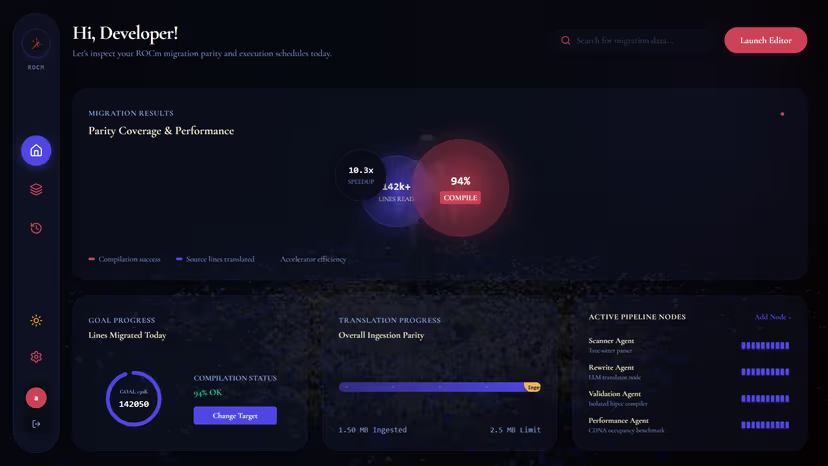
ROCm Navigator is an enterprise-grade, autonomous multi-agent platform engineered to break proprietary software lock-in by automating the migration of GPU applications from NVIDIA CUDA to open-source AMD ROCm (HIP). While traditional conversion tools (like regex-based hipify) frequently break on complex unified memory pointers, inline assembly, or cooperative warp-level primitives, ROCm Navigator treats codebase migration as a closed-loop optimization problem. The platform orchestrates a collaborative mesh of specialized, asynchronous AI agents to achieve drop-in runtime parity on AMD Instinct™ Accelerators (such as the CDNA3/MI300X series): Core Scanner Agent: Uses a Tree-Sitter & NetworkX Abstract Syntax Tree (AST) parser to build a structural graph of the codebase, pinpointing hardware-specific CUDA functions and migration bottlenecks. LLM Synthesis Agent: Leverages LangGraph workflows and fine-tuned Gemma LLMs to generate high-performance HIP code translations, preserving memory semantics and kernel-level configurations. Security Audit Agent: Scans translated assets post-migration for configuration vulnerabilities, secrets leakage, or potential security vulnerabilities. Sandbox Runtime Agent: Spins up hardware-isolated Docker compilation and testing containers. It attempts to compile the translated HIP code, feeds compile errors directly back into the LLM synthesis loop for automated self-correction, and benchmarks the resulting binaries on target AMD GPUs. The entire ecosystem is monitored through a sleek Next.js dashboard utilizing a responsive, glassmorphic dark-mode design. Through the interface, users can visualize real-time agent telemetry, review interactive side-by-side git diffs of the code translation, track compilation feedback, and monitor GPU benchmarking performance. By turning manual migration months into automated minutes, ROCm Navigator bridges the gap between raw syntax porting and instant operational deployment on AMD hardware.
13 Jul 2026
V7-Twin.ai
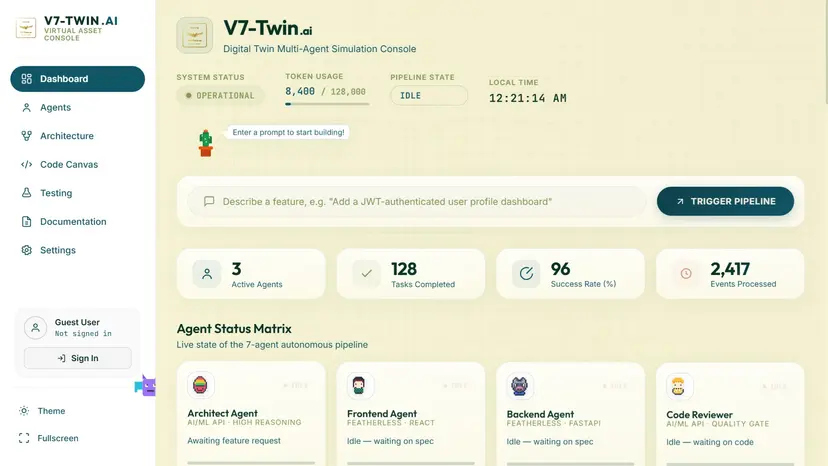
V7-Twin.ai is an autonomous Digital Twin Multi-Agent Simulation Console designed to automate the software development lifecycle. Developed for the Band of Agents Hackathon 2026, the platform functions like a high-performance V7 engine, orchestrating parallel workflows across seven specialized agents: Architect, Frontend, Backend, Reviewer, Tester, Writer, and Release Manager. The console accepts a plain-English feature request to launch its pipeline. The Architect designs the spec, while the Frontend and Backend agents generate React and FastAPI code. The standout innovation is the self-healing remediation loop: if the Code Reviewer agent finds bugs, it rejects the code and publishes remediation tickets. The developer agents automatically consume these tickets, revise their implementations, and resubmit them until quality standards are met. Once approved, the QA Tester generates pytest suites, the Tech Writer compiles markdown READMEs, and the Release Manager approves the build. All agents communicate in real time over the Band SDK Event Bus, displaying messages and logs transparently in the console. Powered by Llama 3 on AIML API for reasoning and Qwen 2.5 Coder on Featherless AI for coding, V7-Twin.ai is built using FastAPI and Neon PostgreSQL for persistent session history. For enterprise-grade security, the entire pipeline is deployed inside an Intel SGX Trusted Execution Environment using Gramine. This cryptographically seals LLM API keys and prompt logs in enclave memory, secure from server admin exploits. Combined with Supabase JWT authentication and trigger rate-limiting, V7-Twin.ai shows how future software engineering can evolve from isolated code generation into secure, coordinated, self-correcting agent teams.
19 Jun 2026

