

tejaswanth surisetty@Tejjjjj
6
Events attended
3
Submissions made
India
2+ years of experience
About me
I’m Tejaswanth Surisetty, a Computer Science undergraduate focused on AI systems, autonomous agents, cybersecurity, and intelligent infrastructure. I’m deeply interested in building adaptive multi-agent systems, enterprise AI workflows, cloud security solutions, and real-time reasoning architectures. My work includes projects involving AI-powered legal analysis, cloud identity attack detection, cognitive simulation systems, and automated security intelligence platforms using technologies like Python, FastAPI, React, TypeScript, Kubernetes, and modern LLM APIs.
🤝 Top Collaborators
.png&w=640&q=75)
.png&w=640&q=75)


🤓 Latest Submissions
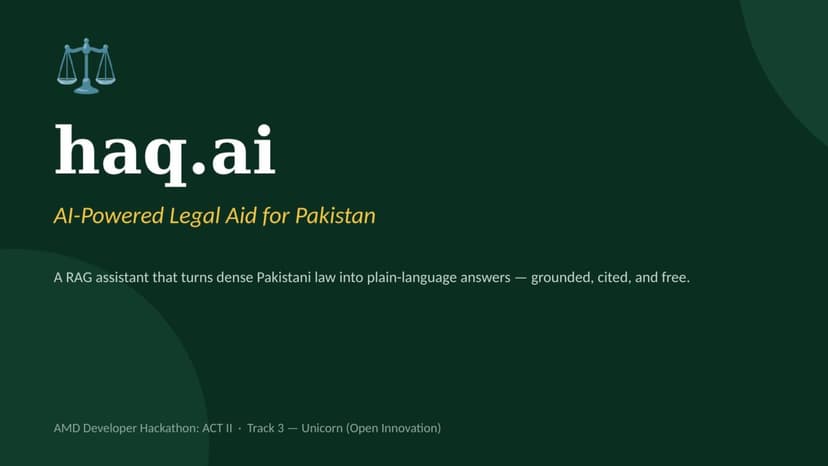
haq ai AI Legal Aid for Pakistan
haq.ai is a Retrieval-Augmented Generation (RAG) application that makes Pakistani law accessible to ordinary citizens who cannot afford a lawyer for basic legal questions. Many people don't know their rights around arrest, family law, contracts, or workplace disputes simply because the law is written in dense legal language they can't parse. The app indexes official Pakistani legal texts — including the Pakistan Penal Code, Code of Criminal Procedure, Muslim Family Laws Ordinance, Guardianship & Wards Act, and Contract Act — into a searchable knowledge base. When a citizen describes their situation in plain English or Urdu, haq.ai retrieves the exact relevant sections and explains them in simple terms, with concrete next steps and emergency contact numbers when appropriate. The system is built with a FastAPI backend and a React frontend. Documents are chunked and embedded using HuggingFace sentence embeddings, indexed in FAISS for fast semantic search. Answer generation runs through Fireworks AI, which serves open-weight models on AMD Instinct GPUs — meaning every response a user receives is generated on AMD hardware. The assistant is strictly grounded in retrieved legal text: it never fabricates section numbers, and if a topic isn't covered in its current knowledge base, it says so honestly rather than guessing — critical for a legal-information tool where wrong answers can cause real harm. Every response includes clear source citations back to the specific law and page it came from. haq.ai demonstrates how open-weight LLMs running on AMD infrastructure can be applied to real social-impact problems — expanding access to legal information for citizens who would otherwise have none.
13 Jul 2026
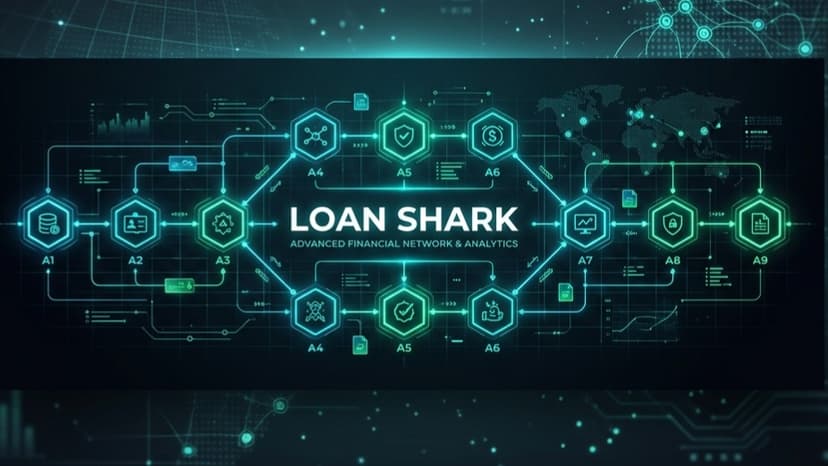
Loan Shark: Multi-Agent AI Banking Pipeline
Loan Shark is an enterprise-grade, multi-agent AI pipeline designed to automate and secure the loan processing workflow. Traditional lending pipelines are slow, fragmented, and vulnerable to compliance oversights, often taking 3 to 14 days to pass applications across credit, fraud, and legal departments. Loan Shark replaces this manual chain with a pipeline of 9 specialized, task-focused AI agents: Intake, Document, Credit, Fraud, Risk, Compliance, Decision, Pricing, and Communication. Coordinated entirely via stateless P2P messaging using the Band SDK, each agent parses the application, appends its unique analysis, and @mentions the next agent. The entire execution takes under 5 seconds. Crucially, the system enforces strict decision safety for high-stakes workflows: 1. Compliance Agent: Enforces regional guidelines (such as Indian RBI exposure limits and KYC rules) and acts as a mandatory gate that can issue overrides. 2. Immutable Audit Trail: Because agents communicate in a shared Band chat room, the persistent message history functions as a tamper-proof audit log. 3. Human-in-the-Loop Gate: The system does not dispatch decisions autonomously. Instead, a custom React officer dashboard displays the real-time pipeline status and presents a drafted sanction or regret letter for physical review and authorization.
19 Jun 2026

V.E.R.A.
Vera is an innovative hackathon project designed to solve real-world challenges through the power of modern technology, intelligent automation, and user-centric design. The project focuses on building a scalable and efficient platform that combines AI-driven functionality with a seamless digital experience. Our goal was to create a solution that is not only technically strong but also practical, impactful, and accessible to users across different domains. The platform leverages modern development frameworks, cloud-based architecture, and smart data processing techniques to deliver fast, reliable, and interactive performance. Vera was developed with a strong emphasis on usability, performance optimization, and scalability, ensuring that the application can handle future growth and feature expansion effectively. One of the key highlights of Vera is its ability to simplify complex workflows and automate repetitive tasks, helping users save time and improve productivity. The project integrates intuitive UI/UX design principles, secure backend systems, and efficient APIs to provide a smooth and engaging user experience. Throughout the hackathon, our team focused on rapid prototyping, collaborative problem-solving, and agile development practices to transform the idea into a functional working solution within a limited timeframe. Vera represents the intersection of creativity, innovation, and technology. Beyond being a hackathon submission, it demonstrates our vision for building intelligent digital solutions that can create meaningful impact in real-world applications. The project showcases our technical expertise, teamwork, adaptability, and passion for solving problems through technology.
19 May 2026


