
🤝 Top Collaborators

.png&w=640&q=75)
.png&w=640&q=75)
.png&w=640&q=75)
🤓 Latest Submissions
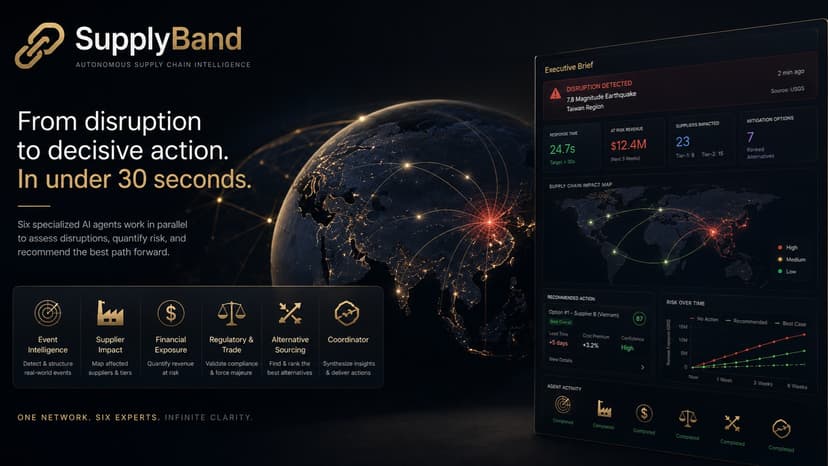
SupplyBand
A breaking news event — a port strike, earthquake, or tariff escalation — is pasted into SupplyBand. A Coordinator Agent reads the event and the company's supplier database, then recruits four specialist agents through Band to investigate independently. The Supplier Impact Agent classifies affected suppliers as Tier-1 or Tier-2 and flags critical-path components that would halt production. The Financial Exposure Agent calculates risk in dollars across three scenarios — 1 week, 3 weeks, and 6+ weeks of disruption — using inventory buffers and revenue contribution data. The Regulatory & Trade Agent checks whether the disruption triggers force majeure clauses, export controls, or insurance notification deadlines, turning the system into a regulated workflow with real legal obligations. The Alternative Sourcing Agent then reads everything posted so far and ranks the top three backup suppliers by lead time, cost premium, and regulatory risk. The Coordinator reads all four findings and produces a single executive brief: a plain-English situation summary, a severity rating, a clear AUTO_RESOLVE or ESCALATE_TO_HUMAN verdict, and the top three recommended actions with deadlines. Every agent handoff and every finding lives permanently in the Band room as an audit trail a human Supply Chain VP can review before approving. We built this because supply chain teams currently spend days manually assembling exactly this information across disconnected spreadsheets, emails, and legal reviews. SupplyBand compresses that into a transparent, live multi-agent pipeline a human can review and approve in minutes. This project is still being actively built — the agent pipeline and Band room are functional, with frontend polish and final demo scenarios in progress.
19 Jun 2026
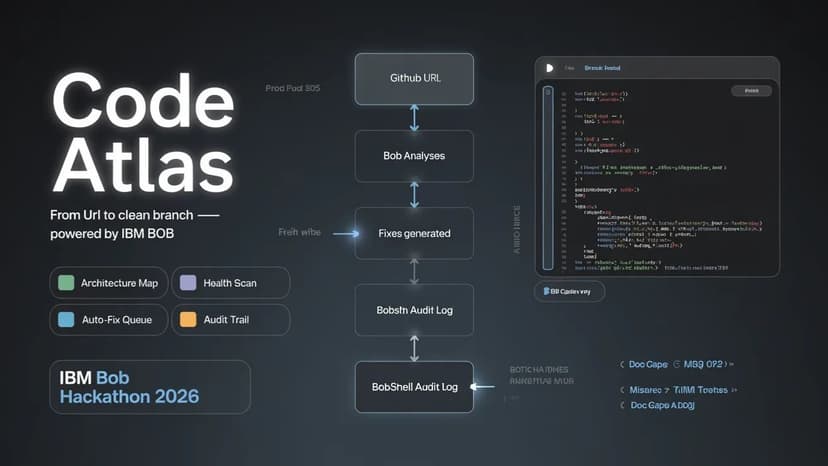
CodeAtlas
CodeAtlas — Codebase Intelligence, Instantly The Problem: Inheriting a legacy or massive codebase is a nightmare. Developers waste hours mapping architecture, hunting orphaned files, and identifying untested logic. Dumping entire repos into LLMs is slow, expensive, and hallucination-prone. Our Solution: CodeAtlas uses a smart hybrid pipeline. Blazing-fast deterministic static analysis clones and scans any repository in milliseconds — instantly mapping architecture and flagging circular dependencies, dead code, missing test coverage, and undocumented functions, while strictly respecting .gitignore rules. Built with IBM Bob: IBM Bob was our development partner throughout. We used Bob's Architect Mode to plan and scaffold the entire system before writing a single line of code. Bob's Full Repo Context helped us generate the static analysis pipeline — including AST traversal logic, circular dependency detection, and the .gitignore-aware file walker. Bob's Code and Test Generation built out our Express backend services and wrote unit tests for our parsers. Bob's Doc Generation produced inline documentation and our README. Every non-trivial service in CodeAtlas was designed, reviewed, or generated in collaboration with Bob — cutting our build time in half and keeping the architecture clean across a 4-person team. The AI Edge: Instead of blindly spamming APIs, we filter for the top 5 highest-severity issues and pass only those to a high-speed Llama model. This delivers instant, context-aware risk summaries without burning API quotas or suffering from hallucinations. Who It's For: Engineering teams, open-source maintainers, and junior developers onboarding to complex projects who need immediate, accurate visibility into technical debt.
17 May 2026

