.png&w=256&q=75)
🤓 Latest Submissions
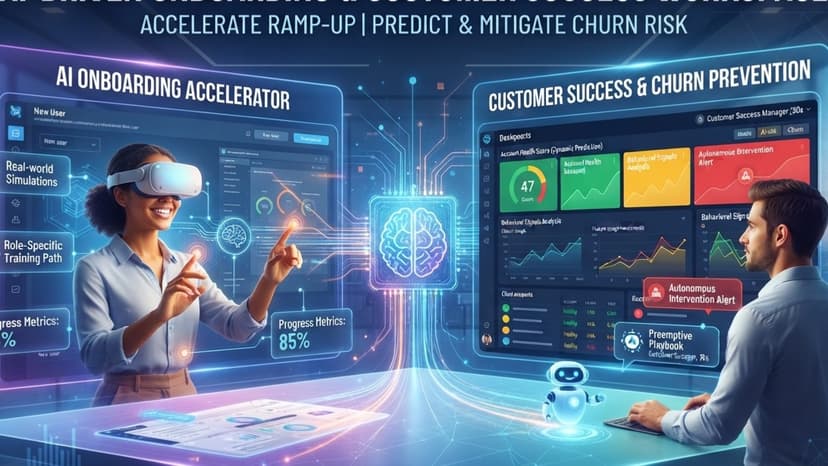
AI Driven Customer Success Onboarding Workspace
The AI-Driven Onboarding and Customer Success Workspace is a dual-purpose platform that accelerates user ramp-up through interactive, scenario-based evaluations while autonomously tracking behavioral signals to predict, score, and mitigate churn risk across all accounts. Generate Custom Exercise uses generative AI to instantly create highly targeted, interactive practice scenarios tailored to a specific professional goal and user role. Instead of using static, generic training templates, it builds dynamic learning content on demand. Key Workflows & Benefits Role Personalization: Uses the dropdown category (currently set to "Other") to anchor the scenario's difficulty, tone, and context to the user's specific skill level.Goal-Driven Content: Directly addresses specific, immediate needs entered by the user. Performance & Risk Assessment acts as a predictive analysis tool, taking raw customer or employee metrics and translating them into clear, actionable health indicators. Its main objective is to identify churn risk early so teams can intervene before a user drops off. Key Workflows & Benefits Quantitative Screening: Collects critical performance metrics—such as Engagement Accuracy (0-100%) and total Tasks Completed—to serve as an objective evaluation baseline. Early Intervention Warning: Evaluates whether current activity levels match healthy historical usage patterns, flagging dropping metrics as a high risk of churn.
12 Jul 2026
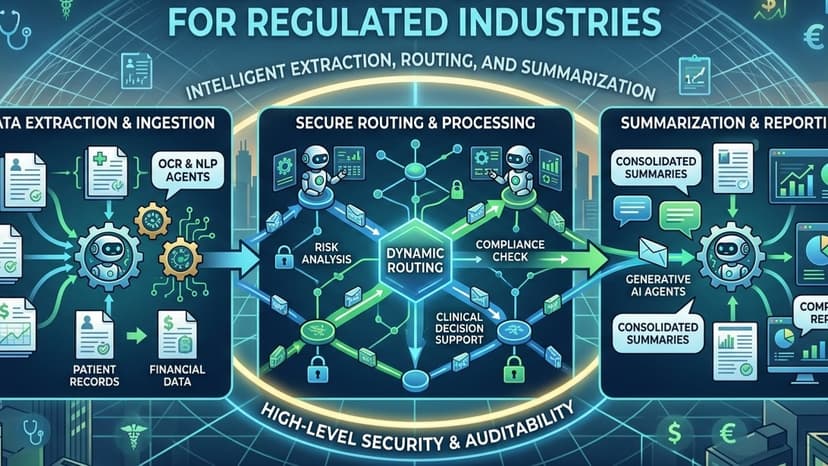
Multi-agent system to extract,route,summarize data
A multi-agent system (MAS) utilizes specialized autonomous AI agents that collaborate to extract raw information, selectively route it to the appropriate processing pipelines, and summarize it into actionable insights. This decentralized workflow prevents context bottlenecks and allows for scalable, highly parallel data handling.The architecture operates via an interconnected lifecycle to manage raw data:1. Extraction Phase: The pipeline ingests raw, unstructured or semi-structured information from documents, emails, or databases. Specialized Extraction Agents use parsing utilities to clean text, strip out irrelevant noise, and convert the raw input into standardized JSON or structured formats. Routing Phase: Instead of using basic keyword matching, the system employs a Router Agent to analyze. Summarization Phase: Once routed, domain-specific Summarizer Agents condense the targeted information. By keeping individual agents focused on narrow mandates, the system prevents irrelevant data from bloating the memory and ensures the final summary remains highly accurate and concise.
19 Jun 2026


