.png&w=256&q=75)
Saya Mubiana@Saya17
2
Events attended
2
Submissions made
Namibia
3+ years of experience
About me
I am a passionate and driven third-year Computer Science student specializing in Software Development at the Namibia University of Science and Technology, with hands-on experience in full-stack development, distributed systems, artificial intelligence, and containerized microservices. I have worked on multiple innovative projects using technologies such as Java, JavaScript, React.js, Node.js, MongoDB, Docker, Kafka, Ballerina, HTML, CSS, and machine learning tools like TensorFlow. I have participated in several competitive hackathons, achieving notable success including reaching the quarterfinals of the A2SV AI for Africa Hackathon with a rural healthcare solution called “Medical Booth,” securing second place at the Indaba X Namibia Hackathon with a machine learning-based waste management system, and winning third place in a Ballerina Hackathon for developing an Attendance Management System that was featured in The Namibian newspaper. Beyond academics, I am actively involved in software engineering projects focused on STEM education, AI-powered platforms, job-matching systems, and open-source AI agents, demonstrating strong problem-solving skills, creativity, teamwork, and a growing passion for impactful technology solutions.
🤓 Latest Submissions

Vision Crafters
The AMD Multimodal Workbench is an advanced, unified AI platform designed to showcase the immense potential of integrating state-of-the-art Vision-Language Models (VLMs) into practical, real-world applications. Built as a sleek, highly responsive web interface, the workbench provides a seamless environment where users can explore three distinct multimodal AI capabilities: industrial inspection, medical workflow analysis, and an interactive intelligent assistant. At its core, the project demonstrates how hardware acceleration—specifically leveraging AMD ROCm on powerful GPUs, alongside flexible CPU fallbacks—can dramatically enhance complex AI inference tasks. By consolidating multiple models, including CLIP for zero-shot classification, BLIP for rich image captioning, and the formidable Qwen/Qwen2 VL for deep visual reasoning, the workbench creates a versatile toolset applicable to diverse industries. The first core feature is the Industrial Quality Control module. This mode revolutionizes automated manufacturing by using zero-shot CLIP ranking. It allows users to upload images of components and define ad-hoc, custom defect vocabularies without ever needing to retrain the underlying model. It instantly evaluates the image against these terms, offering a scalable solution for immediate visual quality assurance. The second feature introduces an Educational Medical Imaging Workflow. Designed strictly for demonstrative and learning purposes using public datasets (like chest X-rays), this mode illustrates how multimodal AI can parse complex medical imagery to generate structured, synthesized analysis reports, pointing toward the future of AI as a supportive analytical tool in healthcare education. Finally, the Interactive Multimodal Assistant provides a dynamic visual Q&A experience. It intelligently routes queries based on available hardware, using BLIP and Qwen text models on standard hardware.
10 May 2026
Python Agent Marketplace
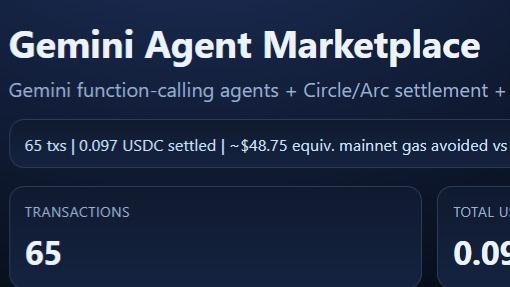
Gemini Agent Marketplace is an AI-to-AI commerce platform where a coordinator agent decomposes a user request, hires specialist agents (research and writing), and settles each completed subtask with sub-cent USDC payments. The project combines Gemini reasoning and function-calling patterns with Circle wallet settlement flows on Arc, so value transfer is built directly into agent collaboration instead of being an afterthought. The system includes policy controls (payment caps, allowlists, approval thresholds), live wallet balances, transaction feeds, and economics metrics that compare micropayment viability versus mainnet-style transfer costs. It also supports Supabase-backed persistence for transaction history and agent registry data, plus exportable audit artifacts (CSV, PDF, JSON) for judges and operators. For demos, the dashboard streams real-time events over WebSockets, supports failure-mode simulation (low balance, quota fallback), and includes multimodal invoice analysis via Gemini when quota is available. The result is a practical prototype for autonomous, economically sustainable agent workflows where machine-to-machine payments are transparent, controllable, and production-oriented.
26 Apr 2026


