.png&w=256&q=75)
🤝 Top Collaborators
.png&w=640&q=75)
🤓 Latest Submissions
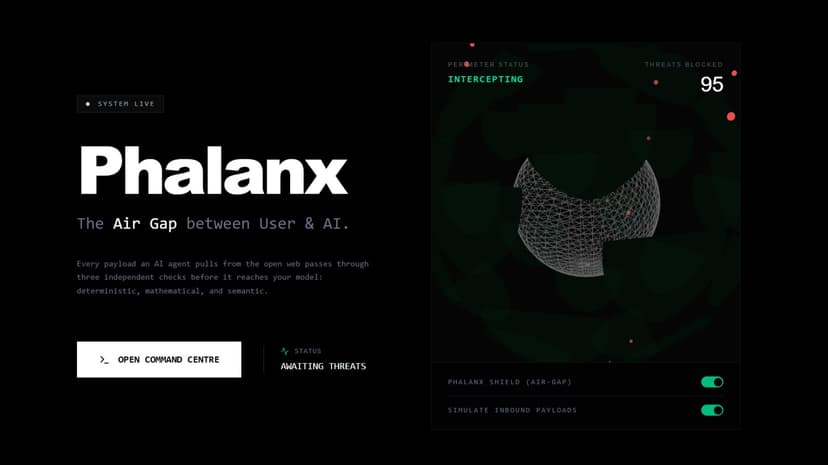
Phalanx
The Problem: Modern enterprise LLM pipelines are blindly trusting external web data, leaving them vulnerable to sophisticated prompt injections and context manipulation. Current security solutions rely on recursive LLM-based filtering, which is both latency-heavy and computationally expensive. The Solution: Phalanx AI acts as an immutable air gap. By leveraging the Band SDK, we orchestrate a decentralized swarm of specialized agents. Our pipeline follows a rigid interrogation order: Ingestion (Bright data SERP): Bypasses 403 blocks via rotating proxies. Deterministic (Regex): Filters known threats instantly. Statistical (Math): Our custom Stats Agent uses Shannon Entropy and cryptanalytic formulas to identify obfuscated/encoded payloads in sub-milliseconds without burning API tokens. Semantic (Gemini): Deep behavioral analysis intercepts logic traps. Compaction (Llama-70B): Only safe, cleared data is distilled into a compact JSON format for your core model. Extra Protection: Phalanx integrates Lobstertrap, an MIT-licensed Go-based edge inspection engine, ensuring structural integrity at the lowest level. Phalanx is model-agnostic, scalable via Google Cloud Run, and engineered to enforce deterministic security over unpredictable generative AI.
19 Jun 2026
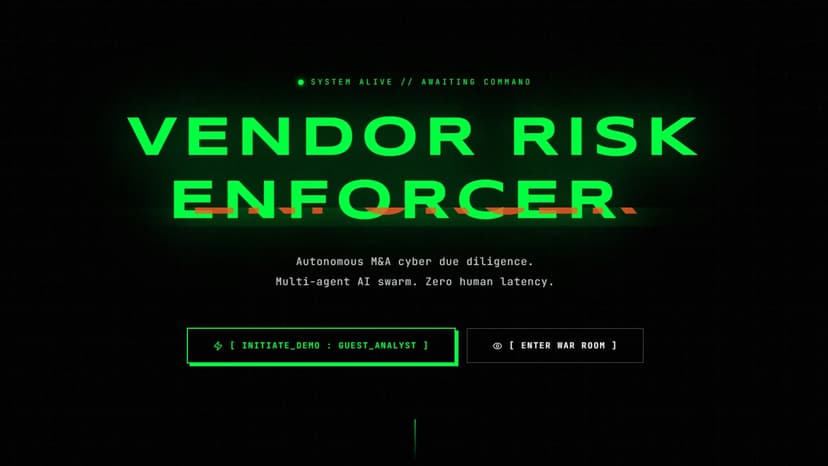
Vendor Risk Enforcer
Traditional M&A cyber due diligence is broken—it relies on slow, manual consulting that frequently misses deep supply chain vulnerabilities until after the acquisition closes. Vendor Risk Enforcer fundamentally changes this paradigm. It is an autonomous, multi-agent AI swarm designed to execute comprehensive third-party risk assessments with zero human latency. By the time a manual $75,000 consultant report is finalized, the threat landscape has shifted, leaving decision-makers exposed to unseen supply-chain risks. Powered by a high-throughput FastAPI async engine and the reasoning capabilities of Gemini 2.5 Pro, our platform deploys a strict pipeline of specialized AI agents. First, the 'OSINT Scout' utilizes Bright Data MCP to aggressively scrape global web intelligence feeds, DNS records, public GitHub repositories, and CVE databases to map the target's exact digital footprint. Next, the 'Threat Hunter' isolates critical vulnerabilities, such as exposed API keys or compromised SDKs. To ensure absolute accuracy, 'The Skeptic' agent (driven by Gemini) cross-references these findings to eliminate false positives. Finally, the 'Compliance Judge' maps the verified threats against frameworks like SOC2 and GDPR to generate a definitive confidence score and a strict Go/No-Go acquisition verdict. The entire system is wrapped in a brutalist, tactical React terminal UI that streams the multi-agent execution in real-time. Vendor Risk Enforcer doesn't just aggregate data; it acts as an autonomous cyber underwriter, transforming weeks of manual security audits into an instant, actionable Threat Ledger.
31 May 2026
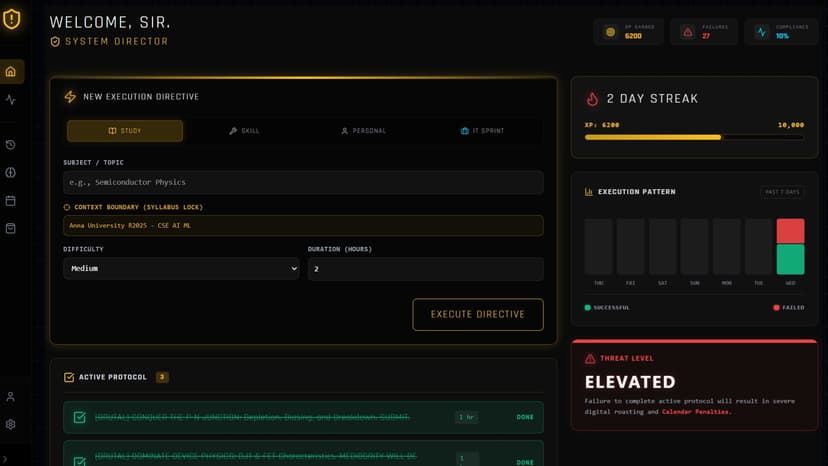
Execution Enforcer v2
The modern enterprise doesn't have a productivity problem; it has an execution gap. Traditional task managers are passive dashboards that quietly watch users fail because they rely entirely on user discipline. Execution Enforcer V2 was built to solve this through active, zero-trust agentic enforcement. Built specifically for the "AI Agents with Google AI Studio" track, this project deploys a production-ready multi-agent orchestration layer. It relies on Gemini 2.5 Pro as its core reasoning engine to actively monitor user task compliance. The architectural innovation lies in the integration of the Model Context Protocol (MCP) to automate three distinct, mutative consequences when Gemini detects a compliance failure: Time Penalties: MCP autonomously bypasses the user and physically injects penalty blocks into their Google Calendar. Immutable Logging: MCP writes a permanent record of the failure into a designated Notion workspace for compliance documentation. Social Accountability: MCP triggers the Gmail API to autonomously draft and send a failure notification to a designated accountability partner or manager. Technical Architecture: The Brain: Multi-agent routing via Google AI Studio and Gemini 2.5 Pro. The Orchestrator: MCP integration for autonomous Gmail, Notion, and Calendar API mutations. The Engine Room: A stateless Python FastAPI backend containerized on Google Cloud Run. The Perimeter: A React frontend hosted on a Firebase Global CDN, secured by Google OAuth 2.0 authentication. The Memory: A real-time NoSQL Firestore database tracking live user states and historical compliance metrics. Execution Enforcer demonstrates a true production-ready agent workflow: moving beyond conversational AI to deliver mutative, real-world accountability enforcement.
19 May 2026


