

🤝 Top Collaborators
.png&w=640&q=75)
.png&w=640&q=75)
🤓 Latest Submissions
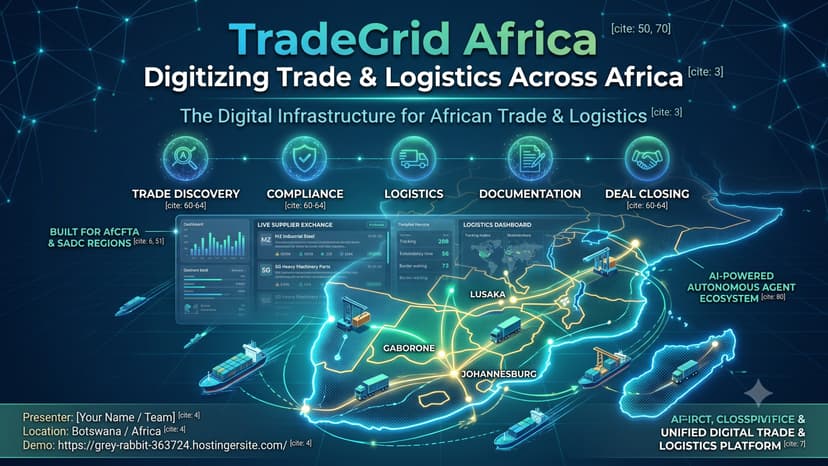
Trade Grid Africa
The TradeGri Africa Application represents a cutting-edge digital platform specifically designed to enhance and modernize trade, logistics, and supply chain operations across the African continent. This innovative application serves as a centralized hub, empowering users to efficiently manage their trade activities, meticulously track operational processes, and seamlessly coordinate logistics. By significantly minimizing manual interventions, the platform not only enhances operational efficiency but also fosters greater transparency throughout the entire trade lifecycle. Tailored for a diverse range of stakeholders—including businesses, traders, and logistics operators—the TradeGri Africa Application aims to optimize workflows, improve visibility, and ultimately drive success in the ever-evolving marketplace. With its user-friendly interface and powerful functionality, the application enables users to respond swiftly to market demands, streamline communication, and make informed decisions based on real-time data. By embracing digital transformation, TradeGri is setting a new standard for trade operations across Africa, ultimately contributing to economic growth and enhanced trade relations within the region.
13 Jul 2026
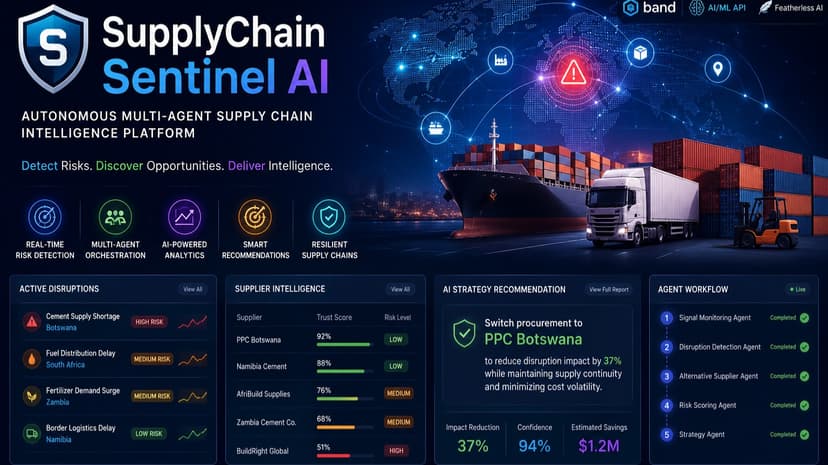
Supply Chain-sentinel
SupplyChain Sentinel AI Autonomous Multi-Agent Supply Chain Intelligence Platform SupplyChain Sentinel AI is an advanced platform designed to help organizations manage supply chain disruptions, supplier risks, and sourcing decisions. Utilizing specialized AI agents, predictive models, and strategic reasoning, it creates a real-time digital operations center for monitoring and responding to market disruptions. Unlike traditional supply chain management, which relies on manual analysis and reactive decision-making, SupplyChain Sentinel AI enables proactive management through a coordinated ecosystem of AI agents. Key agents include: - Signal Monitoring Agent: Analyzes supply chain events and market indicators to identify risks and opportunities. - Disruption Detection Agent: Assesses the severity and operational impact of disruptions. - Alternative Supplier Agent: Searches for viable sourcing alternatives based on compatibility, capacity, and constraints. - Risk Scoring Agent: Generates risk scores and reliability assessments using AI/ML models. - Strategy Agent: Synthesizes intelligence to create actionable recommendations such as supplier substitutions or logistics adjustments. Band orchestrates communication and coordination among the agents, allowing collective intelligence to drive decision-making. The platform features a real-time dashboard for monitoring disruptions, supplier intelligence, risk analytics, and agent activities, helping organizations transition from reactive to proactive, intelligence-driven operations. Applicable across various sectors like manufacturing, logistics, healthcare, and government, SupplyChain Sentinel AI provides a scalable foundation for autonomous operational intelligence.
19 Jun 2026
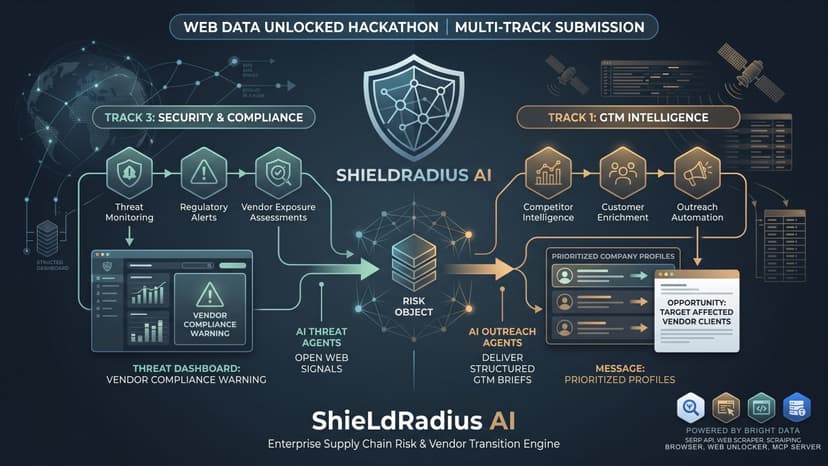
ShieldRadius AI
ShieldRadius AI is a multi-agent platform that autonomously monitors the open web for vendor security breaches and compliance issues. Upon detection, it assesses the enterprise's risk, identifies affected customer accounts, and triggers automated Go-To-Market (GTM) outreach workflows. Developed with Node.js, TypeScript, and Supabase (PostgreSQL), the system is designed for serverless execution and operates as an asynchronous, event-driven state machine to manage tasks efficiently. The core functionality consists of four agents: - Threat Intelligence Agent: Monitors web for new threat indicators and regulations. - Risk Assessment Agent: Evaluates intelligence against compliance standards like GDPR and SOC2, assigning a risk score from 0–100. - GTM Enrichment Agent: Gathers firmographic data through asynchronous web scraping. - Outreach Engine Agent: Compiles client profiles and generates personalized email notifications. Relying on third-party integrations like Bright Data and DeepSeek for bypassing anti-bot protections, the platform features an interactive State-Machine Dashboard. This includes a “Layman Mode” for non-technical users, presenting data in an accessible format with visual risk indicators and structured tables, while allowing developers to access raw JSON for debugging.
31 May 2026
Omni Mind
OmniMind: The Next-Generation Full-Stack Data Intelligence Mind OmniMind is a high-performance "data mind" application meticulously engineered by carolinesedurica-ux. Designed to serve as a hybrid internal AI assistant and sophisticated data visualization dashboard, this platform transforms the foundational google-gemini/aistudio-repository-template into a production-ready enterprise solution. Built with a strict TypeScript architecture for maximum type safety and reliability, OmniMind is currently live and optimized at omni-mind-delta.vercel.app. OmniMind moves far beyond simple prompting by deeply integrating Gemini models with a professional-grade Firebase infrastructure. It utilizes a secure backend featuring custom Firestore rules, robust user authentication, and structured application blueprints to ensure that data integrity and security remain paramount in an AI-driven environment.
19 May 2026
Vantage Point
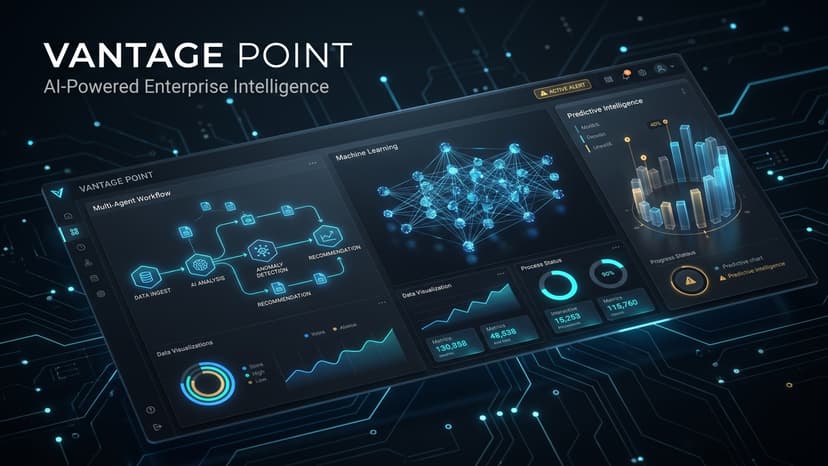
In an automated enterprise environment run by autonomous AI agents, opacity is the ultimate vulnerability. When multiple asynchronous agents execute tasks across cross-department systems—such as shifting a marketing budget, evaluating an HR compliance claim, or rebalancing a corporate treasury—traditional monitoring tools fail to capture the underlying cognitive chain of custody. Vantage Point is the high-fidelity, real-time observability engine and telemetry command center built explicitly for the ActionPilot multi-agent architecture. It translates complex, multi-step agentic workflows into a structured, auditable, and highly visual operational dashboard. By running entirely on specialized cloud compute infrastructure and leveraging open-source intelligence layers, Vantage Point gives enterprise stakeholders an uncompromised bird's-eye view of autonomous decision-making pipelines.
19 May 2026

Forge Sight Quality Control
ForgeSight is a multimodal quality control copilot specifically designed for manufacturing environments. It automates the defect detection and reporting process through a unique four-agent pipeline that includes an Inspector, Diagnostician, Action, and Reporter. These agents collaborate to inspect assembly line images, diagnose the root causes of defects, draft work orders, and publish fully auditable reports. Developed for the AMD Developer Hackathon, the system utilizes a fine-tuned Qwen2-VL vision model hosted on an AMD Instinct MI300X node, employing ROCm and vLLM. By leveraging the impressive 192 GB of memory available on a single MI300X GPU, the 72-billion parameter model operates efficiently without the need for sharding. This capability allows it to deliver real-time inference on the factory floor and provide verdicts in just 20 seconds.
10 May 2026
AURELIUS_CORE_v1.0
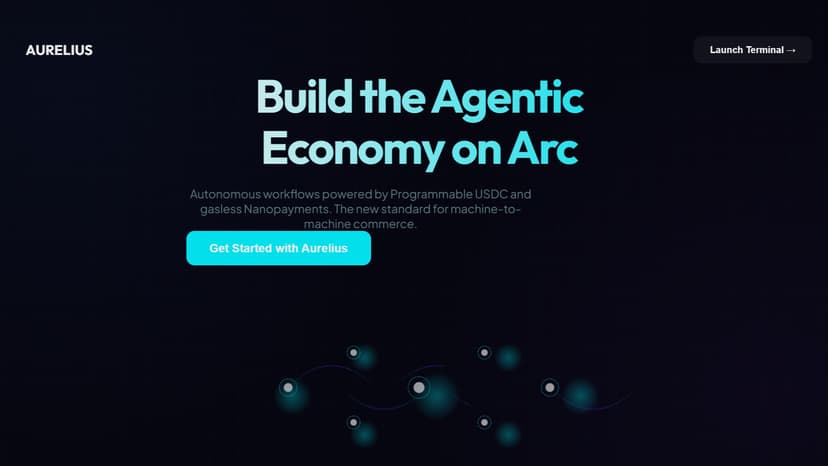
Aurelius is a specialized platform designed to facilitate an autonomous agent economy by utilizing programmable USDC and gasless nanopayments. The system enables machine-to-machine commerce through several tracks, including per-API monetization, real-time agent loops, and usage-based billing. By integrating with Arc, the technology allows for micro-transactions as low as a fraction of a cent, which are typically impossible on traditional networks due to high fees. This infrastructure supports high-frequency AI tasks with a model that ensures positive unit economics and immediate settlement. Ultimately, the source outlines a shift toward micro-commerce where digital entities can exchange value seamlessly without manual oversight.
26 Apr 2026


