
Pankaj Panwar@PankajP
3
Events attended
3
Submissions made
India
8+ years of experience
About me
IIM & NIT alumnus | Reforge & Stanford-trained | Senior Product Manager with 8+ years of experience building AI-driven decision systems and growth platforms across fintech and marketplace businesses. Proven track record of owning end-to-end user journeys (acquisition → activation → transaction) and improving conversion, reducing friction, and scaling operations through data-driven product decisions.
🤓 Latest Submissions
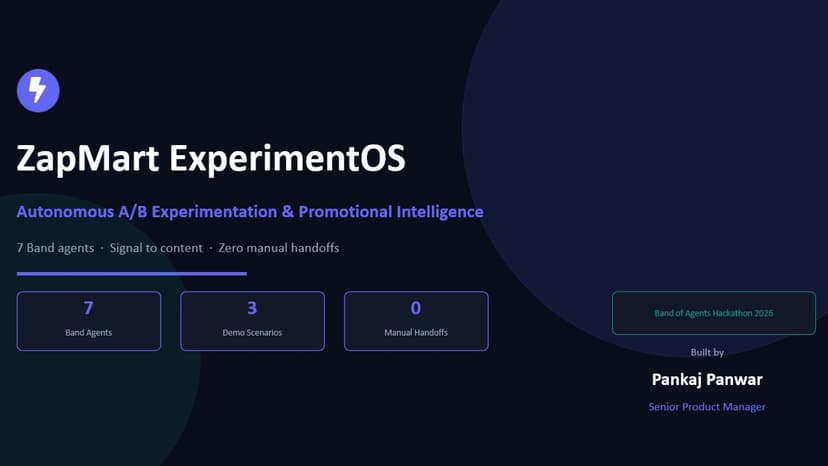
ZapMart ExperimentOS
ZapMart ExperimentOS closes the loop no q-commerce platform has closed — from real-time behavioral signal to promotional content, fully autonomous, zero manual handoffs. Today, Blinkit and Zepto run A/B experiments manually. Swiggy's XP platform automates metric computation but hypothesis generation, decisions, and content briefing remain human work. ExperimentOS automates all of it. Seven Band agents coordinate through a shared context layer: Signal Agent detects conversion drops, cart abandonment spikes, and reorder gaps exceeding confidence thresholds. Hypothesis Agent selects interventions using historical win rates and generates structured hypotheses via Gemini AI. Experiment Design Agent produces CUPED-adjusted sample sizes, variant designs, traffic allocation, and early stopping rules. Integrity Agent monitors for SRM via chi-square detection, enforces novelty windows, and auto-pauses invalid experiments. Results Agent computes statistical significance, effect sizes, confidence intervals, and plain-language readouts. Decision Agent makes go/no-go recommendations with graduated rollout plans and publishes learning signals. Promotional Content Agent generates push copy, homepage banners, and cart banners from winning results — no human brief needed. Band is the nervous system. Agents publish structured context and subscribe to what they need. The Integrity Agent can pause mid-flight and every downstream agent responds immediately. Full reasoning trace visible in real time. Three demo scenarios: dairy conversion drop, cart abandonment with SRM detection and human resume, reorder gap with two-arm results. Built solo in 7 days. Inspired by running 40 experiments/month manually at Snapdeal — and what that workflow looks like when agents replace every manual step.
19 Jun 2026
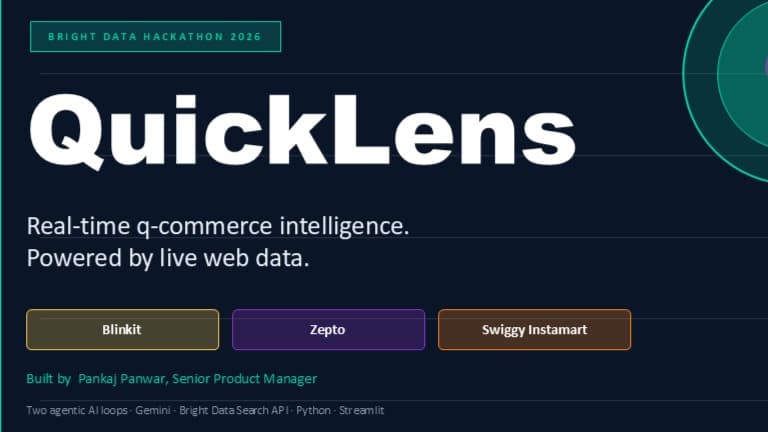
QuickLens
QuickLens is a real-time q-commerce intelligence system built on two autonomous agentic AI loops — one reactive, one proactive — powered by Bright Data's live web data infrastructure. THE PROBLEM Q-commerce prices on Blinkit, Zepto and Swiggy change multiple times a day. Consumers overpay without knowing it. Brands have zero visibility into competitor moves in real time. THE SOLUTION Consumer Loop (reactive): User asks "cheapest 1L Amul Milk in Indiranagar." The agent plans which platforms to query, calls Bright Data's Search API in one batch call across all 3 platforms, observes results, handles failures, and returns a ranked price comparison with delivery times and savings — in under 25 seconds. Brand Loop (proactive): Runs every 5 minutes without being asked. Monitors competitor SKUs, detects price drops and OOS events, reasons about signal significance, and fires natural language alerts with action recommendations — e.g. "Zepto OOS on Tata Salt 500g — boost Blinkit ad spend for next 2 hours." HOW BRIGHT DATA POWERS IT Direct scraping of q-commerce platforms is blocked by bot detection and JS rendering. Bright Data's search_engine_batch is the only viable path — querying all 3 platforms simultaneously in one call. scrape_batch fires as secondary enrichment when SERP snippets lack prices. Bright Data is the foundation, not an add-on. ARCHITECTURE Both loops share a Bright Data tool layer and Gemini 2.5 Flash Lite as reasoning engine. Shared state.json persists price history, watchlist, and alert log. APScheduler runs the brand loop as a background daemon so Streamlit stays responsive. TECH STACK Python · Gemini 2.5 Flash Lite · Bright Data MCP · Streamlit · APScheduler · Pydantic
31 May 2026
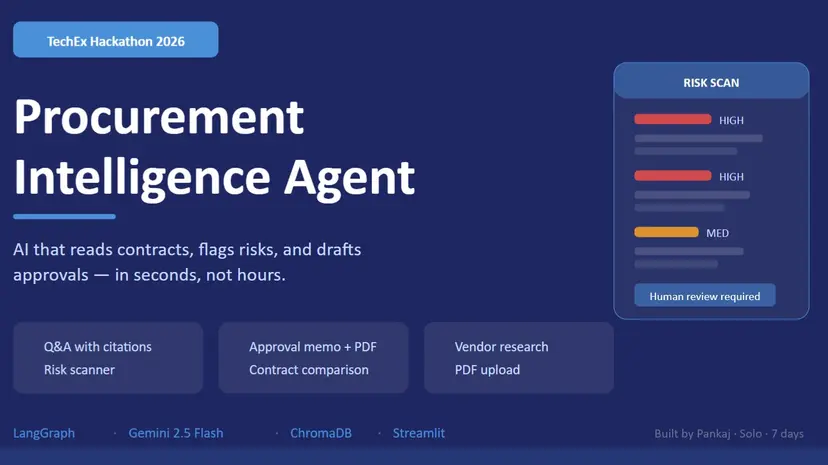
Procurement Intelligence Agent
Procurement Intelligence Agent is an AI-powered contract analysis system built for enterprise procurement teams. It reads any vendor contract PDF, answers specific questions with page-level citations, flags compliance risks across 10 categories, drafts structured approval memos, and researches vendors in real time — all in under 60 seconds. The Problem: Enterprise procurement teams spend 4–6 hours manually reviewing each vendor contract. Risk clauses get missed — auto-renewal traps, IP ownership grabs, inadequate liability caps — and every approval memo is written from scratch. A single overlooked clause can cost the business significantly. Key Features: 1.Conversational Q&A with page-level citations — every answer is grounded in the document 2.AI risk scanner across 10 categories using Gemini response_schema for structured output 3.Approval memo generation with one-click PDF download 4.Multi-contract comparison — side-by-side Q&A or risk scan across 2–4 contracts 5.Live vendor research via Gemini Google Search grounding 6.PDF upload with live ingestion — any contract indexed in under 30 seconds Tech Stack: LangGraph for agent orchestration, Gemini 2.5 Flash for reasoning and structured output, ChromaDB for vector storage, Streamlit for UI, reportlab for PDF export. Gemini Integration: Gemini 2.5 Flash powers all agent reasoning, structured risk output via response_schema, and live vendor web search grounding via the native Google Search tool. Built for TechEx Intelligent Enterprise Solutions Hackathon 2026 on lablab.ai — solo, in 7 days, while working full time.
19 May 2026


