

🤓 Latest Submissions

DUAL-BROKER SOTA ENGINE
Dual-Broker SOTA Engine is an automated trading system capturing real-time arbitrage between TradFi and Web3 prediction markets (Polymarket). The project proves that combining robust web scraping with low-latency LLM intelligence creates a secure, enterprise-grade engine. **Bright Data: Bypassing the Web's Toughest Blocks** Arbitrage demands real-time data from highly protected platforms like Yahoo Finance and Polymarket, where stale data leads to losses. The engine implements a resilient 3-tier extraction fallback powered by Bright Data: - **Bright Data Scraping Browser (CDP):** Renders JS-heavy, dynamic order books and scrapes depth snapshots via Puppeteer. - **Web Unlocker:** Bypasses advanced browser fingerprinting and CAPTCHAs on news feeds to guarantee a 99.9% extraction success rate. - **Residential Proxies:** Rotates IPs across a massive pool, ensuring high-frequency scraping runs continuously without rate-limiting or bans. Standardized via a Bright Data MCP Server, this stack transforms the open web into a structured enterprise data feed. **AI/ML API: High-Concurrency, Cost-Effective Swarm Intelligence** Running financial forecasts in real-time requires a consensus mechanism that is fast and affordable. The engine deploys a 50-persona Bayesian Swarm Consensus powered by the AI/ML API: - **Ultra-Low Latency:** AI/ML API orchestrates up to 50 parallel LLM persona requests simultaneously, converging the decision matrix in under 5 seconds. - **Economic Viability:** Leveraging top-tier models (DeepSeek-V4-Pro) via the gateway keeps token costs at a fraction of a cent. - **Real-Time P&L Safeguards:** The dashboard integrates with AI/ML API's billing API to track consumption and prove positive net profitability. With Apache Flink streaming and a Saga-based transaction sandbox for atomic execution, the engine proves that web data unlocked by Bright Data and reasoned by AI/ML API is ready for enterprise production.
31 May 2026
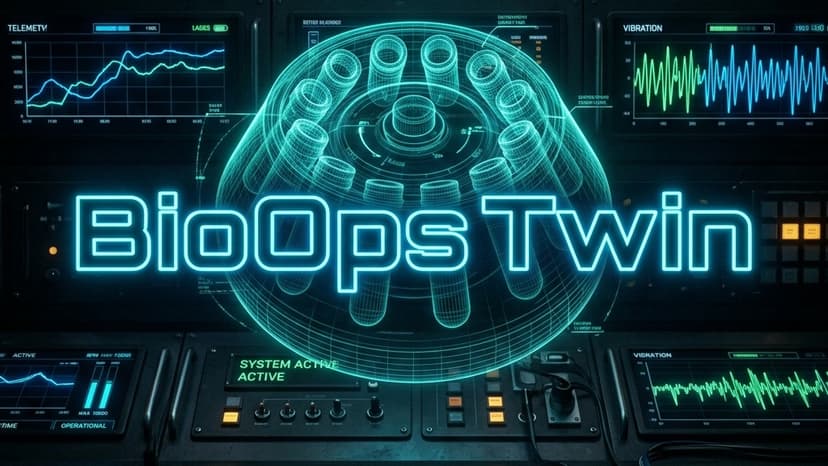
BioOps Twin
BioOps Twin is an enterprise-grade digital twin for laboratory centrifuge calibration, built for the Transforming Enterprise Through AI Hackathon. It addresses a critical gap in biochemical laboratories: centrifuge calibration is manual, error-prone, undocumented, and reactive — leading to damaged specimens, regulatory non-compliance, and costly downtime. Our solution combines Google Gemini 3.1 Pro as a cognitive engine with a real-time physics simulation to create an AI copilot that operators interact with through natural language. The system reads calibration manuals via a hybrid RAG pipeline (ChromaDB dense vectors + BM25 sparse search with Reciprocal Rank Fusion), simulates centrifuge physics (RPM → vibration → RCF), and recommends safe parameters — all autonomously. Key capabilities: • AI Calibration Agent: Gemini 3.1 Pro with structured function calling controls the centrifuge through validated commands. Shadow Mode ensures human-in-the-loop governance for regulatory environments. • Physics Engine: Analytical simulation with finite state machine (IDLE → RUNNING → ERROR → EMERGENCY_STOP), resonance detection, and Z-Score anomaly alerting. • Enterprise Security: All LLM traffic routes through Veea Lobster Trap proxy for deep prompt inspection, PII/PHI sanitization, and adversarial prompt detection. Immutable JSONL audit trail meets FDA 21 CFR Part 11 and EU GMP Annex 11 requirements. • Industrial IoT: MQTT telemetry publishing enables integration with SCADA/HMI systems. Statistical anomaly detection triggers predictive maintenance alerts before equipment failure. • Interactive 3D Digital Twin: Operators can upload custom .glb models via drag-and-drop to visualize their specific equipment in real time. BioOps Twin transforms calibration from a reactive, undocumented process into a proactive, AI-assisted, fully auditable workflow.
19 May 2026
OncoAgent: High-Precision Medical System
OncoAgent is an open-source, multi-agent AI system designed for clinical oncology triage. It safely cross-references complex patient histories against official medical guidelines. Here is a concise breakdown of its core architecture: 1. Hardware-Optimized Foundation Built exclusively for AMD Instinct MI300X accelerators (ROCm), it leverages vLLM to power a dual-tier setup of Qwen models (9B/27B), ensuring high-throughput, low-latency clinical inference. 2. Multi-Agent Orchestration (LangGraph) A stateful workflow replaces monolithic prompting. A Router Agent sanitizes input (stripping private data via a Zero-PHI policy), a Specialist Agent analyzes the case, and a Critic Agent runs a Reflexion loop to verify the medical accuracy of the output before it reaches the user. 3. Advanced Medical RAG The engine ingests NCCN and ESMO oncology guidelines using Adaptive Semantic Chunking (splitting by medical headers, not arbitrary characters). It uses local vector databases (ChromaDB/FAISS) and exposes retrieval confidence metrics directly in the UI for full transparency. 4. Strict Safety Policies To prevent dangerous AI behavior, OncoAgent enforces a strict Anti-Hallucination Policy. If a treatment isn't explicitly found in the retrieved guidelines, the system must state: "Information inconclusive in the provided guidelines." 5. Deployment & UI Modular and fully Dockerized for seamless deployment (e.g., Hugging Face Spaces), it features a professional Gradio UI that focuses on clinical usability, fast response times, and clear, structured results.
10 May 2026

JaaS — Jurisprudence-as-a-Service
JaaS (Jurisprudence-as-a-Service) is an autonomous legal intelligence engine that transforms how jurisprudential knowledge is consumed, computed, and monetized—entirely machine-to-machine. THE PROBLEM: Traditional legal research is slow, expensive, and locked behind rigid SaaS subscriptions that cannot serve the emerging agentic economy. When AI agents need specialized legal knowledge on demand, they face two barriers: (1) no programmatic access to curated jurisprudence, and (2) gas costs on Ethereum L1 ($2.00+) that make micro-transactions economically impossible. THE SOLUTION: JaaS deploys a multi-agent orchestration architecture where Gemini 3 Pro acts as the reasoning engine, routing complex queries through specialized extraction models (Featherless Qwen2.5-3B) via the x402 HTTP Payment Protocol. Every query is settled in USDC on the Arc blockchain for fractions of a cent, enabling a true pay-per-compute model with zero subscriptions and zero counterparty risk. TECHNICAL ARCHITECTURE: - Orchestrator Agent (Gemini 3 Pro): Parses legal queries, establishes reasoning paths, and synthesizes final jurisprudential reports. - Extractor Agent (Featherless Qwen2.5-3B): Performs low-level doctrine extraction and citation mapping via isolated API calls. - Payment Layer (Circle DCW + x402 + Arc): Every agent computation triggers an HTTP 402 nanopayment, settled on-chain via Circle Developer-Controlled Wallets on the Arc Testnet. UNIT ECONOMICS (Validated): - Revenue per query: $0.01 USDC - AI inference cost: $0.0020 USDC - Arc network gas: $0.00002 USDC - Gross margin: 79.8% - On Ethereum L1, the same operation yields -5,000% margin. STRESS TEST: We executed 50+ sequential on-chain legal queries with a 100% success rate, zero failures, and sub-second USDC settlement on every transaction—proving Arc's viability for high-frequency agentic workloads.
26 Apr 2026


