.png&w=256&q=75)
🤓 Latest Submissions
OfficeOps
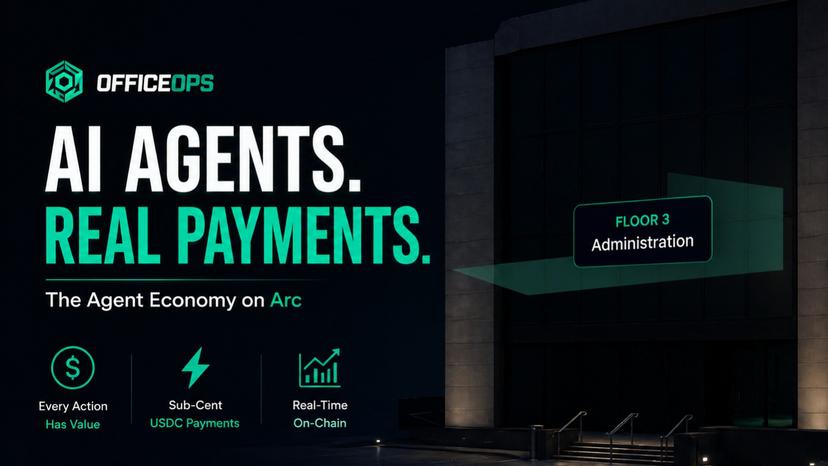
OfficeOps is a real-time multi-agent system where AI agents operate like a company. Agents are organized into departments such as executive, marketing, engineering, and operations. Each agent has a role and works together to complete a goal provided by the user. When a user inputs a task such as launching a marketing campaign, the system breaks it into smaller steps. Different agents handle research, writing, design, execution, and verification. Each step is treated as a unit of work. What makes OfficeOps unique is that every action is tied to a real payment. Each task triggers a sub-cent USDC transaction that settles on Arc. This creates a continuous flow of value between agents. Instead of a simple API call, every action has a cost and a record. The system shows a live view of agents working inside a virtual office. Agents move across different floors such as executive, marketing, and engineering. As they complete tasks, payments are triggered and logged in real time. OfficeOps demonstrates a new way to think about AI systems. Agents are not just tools. They are economic actors that can earn, spend, and coordinate through payments. This enables high-frequency interactions that would not be possible with traditional systems due to cost and latency. The result is a fully transparent workflow where users receive both the final output and a complete history of every action and payment that produced it. OfficeOps shows how AI and on-chain payments can combine to create a real agent economy.
26 Apr 2026
.png&w=828&q=75)
Hair robot for natrual 4c hair
PalmTwist AI-Controlled Robotic Loc Retwist Digital Twin PalmTwist is a real-time robotic digital twin that simulates precision cosmetic manipulation — specifically the palm-twisting of natural locs — using a 6-axis articulated robotic arm and a real-time inverse kinematics control system. This project demonstrates how robotics, simulation, and intelligent control systems can be applied to delicate, high-precision personal care tasks. Core Concept PalmTwist models a Perception–Planning–Control loop inside a browser-based 3D simulation: Perception The system detects loc root targets using spatial raycasting within the digital twin environment. Planning A real-time analytic inverse kinematics (IK) solver calculates optimal joint angles for a 6-DOF articulated robotic arm to reach the selected loc root. Control A smoothed trajectory controller moves the robot autonomously into position, applying controlled torque and tension to simulate palm twisting. 🤖 Robotic System Robot Type: 6-Axis Articulated Arm Motion Solver: Real-Time Analytic IK + Trajectory Smoothing End Effector: Compliant Two-Finger Precision Gripper Control Loop: 60 Hz Closed-Loop Controller Telemetry: Joint angles, torque, end-effector speed, contact force
15 Feb 2026
AI adventure maker
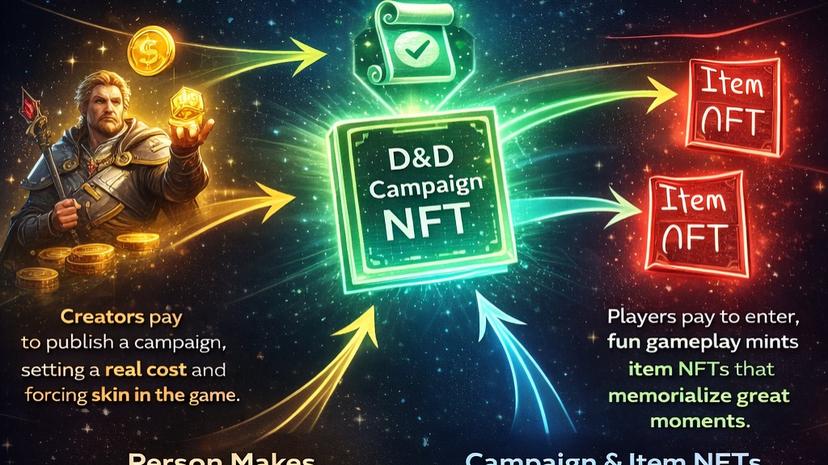
Creators don’t just publish campaigns, they invest in them. To launch a game campaign, creators pay a real, on-chain publishing cost, ensuring true skin in the game and filtering for creators who believe in what they’re building. This cost aligns incentives from day one and prevents low-effort or disposable content. Once live, players pay to enter campaigns they find compelling. As gameplay unfolds, the system automatically mints NFTs in real time, capturing meaningful moments, rare items, victories, decisions, and story-defining events as unique on-chain assets. Every playthrough becomes a source of collectible value, not just ephemeral entertainment. Payments flow entirely on-chain and are routed programmatically between campaign creators, contributors, and the protocol. Campaigns that are genuinely fun, replayable, and memorable naturally earn more, not through hype, but through actual play. The best-designed experiences rise to the top simply because players keep coming back. In this system, creativity is rewarded by engagement, not speculation. Great games generate assets, assets generate value, and value flows transparently to the people who built the experience. Play becomes proof, and fun becomes the ultimate economic signal.
24 Jan 2026


