
Patrick Steve Harrison Vasantharaj@Invictus
5
Events attended
3
Submissions made
Singapore
4+ years of experience
About me
I live at the boundary where hardware meets intelligence and I wouldn't have it any other way. I'm Patrick, an engineer who has spent years pushing silicon to its limits, from writing firmware that talks directly to metal, to deploying computer vision pipelines on embedded systems, to architecting distributed backends that scale without flinching. At NUS, my research has taken me deep into the mechanics of how machines perceive, reason, and act — working across compressible flow data acquisition, graph-based retrieval systems, and high-frequency sensor pipelines. I don't just consume cutting-edge research — I build on top of it. As Head of RHDevs, I led a team of engineers building real systems under real constraints — shipping code, iterating fast, and learning the hard way that good architecture is the difference between a prototype and a product. I'm fluent in Python, C++, Node.js, React, TensorFlow, and ROS. I understand the full stack — from register-level firmware to cloud-deployed ML models. And when it comes to GPU-accelerated computing, parallel workloads, and the kind of performance optimization that AMD lives and breathes — I'm not just interested. I'm ready.
🤝 Top Collaborators
.png&w=640&q=75)
🤓 Latest Submissions
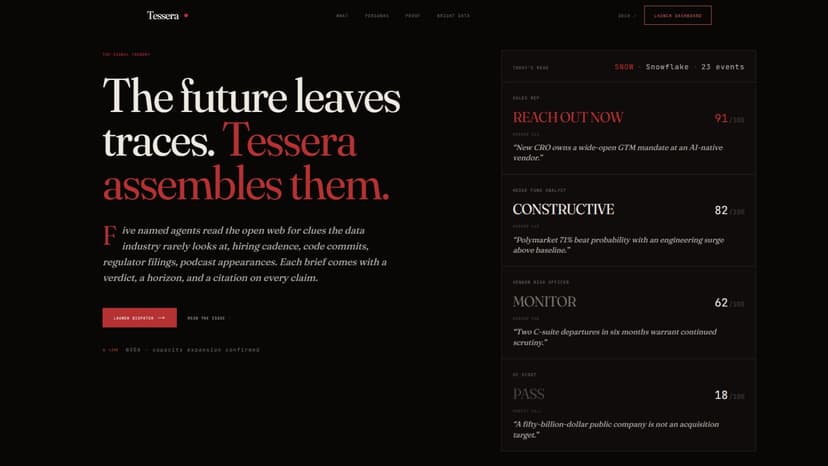
Tessera - The Signal Foundry for Open Web
The intent-data industry sells $4.5B of signals every year, and only 26% convert — everyone buys from the same wholesalers and sees the same hot lead on the same Tuesday. Tessera flips it: stop buying signals, start building them from the long tail of the open web. Tessera scours eleven sources today and growing — SEC EDGAR, GitHub commit cadence, Wayback pricing-page diffs, podcast transcripts, Polymarket odds, regulator portals, career pages, Blind threads. Five cooperating agents (Collector, Normalizer, Investigator, Writer, Resolver) turn raw observations into time-stamped, citation-grounded events, then compose the brief. The differentiator: same data, any buyer. Pick a persona at the top — sales rep, hedge fund analyst, vendor risk officer — and Tessera re-ranks twenty public companies and rewrites the brief for that lens. Describe a new persona in one sentence and Tessera builds a Tessera-grade prompt around it on the fly. One Snowflake stack of twenty-three events reads as REACH OUT NOW · 91 for the sales rep, CONSTRUCTIVE · 82 for the hedge fund analyst, MONITOR · 62 for vendor risk, PASS · 18 for the VC scout. Same engine. Four decisions. Every brief carries a verdict (label, score, horizon, one-liner) and an executable agent task ready for human approval. Every claim cites the page it came from. Built on Bright Data's full stack: Web Unlocker for protected pages, SERP API for podcast discovery, Scraping Browser for JavaScript-rendered regulators, Web Scraper API as the routing layer, MCP Server as the agent harness — five products, each mapped to a specific job. Tessera doesn't predict the future yet. But it ships the cleanest open-web event substrate anyone has built to predict from.
31 May 2026
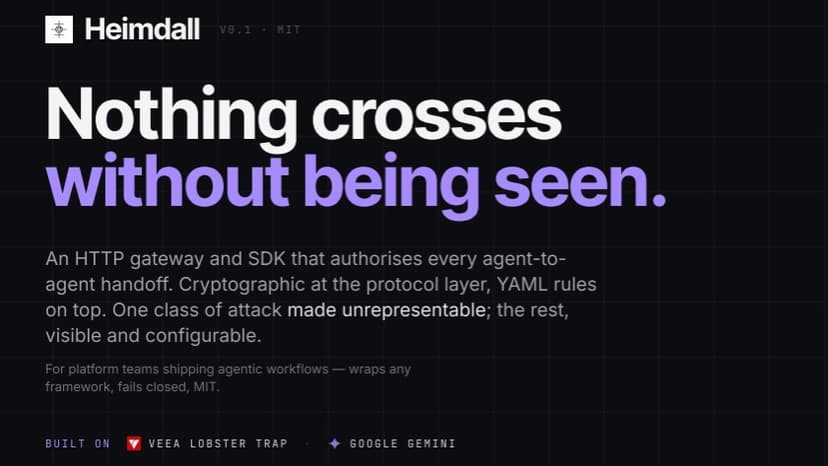
Heimdall
Heimdall is a runtime governance layer for AI agent delegation chains — the air-traffic-control gap that opened up when agent stacks started ending with one agent calling another to finish a task. The architecture is two layers, deliberately separate. Layer 1 is cryptographic capability attenuation: a child credential's scope must be a subset of its parent's, enforced by the JWT signing function itself. A compromised agent cannot forge a permission it was never granted — the credential simply does not exist. There is no rule to bypass. Layer 2 is a YAML policy engine with six primitives: chain_pattern, chain_depth, value_threshold, agent_state, intent_mismatch, and behavioral_drift. Hot-reloadable, mappable to HIPAA / SOC 2 / EU AI Act sections via the shipped compliance packs. The integration surface is one HTTP call before every agent-to-agent hop: POST /api/v1/delegate. The SDK is five methods (pip install heimdall-sdk or npm i @heimdall/sdk). Self-host via docker compose up. Built on Veea Lobster Trap — Lobster Trap inspects what an agent says to its model; Heimdall inspects what agents say to each other. Two boundaries, no overlap. The Step Finance class of attack (Jan 2026, 261K SOL moved by compromised AI trading agents) crosses both. Ships with three verticals: DeFi (end-to-end, real Sepolia wallet), Healthcare (HIPAA pack, mock EHR), and Customer Service (SOC 2 pack, policy-only). Use Gemini to generate instant incident reports too. MIT licensed. One builder, seven days.
19 May 2026
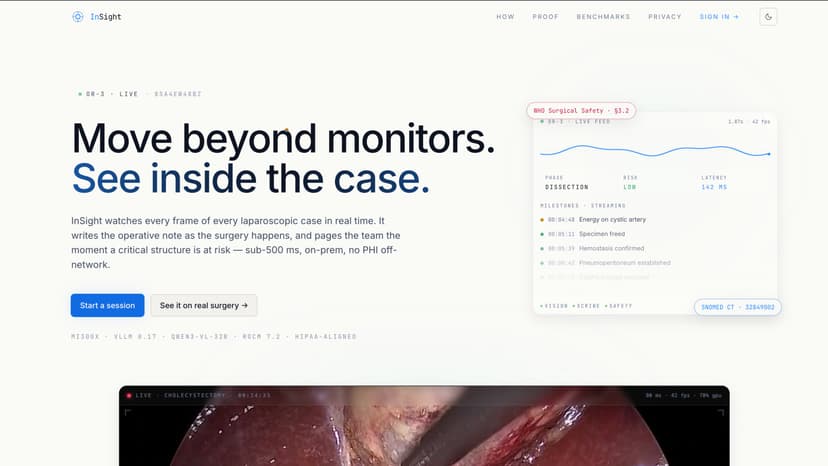
Insight - Real Time Copilot for the OR
Surgeons spend hours after every case dictating operative notes from memory — a tax on the highest-paid clinical hours in medicine, and a process that produces incomplete records. We're building the data and intelligence layer for the OR by continuously ingesting audio and video throughout a procedure, Insight does three things no existing tool does in real time: it generates a structured operative note as the surgery unfolds, it detects technical errors and deviations from standard technique as they occur, and it delivers intra-operative decision support at the moments that matter most. For surgeons, this means walking out of the OR with a complete, accurate record already drafted — not a task waiting for them at the end of an exhausting day. For health systems, it means richer procedural data, tighter compliance, and a new layer of quality intelligence across every case.
10 May 2026


