
🤝 Top Collaborators
.png&w=640&q=75)
.png&w=640&q=75)

🔥 Own Projects


🤓 Latest Submissions
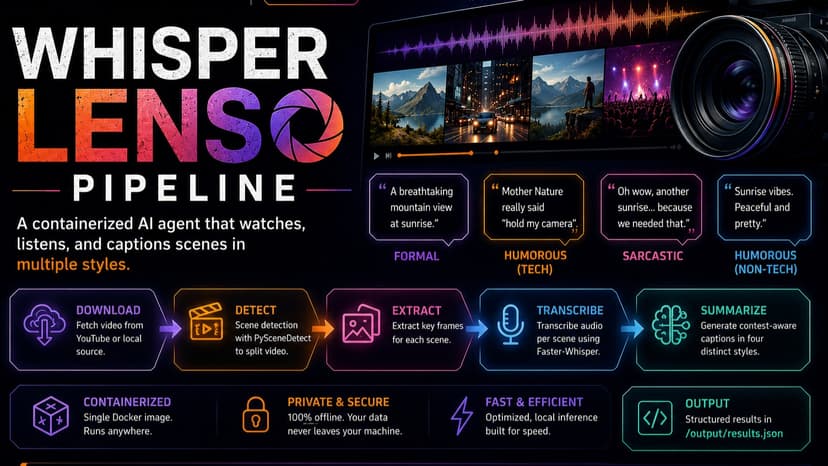
WhisperLens
This submission is a containerized video captioning pipeline built for the AMD Developer Hackathon (ACT II) Track 2. It takes a tasks.json file containing video URLs and requested caption styles, detects scenes, extracts and clips audio, transcribes speech, summarizes each scene using a vision-language model, and finally generates styled captions in formats such as formal, sarcastic, humorous tech, and humorous non-tech. The pipeline uses PySceneDetect for scene boundary detection, FFmpeg for audio extraction and clipping, OpenAI Whisper for speech-to-text transcription, and a local Ollama VLM (default gemma4:e2b) or Fireworks AI for scene understanding and caption generation. The Docker image is designed to run on AMD GPUs by default, using the ROCm 6.2 PyTorch wheel. It can also be rebuilt for NVIDIA CUDA or CPU-only targets via the TORCH_INDEX_URL build argument. A runtime fallback script detects the available GPU and can reinstall PyTorch automatically when TORCH_RUNTIME_FALLBACK=1 is set. The container bakes both the Whisper model and the Ollama VLM model into the image so no network access is required at runtime. For hackathon submission, set AUTO_RUN_PIPELINE=1 so the container processes the mounted input and writes results.json to the output directory before exiting. Configuration is fully environment-driven, with support for custom models, VLM providers, image resizing, input/output paths, and GPU backend selection.
13 Jul 2026
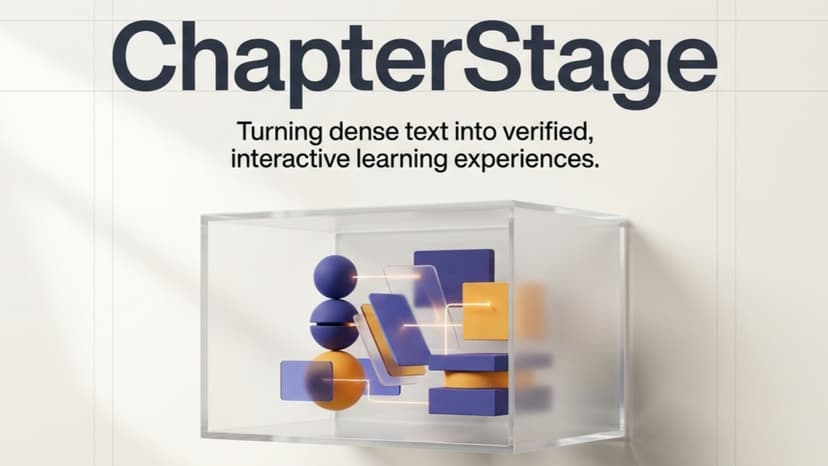
ChapterStage - Visual Learning Journey
ChapterStage helps educators, corporate learning teams, and self-learners transform dense written material into engaging interactive modules. Instead of relying on one model to summarize a chapter, ChapterStage coordinates a team of specialized agents through Band: a Structure Agent, Research Agent, Auto-Brainstorm Agent, Visual Storyboard Agent, and Verifier Agent. Each chapter becomes a Band room where agents delegate, critique, revise, and produce a traceable final output. The differentiator is the Auto-Brainstorm Lab: inspired by Karpathy’s AutoResearch loop, agents generate multiple creative learning designs, score them against faithfulness, clarity, engagement, and feasibility, discard weak versions, and refine the strongest one.
19 Jun 2026
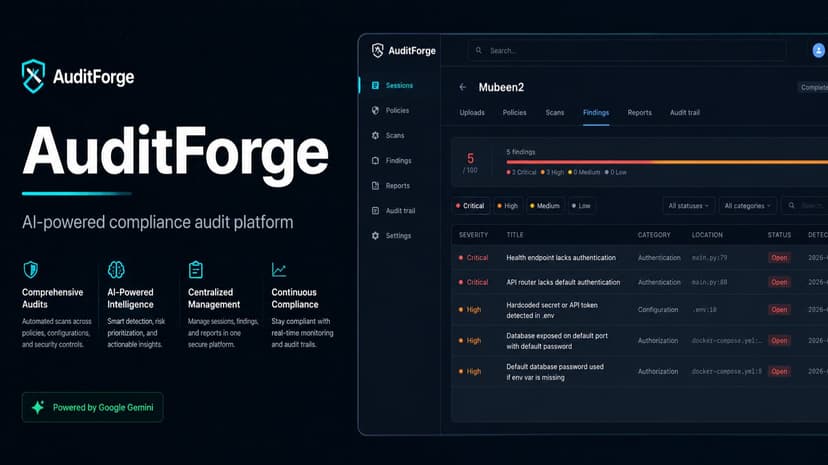
AuditForge
Enterprise AI deployments are moving fast, but the systems those agents touch — codebases, APIs, databases — are still audited manually, slowly, and inconsistently. AuditForge changes that. AuditForge is a multi-agent compliance audit platform built on Google Gemini. Security teams upload their artifacts — a codebase, an OpenAPI spec, a database schema, a cloud config — and AuditForge dispatches specialized Gemini agents to analyze them against OWASP API Top 10, HIPAA Technical Safeguards, and SOC2 Common Criteria. Gemini's long-context window is the core advantage: rather than scanning files in isolation, the analysis agent reads an entire codebase at once, catching cross-file vulnerabilities that line-by-line tools miss entirely. Every finding is standardized — severity, evidence with the exact file and line, AI-generated remediation with a code example, and a direct mapping to the compliance clause it violates. When the audit is ready to hand off, AuditForge generates a cryptographically signed PDF report that maps every issue to its regulatory reference — the kind of document a CISO or external auditor can act on without a translator. Adding support for new system types — Terraform, Kubernetes, CI/CD pipelines — requires only a new connector module; the policy engine and report layer need no changes. Every action is recorded in a tamper-evident, cryptographically chained audit trail, making the audit of the audit verifiable too. The frontend runs natively on desktop and in the browser from a single Kotlin Multiplatform codebase. Server-Sent Events stream findings in real time as the scan runs. AuditForge makes compliance auditing something engineers can run themselves, security teams can trust, and regulators can read.
19 May 2026

LinguaLink - Realtime Translations
LinguaLink is an open-source, AI-powered translation desktop application built with Kotlin Multiplatform and Compose. It enables real-time bilingual conversations by connecting three AI services in a seamless pipeline: your voice is captured by the microphone, transcribed to text using Deepgram's streaming ASR (nova-3 model), translated into the target language by a serverless LLM hosted on AMD's Fireworks AI infrastructure, and then converted back into spoken audio using Deepgram's Aura-2 TTS voices — all within seconds. Beyond voice calls, LinguaLink also supports text-based chat translation with the same AI backend. It supports 13 languages including Arabic, Chinese, Urdu, Hindi, Japanese, Spanish, and more. Every session — whether a voice call or a text chat — is automatically saved to a local SQLite database with a full transcript, so users can revisit and replay past conversations at any time. Built for the AMD AI Hackathon, LinguaLink demonstrates how AMD-hosted open-source LLMs on Fireworks AI can power production-quality, latency-sensitive language applications on the desktop — with no cloud lock-in and full local data ownership.
10 May 2026


