
🤝 Top Collaborators
.png&w=640&q=75)
.png&w=640&q=75)

🤓 Latest Submissions
Sentinel Relay
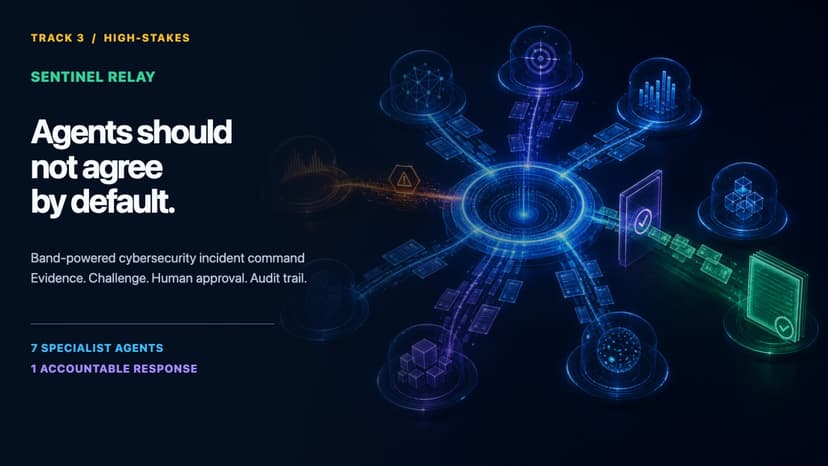
Security incidents are not single-prompt problems. Investigation, engineering review, threat assessment, compliance judgment, approval, containment, and reporting are separate responsibilities that must share context without collapsing into one opaque answer. Sentinel Relay turns that process into a visible multi-agent workflow. A Band Leader opens a shared incident room and delegates work to Forensics, Code Review, Threat Intelligence, Risk & Compliance, and Remediation agents. Each specialist posts structured findings and evidence references into Band. Risk & Compliance can challenge unsupported claims, and high-impact containment remains blocked until a human Security Lead approves a precisely scoped action. Band is the coordination layer—not a notification wrapper. It carries agent identity, task handoffs, shared room context, challenges, approval state, remediation updates, and the collaboration record used to generate the final report. The War Room makes that coordination legible in seconds through a message stream, evidence board, collaboration map, decision state, and audit replay. The demo investigates a synthetic API-key exposure after a Friday deployment. Agents correlate API access, authentication events, code changes, incident policy, and customer-impact evidence. They distinguish proven unauthorized access from unsupported exfiltration claims, request approval for issuer-first containment, and preserve the decision boundary that customer notification remains held pending scope verification. Sentinel Relay includes a production-deployed Next.js interface, typed shared schemas, Python agent workers, a server-side Band adapter, AI/ML API reasoning for the policy gate and Band Leader synthesis, deterministic replay for demo reliability, two generalization fixtures, and verification gates covering build, schema integrity, evidence grounding, dissent, approval controls, routing, and report traceability.
19 Jun 2026
Nexus AI
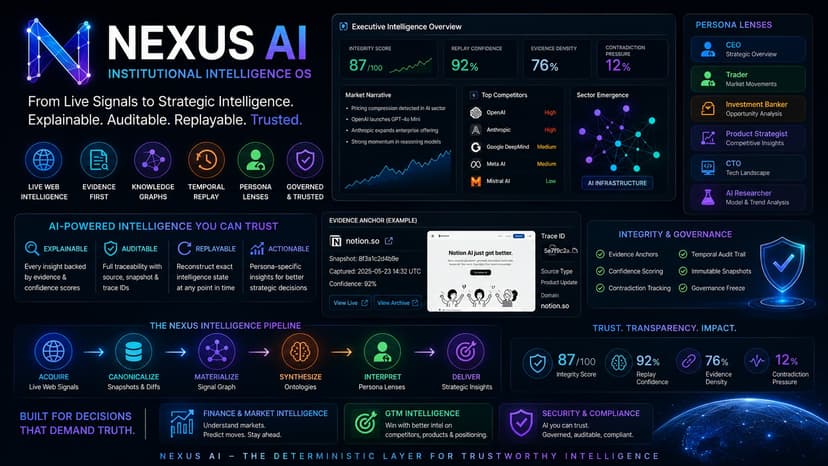
NEXUS is an Institutional Intelligence Operating System designed to transform fragmented web data into trustworthy, explainable, and auditable strategic intelligence. Unlike traditional AI applications that rely on black-box responses, NEXUS combines live market acquisition, deterministic knowledge graphs, temporal replay, explainable AI, and evidence-backed reasoning to ensure every insight can be traced back to its source. The platform continuously ingests competitor signals, pricing changes, product updates, release notes, and market events from the web. These signals pass through a governed intelligence pipeline where they are validated, scored, materialized, and connected into a canonical knowledge graph. Every inference is supported by evidence anchors, confidence scores, source URLs, timestamps, trace IDs, and archived snapshots for zero-trust verification. A unique feature of NEXUS is its Temporal Replay Engine, which allows users to reconstruct the exact intelligence state at any point in time. Organizations can understand not only what happened, but what the system knew, believed, and recommended historically. Combined with Persona-Based Cognitive Lenses, the same verified intelligence can be interpreted differently for CEOs, Traders, Investment Bankers, Product Strategists, CTOs, and AI Researchers without altering the underlying truth. NEXUS also includes an Institutional Copilot that answers questions using graph-native evidence rather than generic language-model guesses, dramatically reducing hallucinations. Through explainability panels, contradiction tracking, governance controls, and trust observability metrics, the platform provides a level of transparency rarely seen in modern AI systems. Built with FastAPI, Next.js, Playwright, knowledge graphs, and deterministic intelligence workflows, NEXUS demonstrates a new approach to enterprise AI: governed, explainable, replayable, and trustworthy cognition at scale.
31 May 2026


