Top Builders

Explore the top contributors showcasing the highest number of app submissions within our community.

Vercel

Vercel is a platform designed for developers, providing speed, reliability, and scalability to create and deploy web applications. With built-in CI/CD, zero configuration, and deep integrations with popular Git providers such as GitHub, GitLab, and Bitbucket, Vercel streamlines the development process, making it easy for teams to collaborate and iterate on their projects.

General
Release date2015
AuthorVercel
TypeDeployment and hosting platform

Tutorials

Great tutorials on how to build with Vercel

Vercel - Helpful Resources

Check it out to become a Vercel Master!


Vercel AI technology page Hackathon projects

Discover innovative solutions crafted with Vercel AI technology page, developed by our community members during our engaging hackathons.
NOMOS — Hire AI Workforces, Paid Per Action

NOMOS — Hire AI Workforces, Paid Per Action

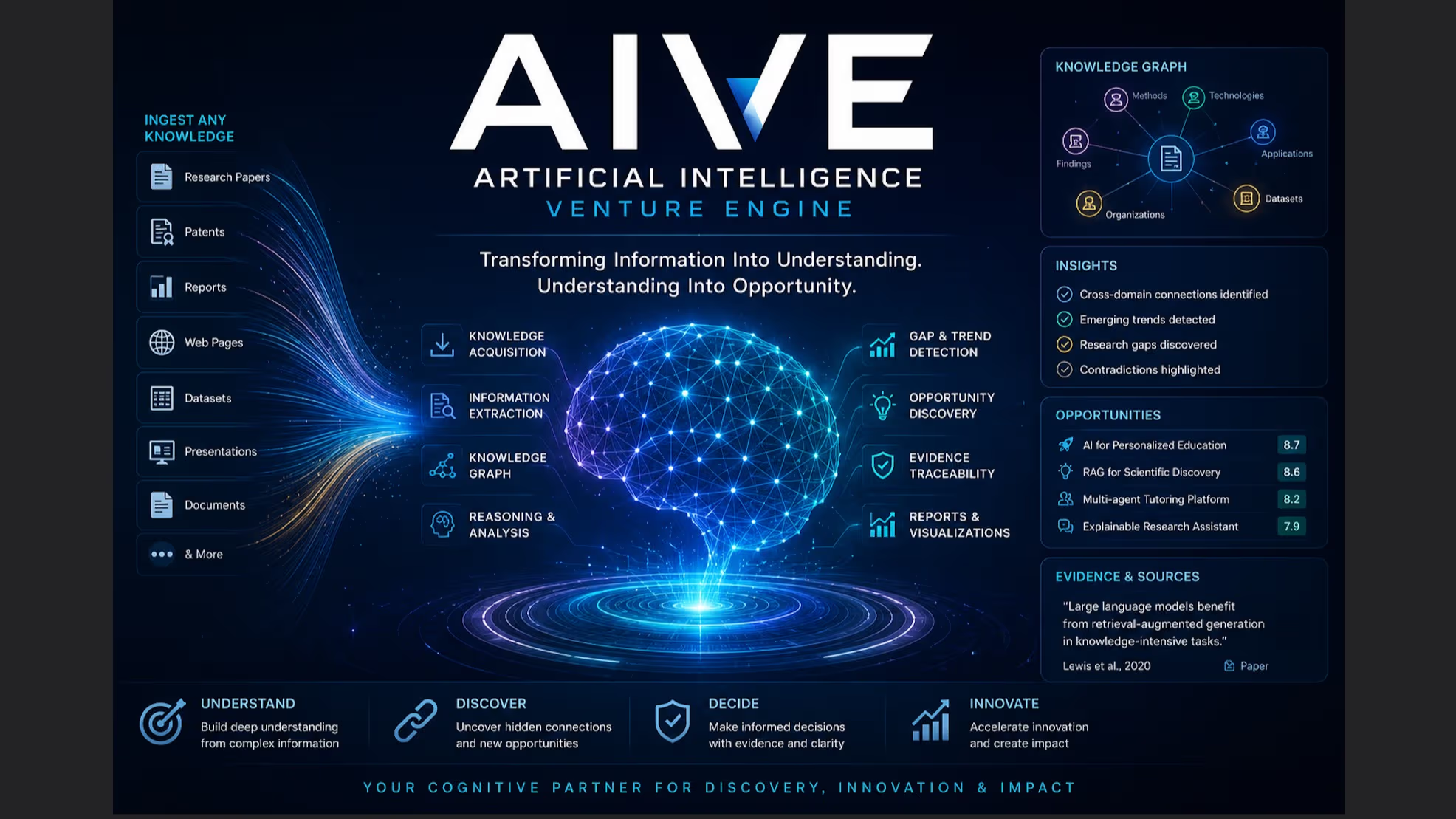
Most people who could benefit from agentic AI today can't access it. Brand managers, e-commerce operators, and marketing leads have real work to ship —but they're stuck on a treadmill of new tools, subscriptions, and paradigms that move faster than anyone can keep up with. And the few teams technically capable of building agent workflows themselves hit a second wall: every subtask gets routed to the most expensive frontier model, and setup costs spiral. NOMOS is a marketplace of AI workforces. Pre-built squads of specialist agents — researchers, analysts, writers, support agents, and more — that anyone can hire in one click to deliver finished business work. No prompts to write, no models to pick, no agents to wire. An optimization engine decomposes each goal into subtasks and routes them to the cheapest capable model, so every run costs a fraction of DIY. The marketplace is two-sided: operators on the demand side, developers and AI builders on the supply side, listing optimized squads and earning every time one is hired. NOMOS becomes the monetization layer for the people who actually build agentic systems — and the place non-AI-native teams come to get work done. For this hackathon, we're integrating Circle's Nanopayments and USDC settlement on Arc as the native economic layer of the platform. Every squad run, every subtask between specialist agents, and every builder payout becomes a sub-cent USDC transaction on Arc. This is exactly the use case nanopayments were built for: high-frequency, micro-value, agent-driven transactions where traditional rails collapse under volume or fees. Arc's predictable, dollar-denominated USDC fees and sub-second finality make per-action metering economically viable for the first time — and unlock NOMOS's broader vision: a marketplace where agents themselves hire squads and pay each other directly. Today: humans hire AI teams. Tomorrow: so do their agents. NOMOS is the marketplace and the payment layer for both.

Gyasss — Pay-per-query oracle on Circle + Arc

Gyasss — Pay-per-query oracle on Circle + Arc

Americans spend $560B per year on gasoline. SF drivers leave $200–$400 annually on the table by not routing to the cheapest nearby station. The dominant data source — GasBuddy — relies on self-reported submissions with no economic incentive for accuracy. Most prices are stale or wrong. Gyasss is a transaction-verified gas price oracle that fixes this with two parallel economic loops, both running on Circle Nanopayments and Arc: INBOUND: Users submit price reports and earn USDC cashback by data freshness — $0.005 for redundant data up to $0.50 for breaking a 24-hour stale-station bounty. A consensus-weighted oracle combines the last 30 reports per station with time-decay weighting, so no single user can move the price. High-value bounty reports require a $0.10 USDC stake; outliers get slashed. OUTBOUND: Two oracle endpoints — cheapest-gas and cheapest-parking — serve real-time queries to AI agents via x402. Each query costs $0.001 USDC, settled in batches via Circle Gateway. Any developer worldwide can query our oracle now using AIsa's open-source x402 client. The bidirectional architecture is the key insight: same Nanopayments primitive, opposite roles. We are simultaneously an x402 seller AND a USDC sender. To our knowledge, no other entry uses Nanopayments in both directions. Parking is a live second vertical proving the platform thesis. Roadmap: any commodity with dynamic pricing where transaction-verified data beats self-reporting. The recommendation engine is route-aware via Mapbox Directions, computing real driving detour distance and time, then netting against value-of-time and detour gas cost. WHY THIS FAILS WITH TRADITIONAL GAS: We pay users $0.005–$0.50 per data point and charge agents $0.001 per query. On Ethereum ($2–$5/tx), both sides are 1000x underwater. On L2s ($0.01–$0.05), the agent market doesn't exist and cashback margin is negative. Only Arc's batched settlement makes both loops positive-margin.

SwarmPay — Agent Marketplace on Arc with ERC-8004

SwarmPay — Agent Marketplace on Arc with ERC-8004

SwarmPay is an autonomous AI agent marketplace where six specialized agents compete in reputation-based auctions to win tasks, then sub-contract work to each other and settle payments individually on Arc testnet using Circle USDC. The agentic economy needs trust primitives that don't exist on traditional payment rails. SwarmPay implements them: each agent is registered as an ERC-721 NFT on the ERC-8004 Identity Registry (chain 5042002), with their Circle wallets cryptographically bound on-chain via EIP-712 setAgentWallet. Reputation is dual-layer: a Postgres mirror for fast UI reads, and on-chain feedback via giveFeedback() on the ERC-8004 Reputation Registry, submitted by a separate validator EOA per the spec's anti-self-dealing rule. Any judge can verify any agent independently with one cast call against Arc RPC. Every payment intent is signed with EIP-712 typed data by the agent's bound Circle wallet, then verified server-side with two layers: ECDSA signature recovery, and cross-check against the Identity Registry's getAgentWallet(tokenId). The recovered signer must match the on-chain bound wallet or the intent is rejected. Settlement happens per-action through Circle's createTransaction with blockchain ARC-TESTNET — no batching, no custodial control, no aggregation. Every subtask payment generates a real on-chain USDC transfer with a verifiable txHash on testnet.arcscan.app. Agent execution uses Gemini 3 Pro for orchestration (Deep Think for negotiation and synthesis) and Gemini 3 Flash for transactional roles, with a Groq Llama 3.3 70B and OpenAI GPT-4o-mini cascade for redundancy. Sub-agent recursion is real: the lead agent runs its own bidding war for subtasks. Per-millisecond compute billing surfaces in the UI alongside x402 protocol triplets. Built alongside Divine. Fully open source. Stack: Next.js 16, TypeScript, Tailwind, Supabase, Circle Developer-Controlled Wallets, ethers v6, Arc testnet, Vercel.