Top Builders

Explore the top contributors showcasing the highest number of app submissions within our community.

💛 Vectorboard

Vectorboard is an open-source framework for optimizing and evaluating embedding and retrieval-based machine learning models, particularly those built around RAG (Retrieval-Augmented Generation).

RAG is a methodology that enhances machine learning models by combining generative and retrieval-based aspects.

Importance of Good Embeddings Good embeddings are vital for the successful execution of RAG applications. They serve as the basis for retrieving contextually relevant information.

How Vectorboard Helps

Vectorboard simplifies the complex task of optimizing these embeddings by trying different hyperparameters (chunk size, overlap, splitting function, embedding algorithm, etc,) in a structured framework.

In the end, Vectorboard provides you with a Results Dashboard that allows you to compare the performance of different embeddings and hyperparameters, ran on your own data.

General
Relese dateSep, 2023
AuthorVectorboard
Repositoryhttps://github.com/VectorBoard/vectorboard/
TypeEval and Hyperparameter Optimization for embeddings

Vectorboard - Resources

Resources to get stared with Vectorboard:


Vectorboard Libraries

A curated list of libraries and technologies to help you build great projects with Vectorboard.


Vectorboard 💛 AI technology page Hackathon projects

Discover innovative solutions crafted with Vectorboard 💛 AI technology page, developed by our community members during our engaging hackathons.

Autonomous Enterprise AI Auditor

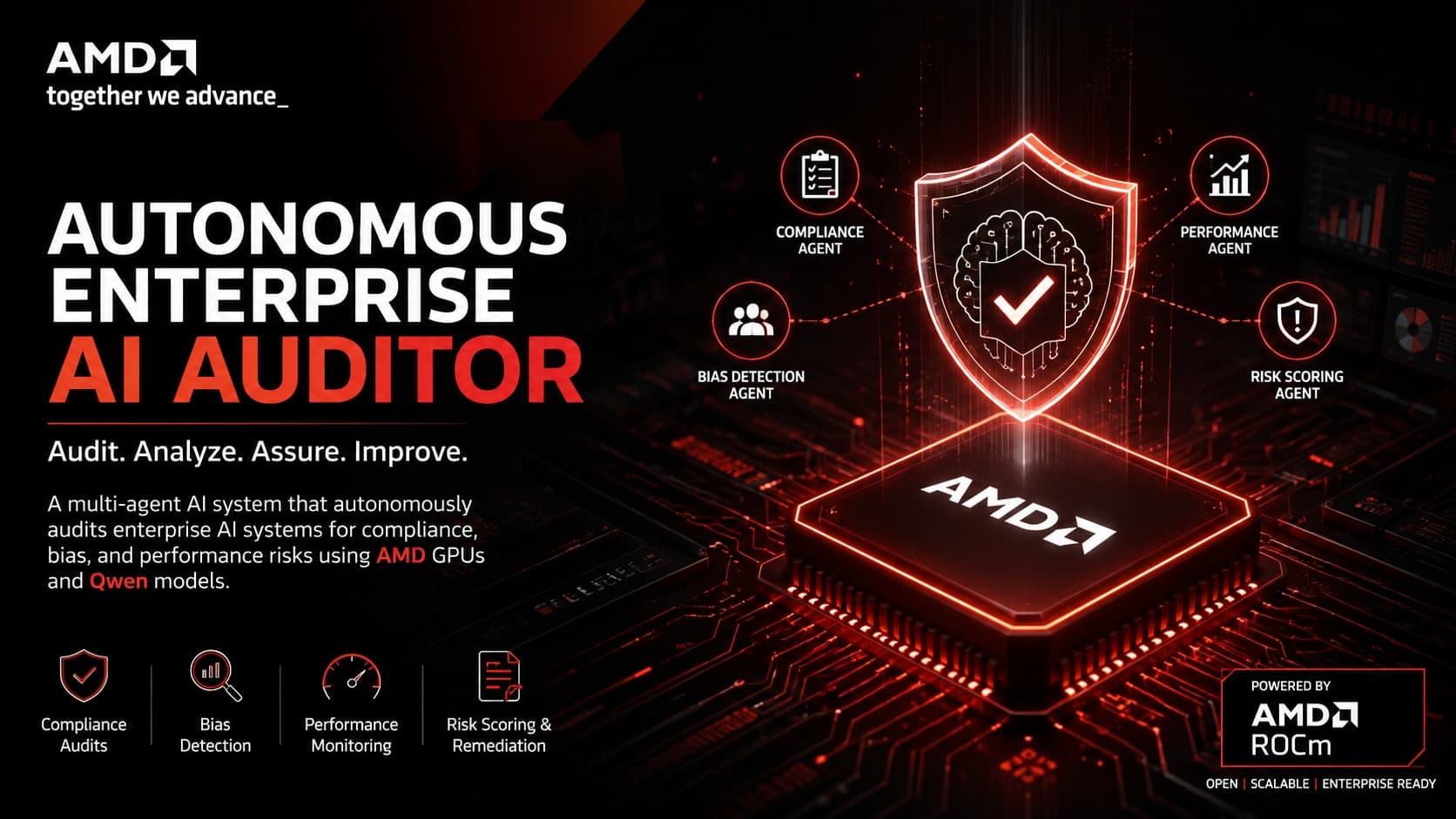
Autonomous Enterprise AI Auditor

Autonomous Enterprise AI Auditor is a multi-agent AI governance and compliance platform designed to help enterprises automatically audit, monitor, and improve their AI systems in real time. As organizations rapidly adopt generative AI and autonomous agents, enterprises face increasing challenges related to compliance, hallucinations, bias, transparency, security, and operational reliability. Our solution addresses these challenges by providing an intelligent auditing layer powered by advanced AI agents running on AMD GPU infrastructure. The platform uses multiple specialized AI agents working collaboratively to analyze enterprise AI systems from different perspectives. A Compliance Agent evaluates outputs against organizational policies and regulatory requirements. A Bias Detection Agent identifies unfair or potentially harmful responses. A Performance & Reliability Agent measures hallucination risks, consistency, latency, and output quality. A Risk Scoring Agent aggregates findings into a unified enterprise risk score with explainable insights and remediation recommendations. The system is powered by open-source Qwen models accelerated with AMD ROCm and AMD GPU infrastructure, enabling scalable and cost-efficient inference for enterprise workloads. Using AMD Developer Cloud and optimized inference pipelines, the platform delivers real-time auditing capabilities suitable for modern AI-powered applications, customer support systems, enterprise copilots, and internal AI agents. Our goal is to build a trustworthy AI auditing framework that helps enterprises confidently deploy AI systems while improving governance, transparency, and operational safety. By combining multi-agent orchestration, explainable AI analysis, and AMD-accelerated infrastructure, Autonomous Enterprise AI Auditor demonstrates how AI can be used to responsibly monitor and govern other AI systems at scale.

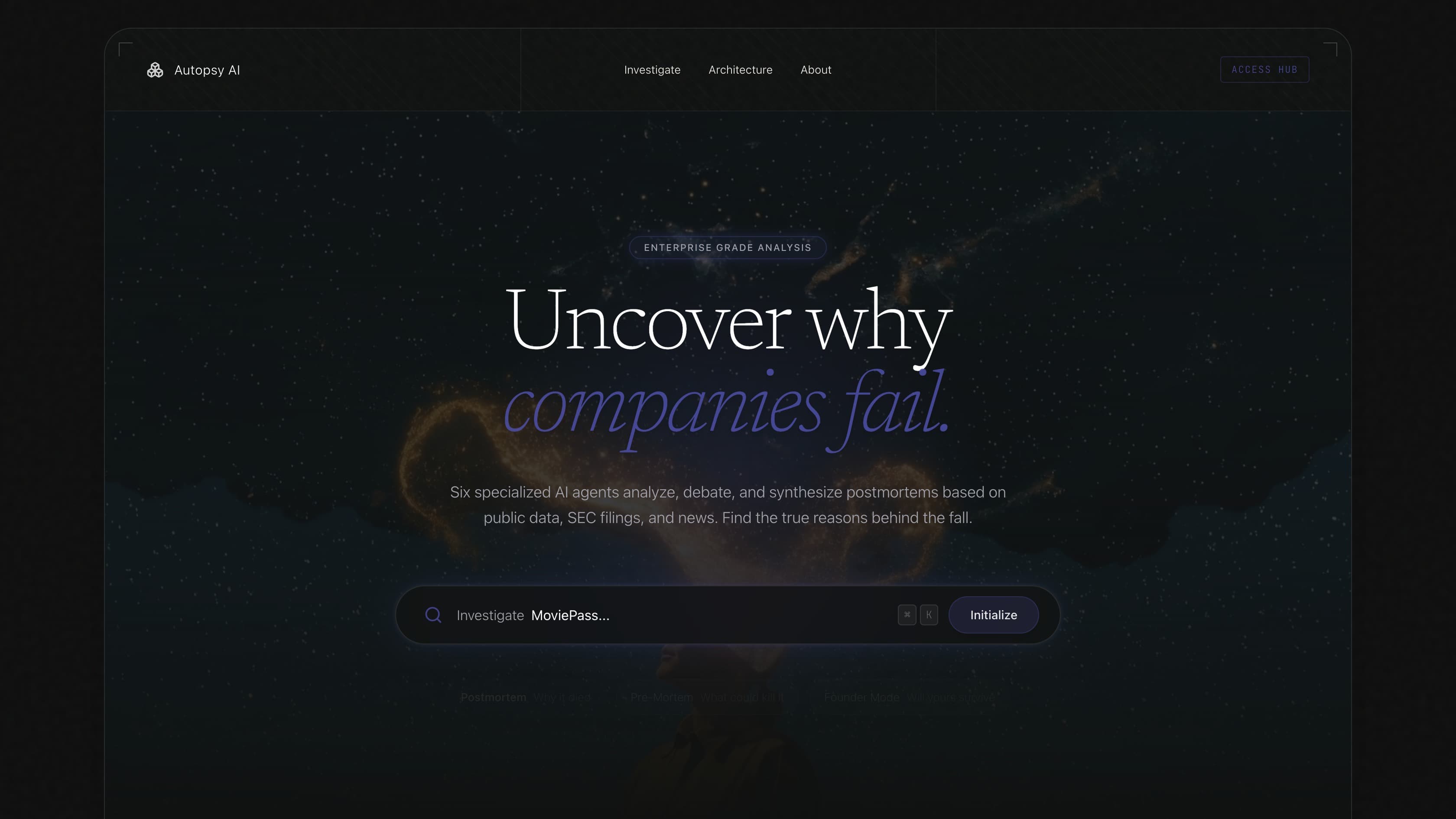
Autopsy investigates why companies fail

Autopsy investigates why companies fail

What it is Autopsy investigates why companies fail — and what could have saved them. Six specialized AI agents per mode research in parallel, debate each other's findings, and produce a forensic verdict in ~22 seconds. Four modes: Postmortem — investigate why a company failed Pre-Mortem — predict what could kill a living company Founder Mode — analyze your own startup before it fails Counterfactual — explore alternate histories: "What if they made a different decision?" Counterfactual Mode The 4th mode asks: What if [company] had made a different decision? Six counterfactual agents reason about what didn't happen: CF Market Analyst — skeptical about internal decisions changing external market realities CF Operator — assesses whether the alternate decision could actually be executed CF Money Trail — models the financial impact of the alternate path CF Customer Voice — evaluates whether users would have responded differently CF Engineer — honest about technical complexity vs. leadership beliefs CF Historian — finds real precedents (requires 2+ historical cases as evidence) Each agent must: understand the actual causal chain, identify the decision point, model the alternate chain, find real precedents, and assess second-order consequences (butterfly effects). The synthesizer renders one of five verdicts: would have survived, would have delayed failure, would have failed differently, would have made no difference, or could have transformed the company. Preset scenarios: Blockbuster/Netflix, Kodak/Digital, Yahoo/Google, Quibi/TV, Theranos/Real Science, MySpace/Better Tech.

Qubic Liquidation Guardian

Qubic Liquidation Guardian

Qubic Liquidation Guardian is a hybrid Track 1 + Track 2 project built by CrewX that brings real-time liquidation protection, institutional-grade risk analysis, and automated alerting to the Qubic Network. The problem is simple: DeFi liquidations happen instantly, but users do not get instant signals. As a result, borrowers lose capital, protocols lose liquidity, and investors hesitate to adopt new systems without safety infrastructure. Inspired by this gap, Qubic Liquidation Guardian provides a complete safety layer over lending protocols deployed on the Nostromo Launchpad. At its core, the system includes an on-chain event listener and a real-time risk scoring engine, which analyzes: • Health Factor • Liquidation Proximity • Total Debt Exposure • Active Positions These metrics are combined into a 0–100 Risk Score, dynamically updated for each borrower. Based on the score, users are automatically classified into Low, Medium, High, and Critical risk tiers, enabling rapid decision-making. The platform also includes advanced features such as: • Whale Watch: Detect large-value transactions to anticipate market shifts • Smart Alerts: Severity-based notifications connected to any tool • Auto-Airdrop: Rewards for users who resolve high-risk positions • Crash Simulator: A built-in testing environment to simulate -70% market dumps, rebounds, and full resets to verify protocol safety Qubic Liquidation Guardian is designed to strengthen the Nostromo ecosystem by improving investor confidence, increasing protocol safety, and enabling risk-aware liquidity management. With over 35 production-ready API endpoints, an edge-distributed database, and a Next.js 15 architecture, the application is fully deployable and already live for testing. Ultimately, this project delivers exactly what new chains and protocols need: speed, stability, transparency, and automation—making Qubic safer for everyone.

Senior Intern

Senior Intern

Senior Intern bridges a growing global gap: seniors want flexible meaningful work, and startups urgently need judgment and strategic clarity but can’t afford full-time executives. Life expectancy is rising, millions of professionals with 25–30+ years of leadership, sales, tech, and operational experience are retiring early, feeling invisible and underutilized. At the same time, early-stage founders struggle with complex decisions, unclear root causes, and lack of senior guidance. Senior Intern combines AI + human expertise to solve both problems. Founders submit their biggest challenge, and our Virtual Senior Advisory Board, powered by Google Gemini 1.5 Flash, analyzes it through CEO, Marketing, Sales, and CTO lenses. The system produces a clear root-cause diagnosis and a structured action plan within seconds. Senior profiles (skills, industries, strengths, availability) are embedded and stored in Qdrant Vector Database, enabling precise semantic matching. Qdrant identifies the senior professionals best suited to solve the founder’s issue — instantly, contextually, and without keyword limitations. This creates a new category of talent: not mentoring, not consulting, not employment. Senior Interns are flexible, part-time, experience-rich contributors who bring maturity and direction at startup speed. Our MVP uses Streamlit, Gemini, and Qdrant to demonstrate end-to-end problem intake, AI reasoning, advisory output, and expert matching. The result: founders get clarity and direction; seniors gain purpose, dignity, and new opportunities in the AI age.

NetConnect

NetConnect

Public Sector Network Connectivity Analyzer The Public Sector Network Connectivity Analyzer is a comprehensive solution designed to address the critical need for reliable network monitoring across public institutions. Our application serves as an essential tool for IT administrators managing connectivity infrastructure for schools, healthcare facilities, government offices, libraries, and other public service organizations. Core Capabilities Real-Time Network Visualization Interactive diagrams and topology maps provide clear visibility into how public institutions are connected, displaying network elements, connection points, and infrastructure components with intuitive visualization tools. Performance Monitoring System Our platform continuously tracks vital network metrics including uptime percentages, latency measurements, bandwidth utilization, and connection status across the entire public sector network, enabling proactive management. Advanced Simulation Engine IT professionals can run comprehensive simulations to test network resilience under various scenarios such as increased user loads, infrastructure failures, or cyber incidents, helping identify vulnerabilities before they impact critical services. Institution Management Portal Administrators can efficiently manage information about connected institutions, monitor their connection status in real-time, and access detailed performance metrics through a unified dashboard interface. Geographic Mapping Integration Our system incorporates geographic visualization capabilities to display the physical distribution of institutions and network infrastructure across regions, facilitating better resource allocation and planning. Technical Implementation This solution addresses the unique challenges faced by public sector organizations that require reliable connectivity for delivering essential services to communities, while providing the tools needed to ensure network resilience, performance, and security.