Top Builders

Explore the top contributors showcasing the highest number of app submissions within our community.

Samsung

Samsung Electronics Co., Ltd. was founded in January 1969 as a spin-off from the broader Samsung Group conglomerate. Headquartered in Suwon, South Korea, it has grown into one of the world's largest technology companies by revenue, producing everything from NAND flash memory and OLED displays to Galaxy smartphones and home appliances. For developers, Samsung is most relevant as the maker of the Galaxy device ecosystem, the Knox enterprise security platform, the SmartThings IoT platform, and the on-device AI infrastructure powering Galaxy AI across its latest flagship hardware.

General
CompanySamsung Electronics Co., Ltd.
FoundedJanuary 13, 1969
HeadquartersSuwon, South Korea
Websitesamsung.com
Documentationdeveloper.samsung.com
GitHubgithub.com/samsung
TypeConsumer Electronics and Semiconductor Manufacturer

Core Products

Galaxy Mobile (Smartphones and Tablets)

The Galaxy S, Z Fold/Flip, and A series cover flagship, foldable, and mid-range Android devices. Galaxy S-series flagships run the Snapdragon 8 Elite (custom Samsung variant) and power the company's Galaxy AI on-device inference features.

Knox Security Platform

Knox is Samsung's enterprise mobile security framework, providing hardware-backed secure enclaves (Knox Vault), app containerization, and device management APIs. Knox Vault is also the protected enclave for Galaxy AI's Personal Data Engine, keeping on-device AI data encrypted and local.

SmartThings

An IoT and smart home platform connecting Samsung devices and third-party products under a unified app and developer SDK. SmartThings supports automations, device control APIs, and Matter/Thread connectivity standards.

Bixby

Samsung's voice AI platform, integrated across Galaxy devices for device control, accessibility, and routines. The Bixby ecosystem offers developer extensions for third-party app integration.

Tizen

Samsung's Linux-based OS used in Smart TVs, Galaxy Watches, and IoT appliances. Tizen apps are built with the Tizen SDK and distributed through the Samsung Smart TV app store or wearable ecosystem.


Developer Resources

Samsung offers SDKs covering mobile AI, health sensors, enterprise security, IoT, wearables, and in-app purchases, along with a Remote Test Lab for cloud-based Galaxy device testing.


Key Features

On-Device AI with Galaxy AI Galaxy S-series flagships run AI workloads locally on the Snapdragon Hexagon NPU. Features like Generative Edit, live call transcription, and 20-language translation process data on-device, protected by Knox Vault. The Personal Data Engine analyzes user data locally without cloud upload.

Galaxy Ecosystem Breadth Samsung ships across phones, tablets, foldables, smartwatches, rings, TVs, and home appliances, giving developers a single SDK surface to reach a large installed base of devices spanning form factors.

Enterprise-Grade Security Knox is standard on all Galaxy business devices, offering MDM/EMM integration, remote lock/wipe, app separation, and hardware-backed attestation that meets government and financial-sector compliance requirements.


Use Cases

On-Device Generative AI Applications The Galaxy On-Device AI Partner Portal provides access to the Samsung AI SDK for building applications that run inference locally on the Hexagon NPU, targeting privacy-sensitive or offline-capable AI features.

Enterprise Mobile Deployments Knox APIs enable IT teams to configure, secure, and remotely manage Galaxy fleets across regulated industries including healthcare, finance, and government.

Samsung AI Technologies Hackathon projects

Discover innovative solutions crafted with Samsung AI Technologies, developed by our community members during our engaging hackathons.
EchoWalk: On-Device Guidance for Low-Vision Users

EchoWalk: On-Device Guidance for Low-Vision Users

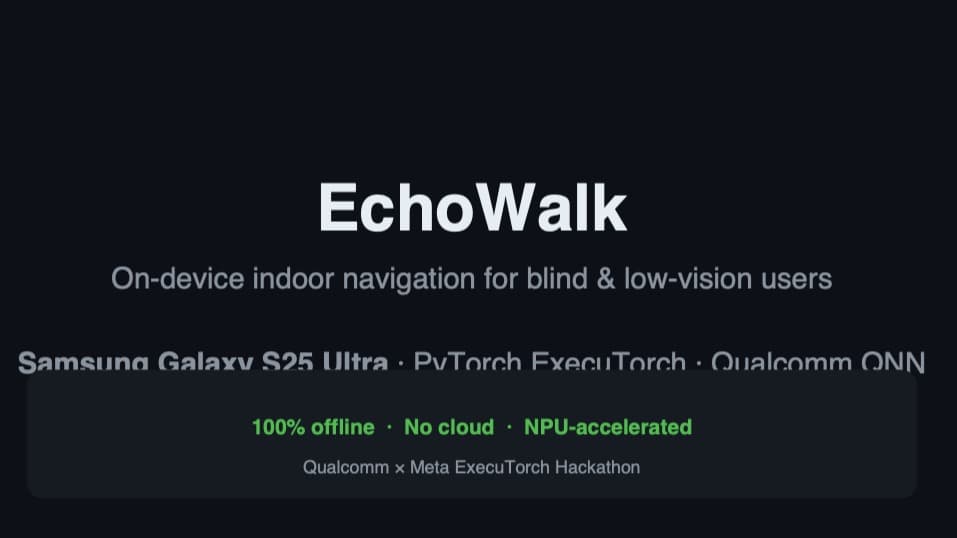
Imagine walking through an unfamiliar room with your eyes closed. You need to know what is ahead, what is around you, and how to reach the chair someone mentioned — without cloud latency or sending your camera feed anywhere. EchoWalk is built for that moment. On a Galaxy S25 Ultra, one shared camera pipeline feeds a central ModeManager that decides when to warn, when to describe, and when to search — all on the Snapdragon NPU via ExecuTorch and Qualcomm QNN. Safety Radar runs continuously. Depth Anything V2 and YOLOv10 fuse on the Hexagon NPU: not just what is there, but how far and whether it is a trip hazard or a wall you can trail. Spatial audio and haptics place obstacles in space; a VoiceWarningEngine speaks when it matters. A live bounding-box overlay helps sighted helpers follow along in demos. Scene Description is on demand — tap the preview, the Describe button, or long-press Volume Up. A short burst of frames runs through a Places365 classifier and pairs the room label with live YOLO directions: "You appear to be in a living room — couch on your left, TV ahead." Auto-describe announces stable scene changes hands-free. The full SmolVLM-500M stack is integrated and validated through handoff scripts; richer VLM captions are ready for the next aligned build. Find Mode is voice-first. Long-press Volume Down, say "find the bottle," and the app maps your words to everyday object labels. It scans the room, guides you turn by turn, warns about obstacles in your path, highlights the target on screen, and remembers where it last saw it so the next search starts with a hint. Accessibility is front and center: lock-screen access, screen-on at launch, spoken onboarding with a first orientation from live radar, eyes-free volume shortcuts, and double-tap to repeat your last description. No cloud. No upload. Your home never leaves your pocket.

SixthSense: Haptic Vision for the Blind

SixthSense: Haptic Vision for the Blind

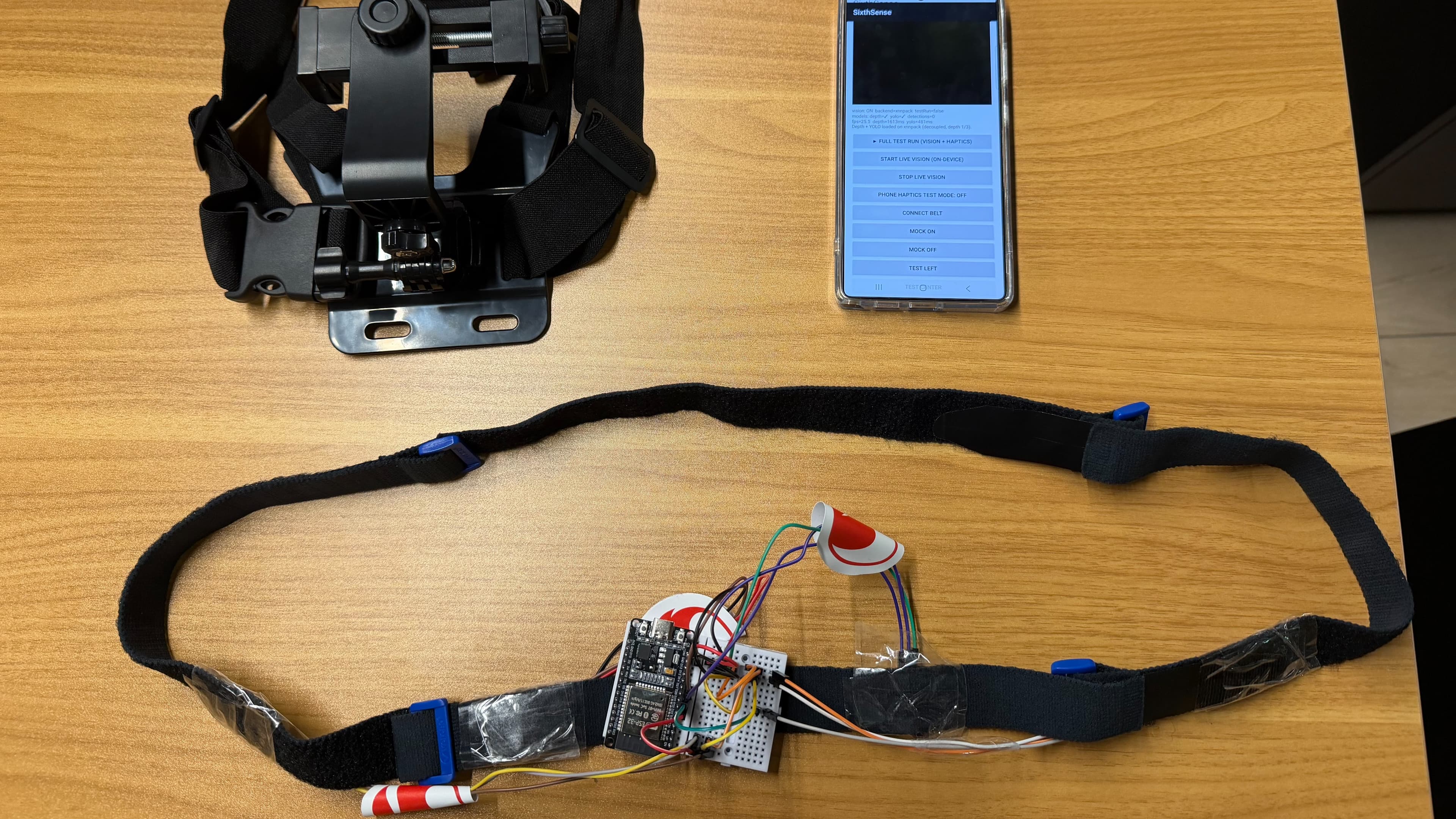
SixthSense is a wearable that helps blind and low-vision people sense obstacles around them and find a clear path. A phone is mounted on the chest and watches the way ahead. On-device models turn what the camera sees into a simple readout: how near obstacles are in the left, center, and right zones, what objects are present, and whether the path is clear. That readout drives a vibration belt worn at the waist, which buzzes on the side of the nearest obstacle so the user can feel which way to move. The point is that knowing something is close is not enough. A basic vibrating cane buzzes whenever anything is near, so in a crowd it buzzes constantly without telling you where the gap is. SixthSense reads each zone separately and steers the user toward open space, so it stays useful in busy areas. The user can also ask what is ahead and hear a short spoken answer, or point the camera at a sign and have its text read aloud. The vision runs on the phone. YOLOv11n detects objects and tags each to a left, center, or right zone. Depth-Anything-V2 estimates how near things are, which sets how hard the belt buzzes. Qwen2.5-0.5B answers spoken questions about the scene, and ML Kit reads text on demand. The models run through ExecuTorch as compiled files on the phone, offline, on a Qualcomm Snapdragon 8 Elite, with the option to run on the Hexagon NPU. The phone sends a small directional packet over Bluetooth to an ESP32, which drives the belt motors. Cost is the main reason it exists. Smart canes and glasses run from about $850 to over $2,000, and only one in ten people who need assistive technology can get it, dropping to about five percent in lower-income countries. SixthSense uses a phone the user already has and a sub-$20 belt, with room to reach about $50 at scale, putting this within reach of people who are priced out today.

Lodestar — Offline AI Survival Copilot

Lodestar — Offline AI Survival Copilot

GPS denial is no longer rare: Poland logged 2,732 jamming incidents in one month in early 2025, and an EU Commission President's plane lost GPS near Bulgaria and landed on paper maps. When navigation fails, everything built on top tends to fail at once including medical guidance, since most first-aid apps assume connectivity that may not exist when it matters most. Lodestar is an offline, on-device AI survival copilot built for that moment. It runs on Snapdragon hardware via ExecuTorch, requesting no INTERNET permission at all, across three capabilities: TREAT — describe an injury by voice or text and get a severity-ranked, source-cited first-aid response. Severity comes from a deterministic safety-tree engine, not the language model, so the system can't be talked into downgrading a critical call by ambiguous phrasing. The model explains and cites a TCCC/MARCH corpus but cannot override the verdict underneath. We tested negation handling ("hasn't stopped" vs. "has stopped now"), the failure mode that matters in the field — and caught and fixed a real bug here during testing. ORIENT — true north without a satellite. By day, a solar compass derives heading from the sun's position, verified against documented sunrise, sunset, and solar-noon directions. By night, on-device star plate-solving matches a photographed sky against a catalog. A status strip shows the active position source — GPS_TRUSTED, DEAD_RECKONING, SOLAR_FIX, or STAR_FIX — and flips in real time if GPS is spoofed, freezing to the last trusted fix. COMMUNICATE — medic-casualty translation plus a one-tap SOS card from the TREAT conversation. Every model-backed capability sits behind one interface, so the app was built and tested against a stub before the real models landed swapping to production is a one-line change. We're upfront about what's tested today (safety tree, solar math, spoof detection all pass automated tests) versus what's in progress (corpus coverage, runtime integration)