Top Builders

Explore the top contributors showcasing the highest number of app submissions within our community.

Bright Data Web Scraper API

The Bright Data Web Scraper API is a cloud-based data extraction service that delivers structured data from over 120 popular websites without requiring proxy management or anti-bot handling code. Developers send a target URL or platform identifier and receive clean, structured JSON in return, with Bright Data handling unblocking, rendering, and parsing behind the scenes.

General
DeveloperBright Data
TypeManaged Web Scraping API
Sites Supported120+
Ready-made Scrapers600+
Documentationdocs.brightdata.com/scraping
GitHubbrightdata/sdk-python

Core Features

  • 600+ ready-made scrapers: pre-built extractors for Amazon, LinkedIn, Instagram, TikTok, Zillow, and 115+ other sites, maintained by Bright Data.
  • Automatic unblocking: built-in proxy rotation, CAPTCHA solving, and fingerprint management so scrapers do not get blocked.
  • JavaScript rendering: pages requiring JS execution are handled server-side before data extraction.
  • Pay-per-result pricing: charges apply only to successful responses, not failed or blocked requests.
  • Structured JSON output: data returned in clean, schema-consistent JSON without HTML parsing.
  • Cloud scaling: no infrastructure to manage; requests scale automatically with demand.

Scraper Studio

Scraper Studio is an AI-powered scraper builder inside the Bright Data platform. Developers provide a URL and a description of the data they need, and the studio generates and deploys a working scraper. Self-Healing mode automatically updates scrapers when target sites change their structure, reducing maintenance overhead.


Tools and Resources

  • Python SDK: call the Web Scraper API from Python with async and sync support.
  • JavaScript SDK: Node.js, Bun, and Deno compatible client.
  • Bright Data CLI: scrape and extract data from 40+ platforms directly in the terminal.
  • API Reference: full endpoint documentation and payload schemas.
  • Scraper Studio: build and deploy custom scrapers in the browser without writing scraping logic.

Ecosystem and Integrations

  • Integrates with Bright Data proxy networks for combined infrastructure and extraction.
  • Available via the Azure Marketplace as a managed SaaS product.
  • Works alongside the MCP Server to expose scraping capabilities to Claude, Cursor, and other AI agents.
  • Data output can be piped into databases, data warehouses, or AI training pipelines.

Start extracting data in minutes at brightdata.com/products/web-scraper or follow the quickstart guide to make your first API call.

Bright Data Bright Data Web Scraper API AI technology Hackathon projects

Discover innovative solutions crafted with Bright Data Bright Data Web Scraper API AI technology, developed by our community members during our engaging hackathons.

AITinerary

AITinerary

AITinerary – Your AI Travel Co-Pilot AITinerary is an AI-powered travel planning platform designed to simplify every stage of a trip—from discovering destinations to creating personalized itineraries and exploring hidden gems. Instead of spending hours researching across multiple websites, users simply describe their travel preferences, budget, trip duration, and interests, and AITinerary generates a complete travel plan tailored to them. One of the core ideas behind AITinerary is bridging the gap between travel inspiration and actual trip planning. Today, many people discover amazing destinations, restaurants, and experiences through Instagram Reels and YouTube videos, but planning a trip around that content is still a manual process. AITinerary aims to let users provide a Reel or YouTube link and transform that inspiration into a practical itinerary with recommended attractions, restaurants, accommodations, transportation, and nearby experiences. The platform also acts as an intelligent travel companion throughout the journey. It recommends hidden gems beyond popular tourist attractions not to miss, adapts plans based on user preferences, provides contextual information about places, helps optimize travel budgets, and enables expense tracking and bill splitting for groups. For the MVP, the focus is on AI-generated itineraries, social media-inspired trip planning, personalized recommendations, and intelligent travel assistance. The architecture is designed to integrate with travel providers and booking platforms in the future, allowing users to seamlessly transition from planning to booking within a single experience all at one place. By combining generative AI, travel data, and personalization, AITinerary aims to become an all-in-one travel assistant that helps users spend less time planning and more time experiencing memorable journeys. "From inspiration to itinerary in seconds. See it. Plan it. Experience it."

FounderOS – The AI Operating System for Founders

FounderOS – The AI Operating System for Founders

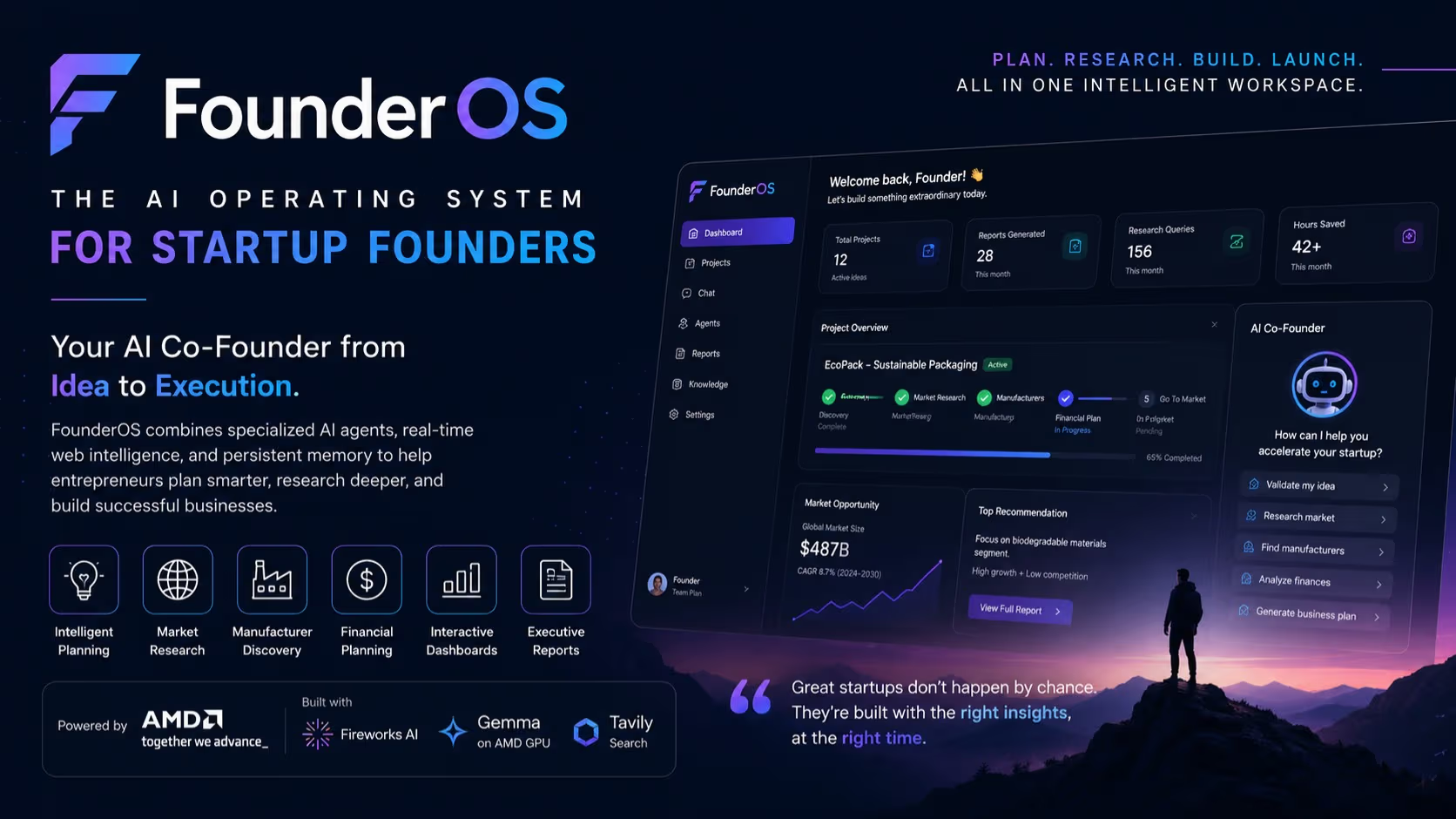
Over 90% of startups fail because founders often have great ideas but lack structured guidance, reliable market intelligence, and access to expert business advice. They spend countless hours switching between different tools for planning, research, financial analysis, and supplier discovery, leading to fragmented workflows and slow decision-making. FounderOS solves this by providing every entrepreneur with an AI Co-Founder—an intelligent operating system that combines specialized AI expertise, live web research, and persistent project memory into a single collaborative workspace. Users simply describe their startup idea, and FounderOS transforms it into a structured business strategy through intelligent planning, market research, manufacturer discovery, financial analysis, and consultant-style executive reports. Instead of generic chatbot responses, it delivers interactive dashboards, comparison tables, actionable recommendations, timelines, and evidence-backed insights that help founders make confident decisions. Key Features 🧠 Smart Agent Orchestration – Automatically selects the most relevant AI capability based on user intent. 🌐 Live Web Intelligence – Grounds responses with real-time market research and verified web sources. 📊 Executive-Style Reports – Presents insights using structured summaries, tables, comparisons, and citations. 💾 Persistent Project Memory – Maintains context across conversations and supports multiple startup projects. 🎯 Actionable Recommendations – Suggests the next best step after every interaction. 🔗 Transparent Research – Provides clickable source links for verification and further exploration. Built on an intelligent orchestration layer, FounderOS dynamically coordinates AI capabilities, reuses project context, and performs live research only when necessary. This enables faster execution, scalable workflows, and a seamless experience that helps founders move from idea to execution with confidence.

Council AI: Multi-Agent Decision Intelligence

Council AI: Multi-Agent Decision Intelligence

Council AI is a multi-agent decision-intelligence system built for the AMD Developer Hackathon: ACT II (Team Error 200). Instead of asking a single chatbot for an opinion, Council AI lets you brief a custom panel of AI specialists on any high-stakes question moving to a new city, choosing a tech stack, deciding whether to attend an event and get back a structured, evidence-backed recommendation. Here's how it works: an orchestrator agent reads the query and dynamically invents 3-4 specialist roles suited to that specific decision, rather than picking from a fixed set of categories. In Enhanced mode, a prompt-engineer agent further refines each specialist's brief. Each specialist then runs live web research via the Tavily API and produces an independent report. A debate agent cross-examines all the reports, surfacing where the specialists agree and where they conflict. Finally, a synthesis agent weighs the evidence and the debate to produce a final verdict, an executive summary, and a bottom-line recommendation. The backend is a FastAPI service that streams the whole pipeline to the browser over Server-Sent Events, so users watch the council assemble, research, and argue in real time instead of staring at a loading spinner. The frontend is built with TanStack Start, React 19, and Tailwind CSS 4, with Framer Motion powering the transitions. All reasoning is powered by GPT OSS 20 Instruct served through the Fireworks AI API. Council AI turns a single-shot LLM answer into something closer to how real high-stakes decisions get made: multiple experts, real research, honest disagreement, and a considered final call.

THE COUNCIL: Expert Advisors Who Fight For You

THE COUNCIL: Expert Advisors Who Fight For You

Everyone faces life-changing decisions alone. THE COUNCIL changes that by giving you your own personal advisory board. Submit your query—whether it's a high-stakes startup offer, career transition, or relocation—and watch five autonomous AI agents with distinct, persistent personalities deliberate in a live-streamed debate. Under the hood, THE COUNCIL is a multi-agent system built on Band.ai. Instead of a single LLM wearing five prompts, we deploy genuine model diversity: Qwen 2.5-32B (The Skeptic) analyzes risks, Llama-3.1-70B (The Strategist) identifies long-term growth, DeepSeek-R1-70B (The Numbers) quantifies quantitative metrics, Llama-3.1-8B (The Devil's Advocate) stress-tests consensus, and GPT-4o-mini (The Chair) synthesizes the room. The debate orchestration runs sequentially via FastAPI WebSockets to stream arguments as they are generated. Unlike typical chatbot wrappers, THE COUNCIL features heavy engineering depth: 1. Deterministic Stakes Classifier: Scores severity (1-10) and risk factors (cliff, vesting, relocation) deterministically without AI. 2. Live Market Grounding: Career queries trigger Brightdata web scraping to search salary listings, providing real-world benchmarks to 'The Numbers'. 3. Convergence Calculator: A custom algorithm that measures consensus (0.0-1.0) using position agreement and semantic text similarity. 4. Cryptographic 'Stare Decisis': Inspired by judicial tradition, it extracts minority dissents and SHA-256 hashes them directly into an immutable verdict chain. 5. 6-Table Database Persistence: Complete deliberation history mapping decisions, arguments, verdicts, evidence, and dissents in SQLite. Presented in an Apple-inspired editorial Next.js UI using stark light-mode whitespace, Playfair Display serif typography, and elegant card components with smooth micro-animations, the system feels alive, premium, and authoritative. Deliberation, not just generation.

AI Crisis Command & Coordination Platform

AI Crisis Command & Coordination Platform

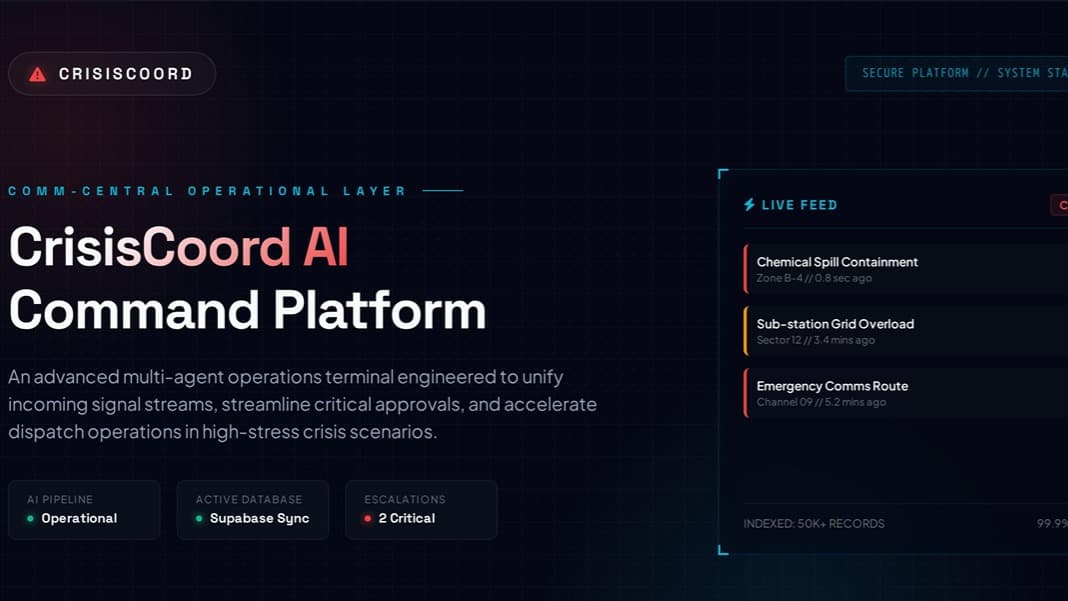
An AI Crisis Command & Coordination Platform is an enterprise-grade, multi-agent operational operating system designed to stabilize high-stakes chaos and synchronize real-time emergency responses during large-scale incidents (e.g., natural disasters, mass-scale cyberattacks, industrial failures, or civil defense threats). By acting as an intelligent "system of systems," the platform unifies disjointed physical and digital infrastructure into a singular, actionable operational layer. It transforms traditional reactive emergency management into a proactive, algorithmically assisted orchestration framework. 1. Core Structural Engine The platform's architecture shifts emergency management from rigid, manual workflows to an agile, automated data-to-action pipeline.Intelligent Data Ingestion: The platform continuously aggregates and cleans highly fragmented, multi-modal data streams in real time. This includes live IoT sensor grids, geospatial satellite imagery, municipal infrastructure feeds, encrypted field radio transcriptions, and external environmental APIs (weather, seismic activity, grid load). Autonomous Multi-Agent Orchestration: At its core, specialized AI agents operating on a shared, low-latency layer collaborate to manage sub-tasks simultaneously. For instance, if an industrial breach occurs, a Logistics Agent instantly calculates optimal route diversions, a Hazmat Agent models plume dispersion, and a Communications Agent drafts localized public warnings—all without human bottlenecks. Calibrated User Experience (UX): Designed specifically for high-stress operational environments, the user interface enforces strict visual hierarchy. It suppresses non-essential analytical noise, highlights high-priority triage vectors, and presents critical indicators through clean, digestible visual matrices to minimize cognitive overload for dispatchers and commandeR