Top Builders

Explore the top contributors showcasing the highest number of app submissions within our community.

Bright Data Proxy Networks

Bright Data Proxy Networks give developers access to one of the largest commercially available proxy pools, covering residential, datacenter, ISP, and mobile IP types. The network spans 195 countries with options for city, carrier, and ASN-level targeting, making it suitable for use cases ranging from high-volume crawling to geo-restricted content access.

General
DeveloperBright Data
Network Size400M+ IPs
Countries195
TypeProxy Infrastructure
Documentationdocs.brightdata.com/proxy

Proxy Types

  • Residential Proxies: IPs sourced from real user devices. Best for accessing sites that block datacenter ranges. Supports unlimited concurrent sessions and rotates IPs automatically. Pricing starts at $5.04/GB.
  • Datacenter Proxies: Server-based IPs with high speed and low latency. Best suited for high-volume tasks where residential appearance is not required. Pricing starts at $0.066/GB.
  • ISP Proxies (Static Residential): Real residential IPs issued directly by ISPs, but static (non-rotating). Ideal for tasks that need a consistent IP address over time. Monthly plans start at $499.
  • Mobile Proxies: IPs from mobile carrier networks. Useful for tasks targeting mobile-specific content or requiring high anonymity. Pricing starts at $14.4/GB.

Proxy Variants

TypeStarting PriceBest For
Residential$5.04/GBSites with strict bot detection
Datacenter$0.066/GBHigh-volume crawling at low cost
ISP (Static)From $499/monthSessions needing a fixed IP
Mobile$14.4/GBMobile-targeted content, high anonymity

Core Features

  • Geo-targeting: Target by country, city, carrier, and ASN for precise location-based access.
  • Automatic rotation: Residential and mobile proxies rotate IPs per request or per session.
  • Concurrent sessions: Residential proxies support unlimited concurrent sessions.
  • 99.99% uptime SLA: Infrastructure backed by a service level agreement across all proxy types.
  • Protocol support: HTTP, HTTPS, and SOCKS5 supported across all proxy types.

Tools and Resources

  • Proxy Manager: open-source proxy management tool for routing, authentication, and monitoring.
  • Pricing Pages: per-GB and monthly plan calculators for each proxy type.
  • Quick Start Guide: set up your first proxy zone in minutes.
  • Python SDK: route requests through Bright Data proxies from Python.

Ecosystem and Integrations

  • Available on Azure Marketplace and Microsoft Marketplace.
  • Works with Puppeteer, Playwright, Selenium, Scrapy, and any HTTP client library via standard proxy authentication.
  • Compatible with Bright Data's Web Unlocker and Scraping Browser for combined unblocking and proxy routing.

Get started at brightdata.com/proxy-types or explore the full documentation for zone configuration and integration guides.

Bright Data Bright Data Proxy Networks AI technology Hackathon projects

Discover innovative solutions crafted with Bright Data Bright Data Proxy Networks AI technology, developed by our community members during our engaging hackathons.

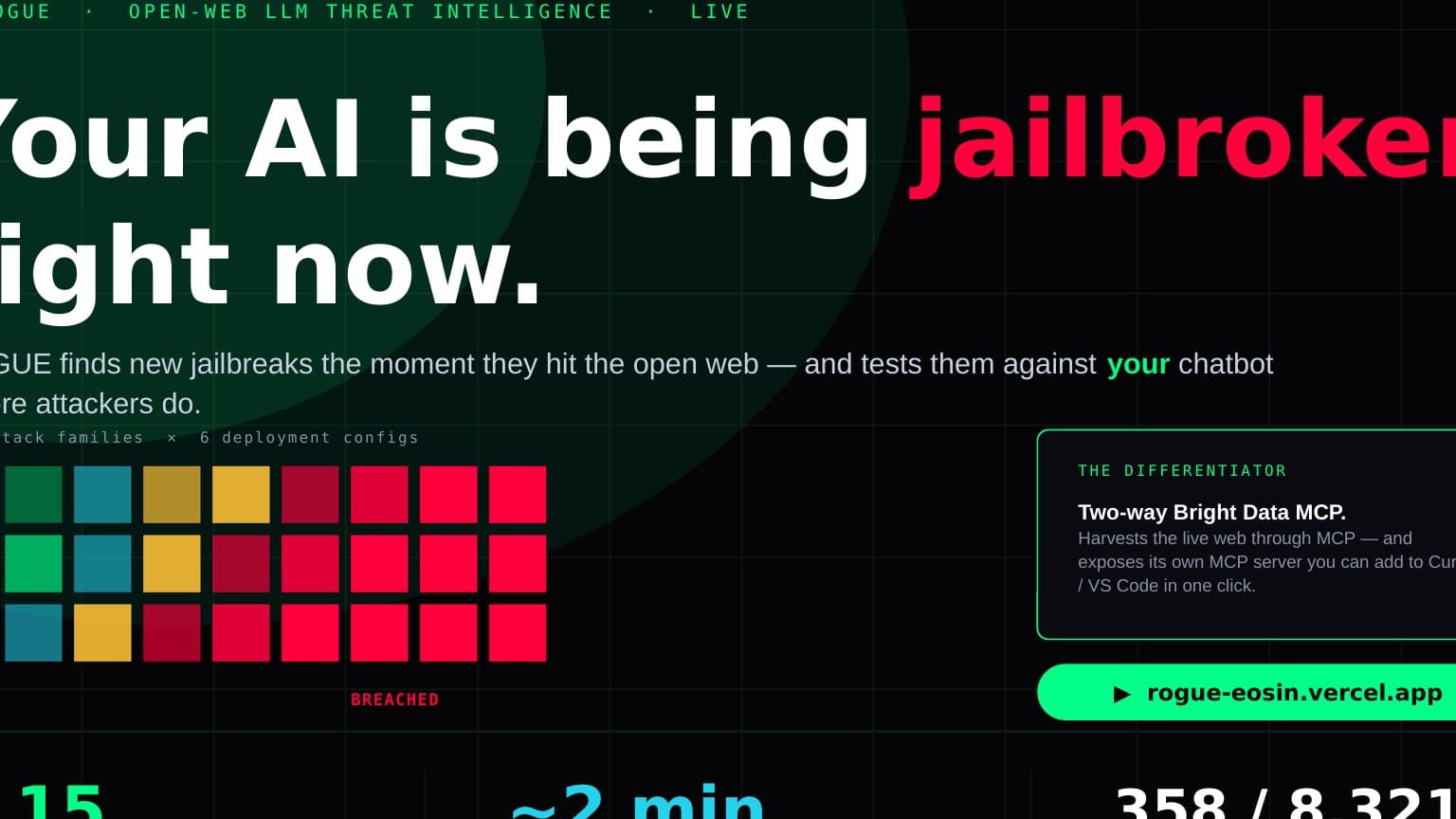
ROGUE: Open-web LLM Threat Intelligence Agent

ROGUE: Open-web LLM Threat Intelligence Agent

A new way to jailbreak AI appears on Reddit, X, or arXiv almost every day. By the time a quarterly red-team catches it, it has already worked on a production chatbot. ROGUE closes that gap , the red-team that never sleeps. ROGUE is an autonomous red-team agent. It continuously harvests new LLM attacks from 19 live open-web sources — Reddit/X jailbreak communities, arXiv, GitHub (the Pliny umbrella), HuggingFace, MITRE ATLAS, OWASP, and vendor safety blogs — then reproduces each against YOUR deployment: your system prompt, your declared tools, your target model, scored together. Not a bare model. Not a frozen test bank. Your actual setup, against today's attacks. It's the only project here using Bright Data MCP on BOTH sides. As a consumer, the discovery agent reasons over Bright Data's MCP tools (Web Scraper, SERP, Web Unlocker, Scraping Browser) to reach sources that block bots. As a producer, ROGUE exposes its own MCP server. Try it now ,the dashboard has one-click "Add to Cursor / VS Code" buttons, and the hosted endpoint (rogue-api-mr5w.onrender.com/mcp) needs zero setup. Connect it and ask, from your own IDE, "what new attacks broke our support bot in the last 24 hours?" — live, during judging. The numbers are real, not a demo fixture. One live sweep: 8,321 breach trials across 6 deployment configs, a 16.5× vulnerability spread between weakest and strongest model. A separate judge scores every trial (REFUSED / EVADED / PARTIAL / FULL) and is calibrated against blind human labels, 98% breach-axis agreement, validated on WildGuardTest and StrongREJECT, not "trust the AI." Bright Data spend: $0.15 per detected breach. Publication-to-breach: ~2 minutes. It also red-teams multimodally, rendering text attacks as images and audio, because a jailbreak refused as text often succeeds as a picture of that text. Built solo in 6 days. Prior: GPTFuzz Grand Prize (Yonsei, 2024) and adversarial-ML research at AIM Intelligence.

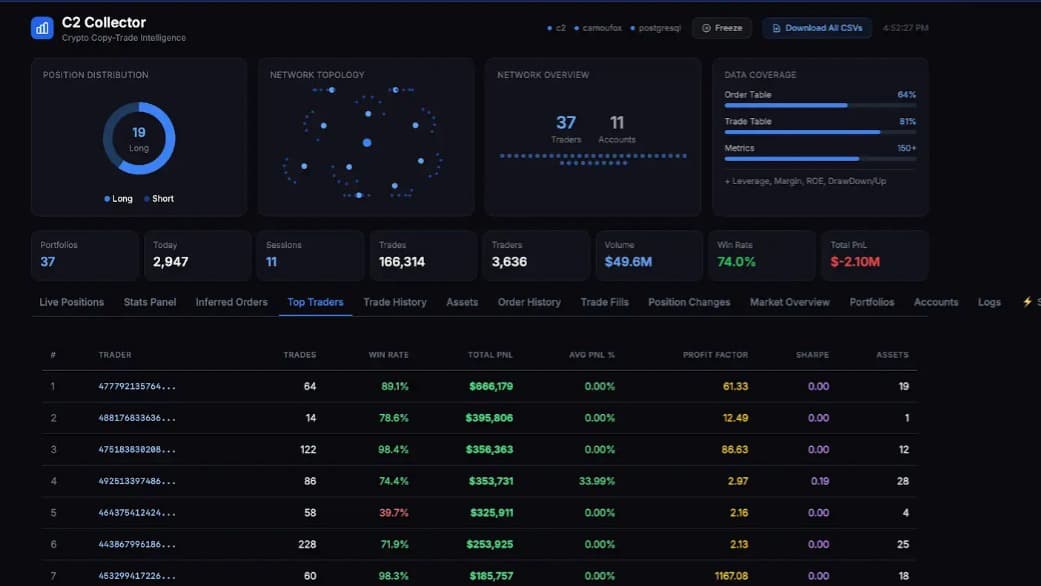
Apohara Synthex

Apohara Synthex

AI agents now run on the live web, but prompt injection is the number-one risk on the OWASP LLM Top 10, and most teams cannot prove what their agents ingested, or that it was safe. Apohara Synthex fixes that. Synthex is the provenance and security layer for the web data an AI agent consumes. It fetches across the full Bright Data spectrum: Web Unlocker, the Web Scraper API, SERP API, Scraping Browser, and the MCP Server. We didn't just use Bright Data; we improved it, contributing PR #140 upstream. Every fetch runs a layered defense before anything reaches a model. A deterministic regex pass and Qwen3Guard on Featherless form a high-recall net; NVIDIA's NemoGuard, selected by a measured benchmark, is the low-false-positive block gate; and a reasoning model on the AI/ML API knows the difference between describing an attack and executing one. Clean content is classified across four lenses, then sealed into an enterprise Evidence Report. The seal is real and shipped: an Ed25519 signature, an RFC 3161 DigiCert timestamp, an offline-verifiable Sigstore Rekor transparency log, and C2PA Content Credentials. Anyone can verify it in seconds with openssl, the industry's own c2patool, and a public ledger. No trust required. Cognee adds memory across re-scrapes, TriggerWare turns it into an automated monitor, and Kiro runs our continuous test and QA hooks. Synthex spans all three tracks, Security & Compliance, Finance & Market Intelligence, and GTM Intelligence, built for the CISO, CFO, compliance lead, and underwriter who need evidence they can defend to a board or a regulator. The average data breach costs 4.44 million dollars; Synthex seals an evidence artifact for a fraction of a cent. Everything signed, nothing trusted, and every number ships with a command to reproduce it.

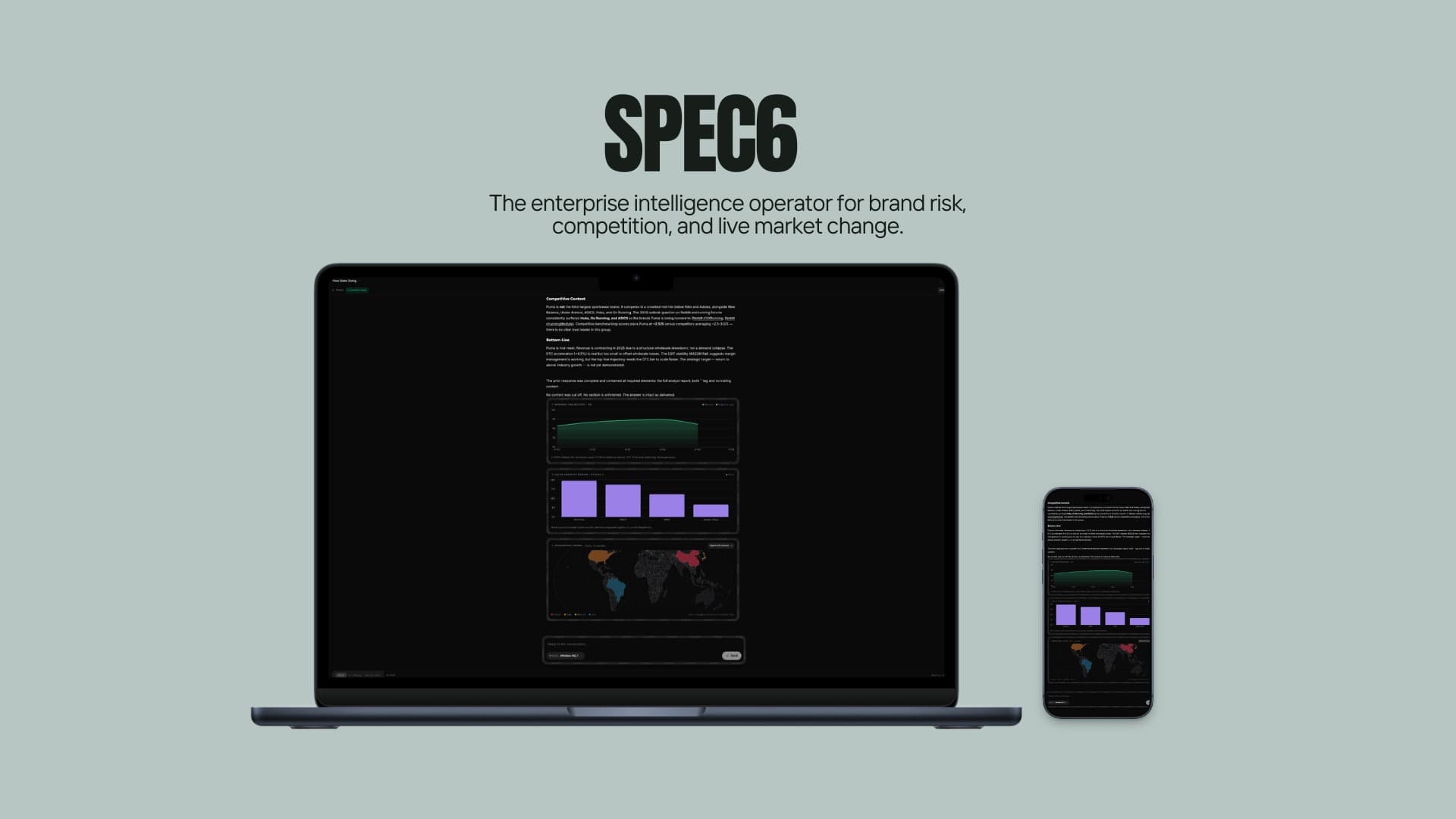
Pulse — Alt-Data Demand Terminal

Pulse — Alt-Data Demand Terminal

Pulse turns the open web into a real-time read on competitive demand. Sales numbers are private, but the signals that precede them aren't: marketplace prices, review velocity, product assortment, and hiring all move on public pages before revenue does. Pulse pulls that data live and unblocked via Bright Data, then turns it into one interpretable, fully-cited number. We use seven Bright Data surfaces: the Web Scraper API across three datasets (Amazon Products, Amazon Reviews, and LinkedIn Jobs), plus the datacenter proxy, Web Unlocker, and the SERP API for both shopping and news. Those streams become time-series signals — review velocity, price index, discount depth, hiring momentum, assortment growth — which roll up into a transparent, z-weighted demand-momentum nowcast. Interpretability is the hero. The gauge breaks the score into signed drivers, and every driver is click-to-expand to its exact inputs and the real source URLs behind it — no black box. When a signal inflects (say a competitor cuts a flagship price), Pulse fires an alert. A graph memory tracks what changed across runs, and a grounded "ask" panel answers "what changed and why" with clickable citations plus an unverified flag that trips if the answer ever contradicts the computed signal. It's built honest and demo-safe: every data point is labeled real or simulated, outputs are framed as competitive-intelligence signals (not investment advice), and the whole app runs end-to-end with zero API keys via graceful fallbacks — adding keys only upgrades the floor to live integrations. The default universe tracks Anker against Belkin and UGREEN in consumer electronics on Amazon, but the company set, nowcast weights, and alert thresholds are all configurable.

Bright Data Proxy Networks