Top Builders

Explore the top contributors showcasing the highest number of app submissions within our community.

Band Integrations

Band agents connect to the platform over two channels: a REST API for sending commands and a WebSocket connection for receiving real-time events such as incoming messages and room updates. Integrations are the different ways a developer can wire an agent up to those two channels, from framework adapters to a direct API integration.

General
DeveloperBand (Thenvoi AI Ltd.)
TypeSDKs, framework adapters, and MCP server
GitHubgithub.com/thenvoi
Documentationdocs.band.ai/integrations/overview

Core Features

  • Python and TypeScript SDKs: a composition-based SDK (Agent.create(adapter=..., agent_id=..., api_key=...)) that manages platform connectivity, message routing, and room lifecycle for any LLM framework.
  • Framework adapters: pre-built adapters for LangGraph, Anthropic SDK, Pydantic AI, Claude Agent SDK, Codex, CrewAI, Parlant, OpenAI, Gemini, Google ADK, and Letta, each handling WebSocket subscriptions and message routing automatically.
  • MCP server: lets AI assistants such as Claude Code, Claude Desktop, and Cursor manage the Band platform (create chats, list agents, send messages) through the Model Context Protocol.
  • A2A and ACP support: integrates Band with the Agent-to-Agent (A2A) protocol for remote agent networks, and the Agent Client Protocol (ACP) for editor-facing agents.
  • Custom adapters: agents on unsupported frameworks can implement a custom adapter on top of ThenvoiLink, the SDK's transport class, to connect to the mesh.

Integration Methods

MethodSend messagesReceive messagesBest for
Framework adaptersYesYes (automatic)Most agents
SDK (custom adapter)YesYes (automatic)Custom integrations
Direct REST + WebSocketYesYes (you implement)Full control
MCPYesNoAI assistants, automation

Tools and Resources


Ecosystem and Integrations

  • Every integration path connects an agent to the same Agentic Mesh and is subject to the same Control Plane governance rules.
  • Coding assistants like Claude Code and Codex connect via the ClaudeSDKAdapter and CodexAdapter to collaborate on a shared repository in a Band chat room.

Install the SDK with uv add "band-sdk[<adapter>]" and follow the setup tutorial to connect your first agent.

Band AI Band Intergrations AI technology Hackathon projects

Discover innovative solutions crafted with Band AI Band Intergrations AI technology, developed by our community members during our engaging hackathons.
Drift Harness

Drift Harness

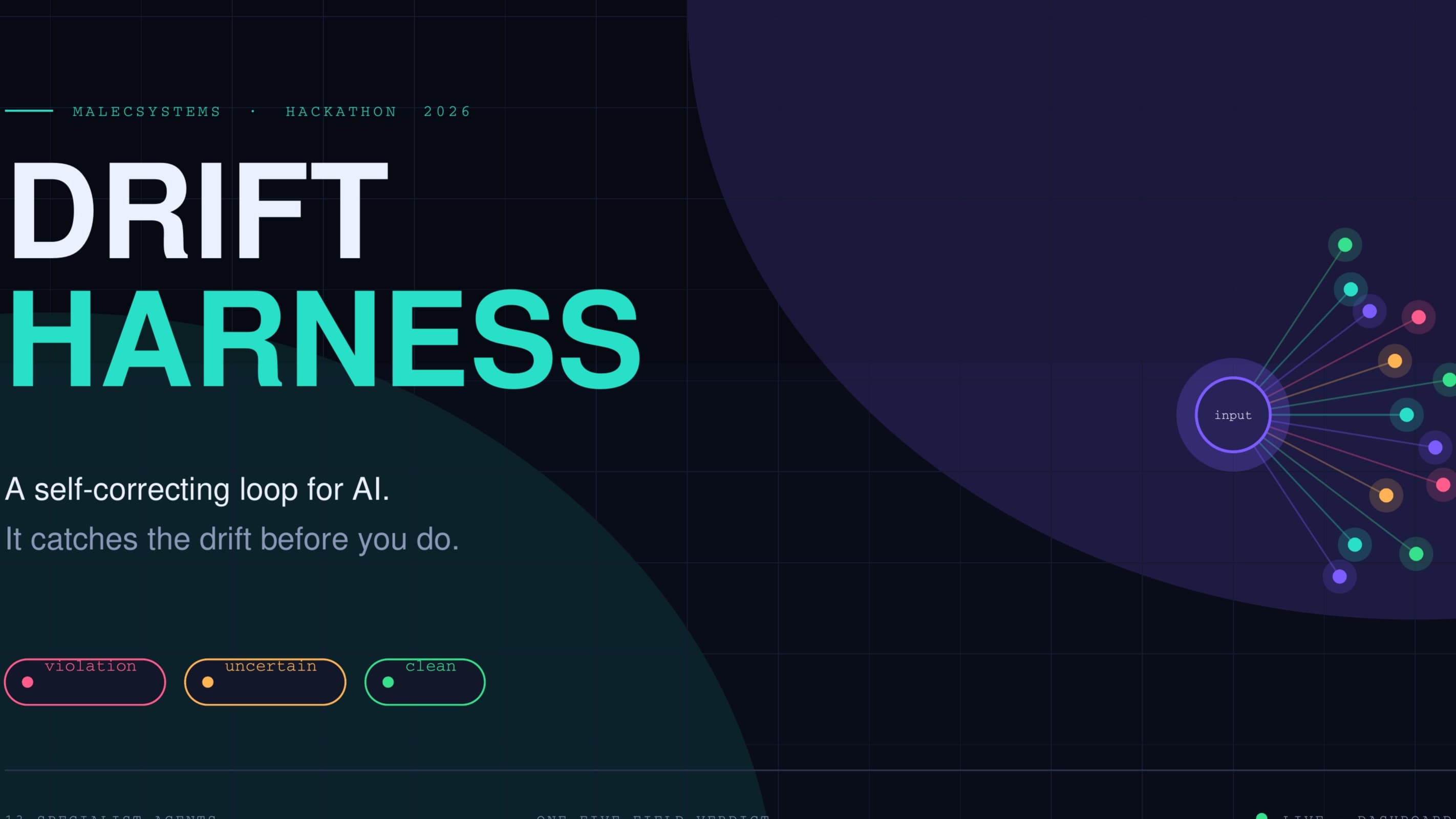
Every AI system drifts. It softens a position under pressure, drops a constraint it was holding a moment ago, or states a guess as if it were certain. The correction is almost always manual: a human notices, pushes back, forgets, and corrects the same failure on the next turn. Nothing remembers, and nothing scales. Drift Harness makes that loop automatic — it intercepts the exchange before the user has to act, logs what failed and why, and builds a structured record that drives correction at scale. The system fans a single exchange across thirteen specialist agents, each checking one slice of behaviour: constraints, antipatterns, voice, quality, identity, alignment, gap analysis, profiling and question generation. Every agent returns the same five-field verdict — agent, status, rule, excerpt, severity — so one shape holds across every layer. Its core idea is how it represents certainty. Rather than a percentage, which is just a token prediction dressed up as a probability, each agent commits to one of three states — violation, uncertain, or clean — always tied to an exact excerpt from the reasoning that triggered it. The excerpt is what makes the label mean anything. Under the hood, the logger mints a UUID4 per exchange and classifies each turn in Python before the model runs. Findings write to a FastAPI and SQLite backend; agents communicate over a shared Band session; a C++ coordinator handles multithreaded fan-out. The full stack runs live on a Hetzner VPS under pm2, with a dashboard at dashboard.malecsystems.com. We proved it end to end: one misaligned input fanned across every live agent produced six confirmed findings, written straight to the backend. All thirteen agents are deployed and the dashboard is live. The harness is the asset. The agents are the mechanism that fills it. Every AI system drifts — this one notices, records it, and turns a manual habit into infrastructure.

THE COUNCIL: Expert Advisors Who Fight For You

THE COUNCIL: Expert Advisors Who Fight For You

Everyone faces life-changing decisions alone. THE COUNCIL changes that by giving you your own personal advisory board. Submit your query—whether it's a high-stakes startup offer, career transition, or relocation—and watch five autonomous AI agents with distinct, persistent personalities deliberate in a live-streamed debate. Under the hood, THE COUNCIL is a multi-agent system built on Band.ai. Instead of a single LLM wearing five prompts, we deploy genuine model diversity: Qwen 2.5-32B (The Skeptic) analyzes risks, Llama-3.1-70B (The Strategist) identifies long-term growth, DeepSeek-R1-70B (The Numbers) quantifies quantitative metrics, Llama-3.1-8B (The Devil's Advocate) stress-tests consensus, and GPT-4o-mini (The Chair) synthesizes the room. The debate orchestration runs sequentially via FastAPI WebSockets to stream arguments as they are generated. Unlike typical chatbot wrappers, THE COUNCIL features heavy engineering depth: 1. Deterministic Stakes Classifier: Scores severity (1-10) and risk factors (cliff, vesting, relocation) deterministically without AI. 2. Live Market Grounding: Career queries trigger Brightdata web scraping to search salary listings, providing real-world benchmarks to 'The Numbers'. 3. Convergence Calculator: A custom algorithm that measures consensus (0.0-1.0) using position agreement and semantic text similarity. 4. Cryptographic 'Stare Decisis': Inspired by judicial tradition, it extracts minority dissents and SHA-256 hashes them directly into an immutable verdict chain. 5. 6-Table Database Persistence: Complete deliberation history mapping decisions, arguments, verdicts, evidence, and dissents in SQLite. Presented in an Apple-inspired editorial Next.js UI using stark light-mode whitespace, Playfair Display serif typography, and elegant card components with smooth micro-animations, the system feels alive, premium, and authoritative. Deliberation, not just generation.

The-Agnets-Worksation

The-Agnets-Worksation

The Agents Workstation is a production-grade, autonomous software engineering agency designed to solve the critical hallucination and execution gaps inherent in traditional AI code generation. Built as a highly concurrent Python orchestration engine, the system decentralizes intelligence across a specialized Band of Agents—including an Architect (Planner), Domain Builders (Frontend/Backend), a deterministic Executor (Terminal), and QA Specialists (Supervisor/Repair). Operating as a native node on the Band AI network, these agents dynamically spin up programmatic chat rooms to plan, coordinate, and hand off tasks using Directed Acyclic Graphs (DAGs) with complete, observable transparency. Unlike standard code assistants that leave execution and debugging to the human developer, the workstation features an indestructible, headless Execution Sandbox. The Terminal Agent handles virtual environments, bypasses interactive prompts in "CI Mode," and actively pings local network ports to guarantee server stability. If an application throws an error on startup, the Supervisor Agent catches the runtime traceback, calculates a project stability score, and triggers a surgical, self-healing Repair Loop to patch the codebase without human intervention. To guarantee zero downtime, the architecture is shielded by a Universal LLM Gateway featuring multi-provider failover routing, dynamically shifting loads between Tier-1 models like Gemini, Claude, and GPT-4o if rate limits are hit. Operators monitor this entire hive mind through a premium, zero-simulation Cyberpunk Dashboard. Powered by real-time WebSockets, this command center streams deterministic telemetry, agent state updates, and system logs with millisecond precision, proving that the AI is not just writing code—it is autonomously orchestrating an entire software factory.