
JC Diamante@zeraphim
1
Events attended
1
Submissions made
Philippines
4+ years of experience
About me
I'm a builder who never really picked one lane — and stopped apologizing for it. Days I'm shipping backend microservices that keep money moving for 94M+ users at GCash. Other days I'm training vision models to spot wildfires from the air, or in class for my Master's in AI at UT Austin. And I genuinely love teaching the stuff once it clicks. Big fan of hackathons, automating anything I'm too lazy to do twice, and the occasional kalimba break. 🎶
🤝 Top Collaborators


🤓 Latest Submissions
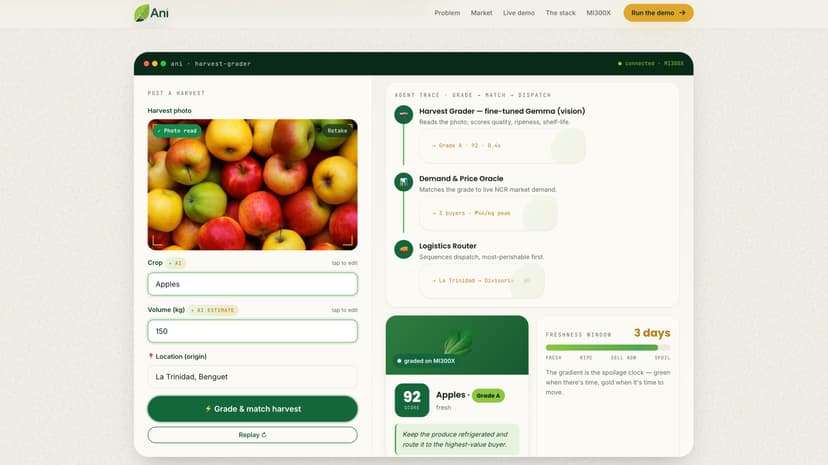
Ani: Multi-Agent Harvest Grading & Market-Matching
Benguet grows roughly 80% of Metro Manila's vegetables — and up to half rots or is dumped before it sells. It isn't a growing problem; it's a coordination problem. Farmers harvest blind into gluts, prices crash, and there's no cold chain to hold what does sell. The losses are happening this season, and they're a software problem. Ani is that fix. A farmer photographs a harvest, and a single vision pass identifies the crop, estimates volume, and scores quality and remaining shelf-life. From there, three specialized agents run under one orchestrator: the Harvest Grader — a LoRA-fine-tuned Gemma 3 vision model — produces a spoilage-urgency score; the Demand & Price Oracle matches the graded crop to live NCR wholesale demand and price using embeddings; and the Logistics Router sequences dispatch so the most perishable loads move first. The whole stack — the Gemma vision grader, the reasoning matcher, and the embeddings — co-hosts on one AMD Instinct MI300X. Its 192 GB of HBM3 runs all three models on a single card, on-prem and private, so a cooperative's pricing, contracts, and farmer data never leave the co-op; on an 80 GB GPU you'd need several machines. Ani grades, matches, and dispatches a harvest — before it spoils. Built by The ODYZEUS for the AMD Developer Hackathon: ACT II — Track 3 (Unicorn).
13 Jul 2026
