🤓 Latest Submissions
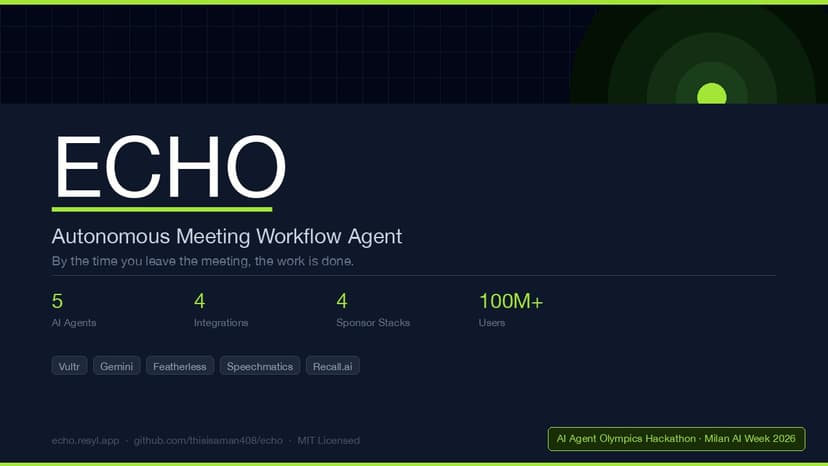
Echo MultiAgent
ECHO is an autonomous multi-agent meeting workflow agent built for enterprise teams. The problem it solves: knowledge workers waste 5+ hours per week on post-meeting admin — updating CRMs, creating tasks, drafting follow-up emails, posting team summaries. ECHO compresses that to zero. HOW IT WORKS A Recall.ai bot auto-joins any Zoom, Google Meet, or Microsoft Teams call via URL — no app install, no calendar permission required. After the meeting ends, five specialist AI agents fire in sequence: 1. Action Extractor (Featherless / Llama 3.1) Extracts every commitment, deadline, and task from the diarized transcript using a domain-specialized open-source model running on Featherless serverless inference. 2. Stakeholder Classifier (Featherless / Llama 3.1) Identifies who said what, their role, company, and who owns each action item. Depends entirely on Speechmatics speaker diarization to know which speaker is which. 3. Decision Maker (Gemini 2.5 Flash) Synthesizes a full cross-system workflow: what to update in HubSpot, what to create in Linear, what to post in Slack, and what to draft in Gmail — based on all prior agent output. 4. Comms Drafter (Gemini 2.5 Flash) Writes the actual follow-up emails and Slack summaries in natural language, ready for human review or auto-send. 5. Executor Fires real API calls to HubSpot, Linear, Slack, and Gmail. Nothing is mocked. Every integration is live and auditable.
19 May 2026
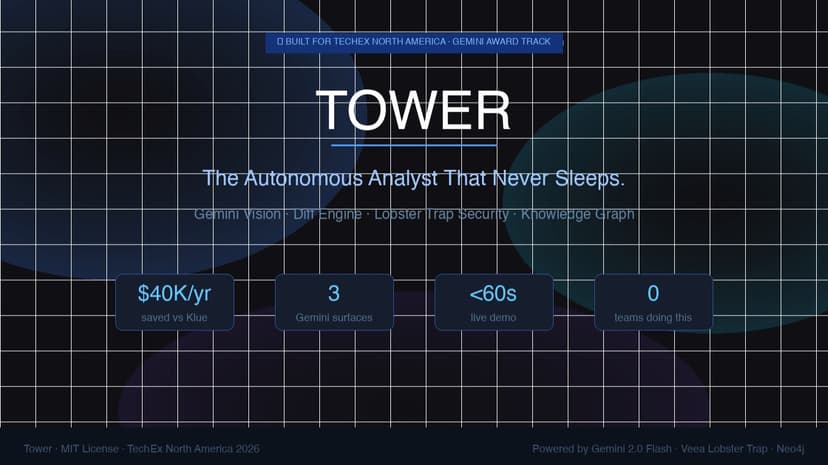
Tower
Tower is an autonomous competitive intelligence platform that replaces $40,000/year tools like Klue with an open-source AI agent stack. The flow: sign up, enter your product URL. Gemini 3.1 Flash analyzes your website, understands your business, and automatically discovers your top competitors. No manual setup. From your dashboard, click any competitor — Tower simultaneously scrapes their pricing page, blog, careers, and changelog, then Gemini Vision extracts structured competitive signals in real time: pricing tiers, product launches, hiring surges, funding rounds, feature changes — each scored 0–100 by business impact and streamed live. Every day at your chosen time, Tower runs a full scan of all your competitors, compares results against the previous scan, and emails you a diff report: here's what changed, here's what stayed the same. You never miss a competitor cutting prices or launching an AI feature that eats your roadmap. The Knowledge Graph visualizes your competitive landscape as a 3D node graph. Each competitor is a node, color-coded by threat level (high/medium/low), with Gemini-generated relationship edges explaining why they compete with each other. Click any node for their pricing, funding, target customer, and core product summary. Security is first-class, not an afterthought. Every single Gemini inference call passes through Veea's Lobster Trap — a deep prompt inspection proxy that detects adversarial prompt injection attacks embedded in competitor pages. Competitors can't hijack your extraction pipeline. Every blocked attack is logged with a full audit trail a regulator could read. Tech stack: Gemini 3.1 Flash (extraction, analysis, graph, briefs, email), Veea Lobster Trap (security layer on every inference), Next.js 16 on Vercel, Neon Postgres, Resend for email alerts. Fully deployed, MIT licensed, production-ready.
19 May 2026
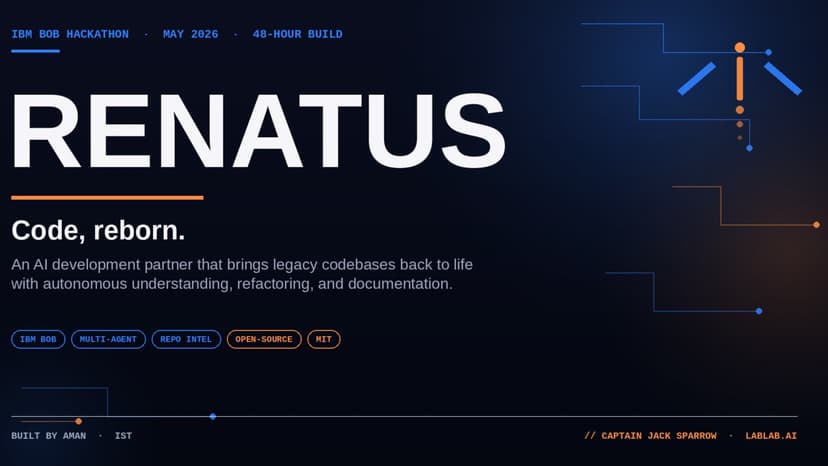
Renatus
Renatus is a production-ready AI platform that applies LLM-driven code changes to real GitHub repositories with the audit rigor that enterprises actually need. Four agents share one engine — Migrate, Refactor, Security Audit, and Codebase Q&A. Every run follows the same pipeline: clone → index imports and symbols into a knowledge graph → Cartographer generates a rule plan → Surgeon patches files using IBM watsonx.ai Granite — the only LLM that runs in regulated cloud environments — → Examiner generates regression tests → Auditor signs the entire event log with ed25519. The signature is verifiable by anyone, offline, with no Renatus account . The knowledge graph is not a vanity visualization. It is the retrieval system. Instead of dumping an entire codebase into a 200k-token prompt, Renatus walks import edges via recursive SQL to find only the files downstream of a breaking change. The LLM sees a focused, relevant slice. Patches are accurate. Hallucinations are reduced. Every Renatus tool is exposed as an MCP server. IBM Bob can call migrate_repository, query_knowledge_graph, propose_patch, or sign_audit directly from the IDE — no context switching, no copy-paste. The same signed audit report that satisfies a compliance reviewer is generated whether the run came from the web app or from a Bob prompt. Built with: IBM watsonx.ai Granite (primary LLM), Next.js 16, Neon Postgres, Inngest durable workflows, isomorphic-git, react-force-graph, WebContainers for in-browser test replay.
17 May 2026


