Thalanayar Muthukumar@thalanayar_muthukumar960
🤝 Top Collaborators

.png&w=640&q=75)
🤓 Latest Submissions
Contract Finder
*Contract Finder* is an AI agent for government contract discovery — Track 1, GTM Intelligence. It filters by location, industry, and deal size, searches live procurement sources, and returns structured RFP intelligence. "Public-sector revenue is on the web, but it's scattered — SAM.gov, state portals, county bids, agency sites. BD teams hunt manually, miss deadlines, and can't filter by geo, industry, and deal size at scale. "Claude Sonnet orchestrates a tool-use loop: *search_web* via Bright Data SERP, *scrape_url* via Web Unlocker, then streams results to the UI. The agent decides when it has enough information, but this can be controlled by the user as well
31 May 2026
Robot Abstraction
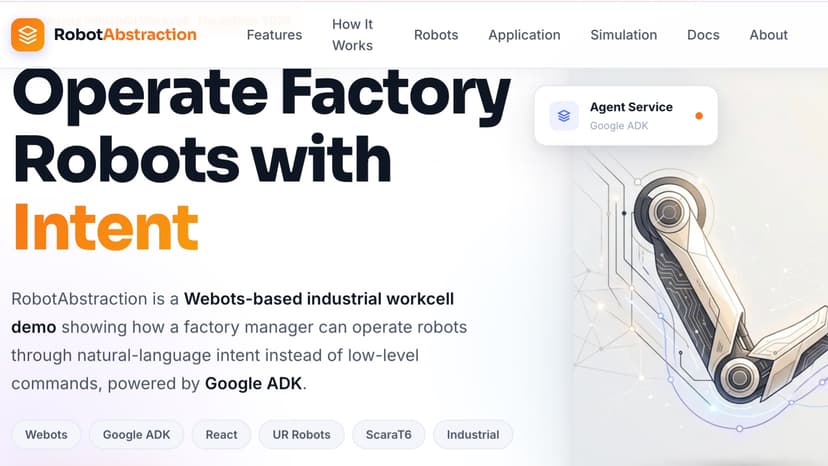
Robot Abstraction allows plant operators to convey their intent for plant objectives to multiple robots in a plant in natural language and for Gemini LLMs using Google ADK to translate into commands that a supervisor agent communicates with different real robots in simulators and the real world. Robot Abstraction enables - Multiple robots from different manufacturers with similar and different capabilities be used. Enables new robot manufacturers to get adoptions - Research institutions to envisage complex workflows that require orchestration to be built just by conveying human intent in natural language - Plant operators to test what if scenarios in simulation environments such as IsaacSIM, Gazebo and webots for their specific factory configurations before making buying decisions. Robot Abstraction is the interface between human intent and robot action through the robot abstraction framework. Robots are physical systems. Mistakes have real consequences. LLM outputs can be unsafe or incorrect. APIs are inconsistent across platforms. Simulations don't perfectly match hardware. Most teams end up rebuilding safety systems from scratch. Robot Abstraction addresses these issues in a simple framework that constrains to typed capabilities such as navigate, stop, inspect - validates actions through policies before execution and guarantees safety and correctness through guard rails. Robot Abstraction starts with simulation first developers and pick and place robots before we move to connecting with physical robots and to humanoid and drones
19 May 2026
.png&w=828&q=75)
RescueOrch - Orchestration platform for simulation
RescuOrch integrates Webots R2025a simulation with DJI Mavic 2 Pro drones, TIAGo++ ground robots and the Gemini 3 Flash LLM to orchestrate multi‑agent rescue operations. Its current demo tackles a kitchen fire, but the same platform can simulate active‑shooter drills, FEMA‑style flood recovery, massive fires in dense areas like Mumbai’s Dharavi, pipeline or oil‑rig accidents and high‑magnitude earthquakes. Gemini produces real‑time plans, so drones scout hazards, ground robots execute tasks and the plan adjusts as conditions change. These simulations address real gaps: U.S. fire‑response times average 6–8 minutes in cities and exceed 10 minutes in rural areas; Mumbai’s fire brigade reports response times of ~10 minutes in the city and 20 minutes in suburbs. Globally, over 180,000 people die from burn injuries each year and 86,473 people died in disasters in 2023. Last year 89 U.S. firefighters died on duty, underscoring the dangers responders face. After earthquakes, survival drops from about 90 % in the first day to 5–10 % after 72 hours, so rapid coordination saves lives. By running “what‑if” scenarios—larger or multi‑room fires, stronger earthquakes or multiple hazards—RescuOrch helps agencies test strategies and decide if additional drones or rugged robots would improve outcomes. With 27,000 U.S. fire departments and 23 oil refineries in India, there is a broad user base for physics‑based simulation training. In short, RescuOrch offers a versatile AI‑driven testbed to help responders plan, train and procure the right equipment for complex emergencies.
15 Feb 2026
Global Insight - Claude 3 Opus
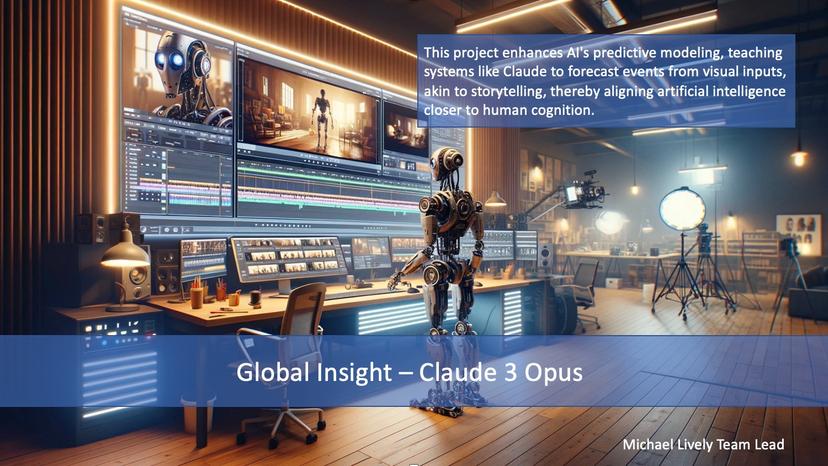
This project explores the advancement of predictive modeling within artificial intelligence, aiming to equip robots with the ability to forecast future events. This capability is designed to mirror the predictive thinking observed in humans, thus enhancing the practical applications and benefits of robotic systems in various sectors. The innovative approach taken involves a unique method of teaching AI systems, like Claude, to interpret and predict future scenarios based on visual inputs, similar to watching television. The methodology focuses on treating visual input as a series of storytelling frames. Claude, for instance, would analyze two given frames, understanding the content and actions within them, and then leverage its natural language generation capabilities to predict and describe what might occur in the subsequent frame. This project not only advances the field of predictive modeling in AI but also opens new pathways for interactive and anticipatory technologies, fostering a closer synergy between human cognitive processes and artificial intelligence.
16 Mar 2024

SimpliMedi-Assist
SimpliMedi-Assist addresses the common challenge of understanding complex medical reports by offering a user-friendly solution. Leveraging sophisticated language processing algorithms, it translates intricate medical terminology into clear, concise language accessible to patients and non-medical professionals. This innovative tool eliminates barriers caused by medical jargon, empowering individuals to comprehend their health information effectively. By bridging the gap between technical medical language and layman's understanding, SimpliMedi-Assist facilitates informed decision-making and promotes health literacy. With its intuitive interface and precise translations, it enhances communication between healthcare providers and patients, ultimately improving healthcare outcomes and fostering patient empowerment.
23 Feb 2024