🤓 Latest Submissions
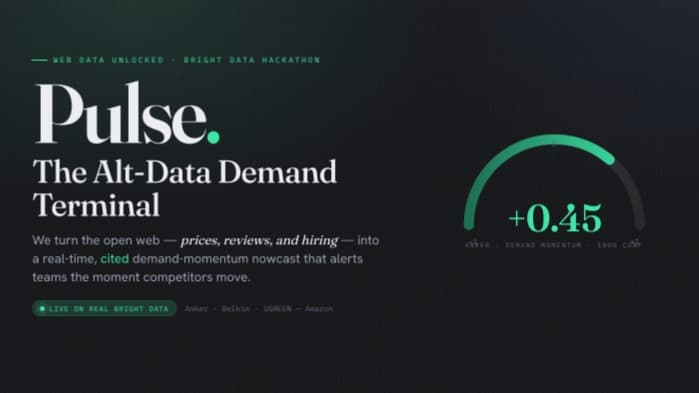
Pulse — Alt-Data Demand Terminal
Pulse turns the open web into a real-time read on competitive demand. Sales numbers are private, but the signals that precede them aren't: marketplace prices, review velocity, product assortment, and hiring all move on public pages before revenue does. Pulse pulls that data live and unblocked via Bright Data, then turns it into one interpretable, fully-cited number. We use seven Bright Data surfaces: the Web Scraper API across three datasets (Amazon Products, Amazon Reviews, and LinkedIn Jobs), plus the datacenter proxy, Web Unlocker, and the SERP API for both shopping and news. Those streams become time-series signals — review velocity, price index, discount depth, hiring momentum, assortment growth — which roll up into a transparent, z-weighted demand-momentum nowcast. Interpretability is the hero. The gauge breaks the score into signed drivers, and every driver is click-to-expand to its exact inputs and the real source URLs behind it — no black box. When a signal inflects (say a competitor cuts a flagship price), Pulse fires an alert. A graph memory tracks what changed across runs, and a grounded "ask" panel answers "what changed and why" with clickable citations plus an unverified flag that trips if the answer ever contradicts the computed signal. It's built honest and demo-safe: every data point is labeled real or simulated, outputs are framed as competitive-intelligence signals (not investment advice), and the whole app runs end-to-end with zero API keys via graceful fallbacks — adding keys only upgrades the floor to live integrations. The default universe tracks Anker against Belkin and UGREEN in consumer electronics on Amazon, but the company set, nowcast weights, and alert thresholds are all configurable.
31 May 2026
