🤝 Top Collaborators
🤓 Latest Submissions
Themis — AI Advisor for Business
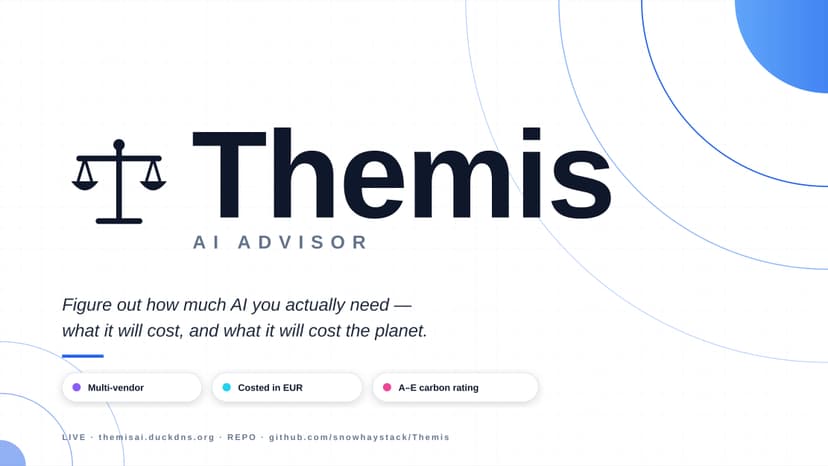
Adopting AI shouldn't require being an AI expert, and shouldn't be a leap of faith. Themis — named after the Greek titaness of fair counsel — turns a short multiple-choice conversation into a structured, defensible AI adoption plan in under five minutes. The user picks two dropdowns (industry, company size), answers a closed-option Q&A about their team and use cases, and watches a four-agent pipeline think out loud: Disambiguator → Analyzer → Decider → Formatter. About 45 seconds later, they land on a typed report. Every recommendation is vendor-neutral. The Analyzer matches each use case to a concrete model across Google, Anthropic, and OpenAI — not a one-size-fits-all answer. The report ships with a monthly and annual cost estimate in EUR, an EU energy-efficiency rating from A to E for the carbon footprint, real-world equivalences (km driven, trees needed, phone charges), per-role impact, ROI estimates in months, and benchmarks from companies that did similar things. Reliability comes from engineering, not prompt hope. Every agent has Zod-validated input and output, responseMimeType: application/json enforced on the Gemini calls, and a deterministic evaluation gate that re-runs the Analyzer or Decider if their output fails sanity checks — hallucinated models, totals that don't add up, implausible ROI. Pricing tables, carbon factors, and benchmarks live as TypeScript constants you can edit, not as numbers buried in prompts. Built on Next.js 15, TypeScript, Tailwind, Zod, Redis, and the Google Gemini API. Docker Compose multi-stage build, deployed on a single Vultr VPS with a one-command script. The full pipeline is live at themisai.duckdns.org and the source is on GitHub under MIT.
19 May 2026
