
🤝 Top Collaborators

🤓 Latest Submissions
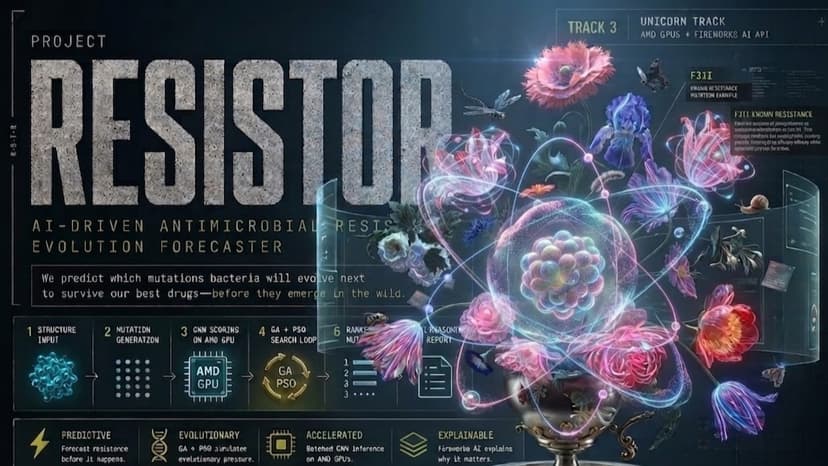
RESISTOR
Most AI drug discovery tools answer "which compound kills this bacteria today" — a crowded, reactive question. RESISTOR asks a different one: which mutations will this bacteria evolve next to survive our best drugs, before it happens in the wild. We built a genetic-algorithm and particle-swarm search loop — adapted from our prior project AETHER — to drive a trained graph neural network that scores binding-affinity and stability deltas for thousands of point mutations on a real, published protein-drug pair (S. aureus DHFR, PDB 2w9g). An attribution layer explains why each high-risk mutation matters structurally, and a live Fireworks AI integration turns that into a plain-language forecast report. Everything is tied together by an orchestration and verification pipeline that confirms every result is fresh and real before it's shown. We ran into real obstacles — AMD cloud access failures, a counterintuitive CPU-beating-GPU benchmark, twice-exposed API keys — and we disclosed all of it rather than hiding it, including a proven parity test and device-agnostic, ROCm-ready code. Our model independently rediscovers F98Y, a real clinical resistance mutation, computed fresh every run — proof this isn't scripted.
13 Jul 2026
Eidolon
Large language models are powerful generalists, but deploying them for specialized domains like legal, medical, or financial applications still requires expensive, time-consuming fine-tuning. Every new task means a new training run, new compute costs, and days of waiting. Eidolon solves this differently. Instead of fine-tuning the base model, Eidolon trains a hypernetwork to generate LoRA adapter weights on demand. Give it a task description and 50 domain examples, and it produces a specialized LoRA matrix set in under a second, injected directly into the frozen base model at inference time. No retraining. No queue. No cost per domain. The architecture centers on a 100M parameter hypernetwork that takes a task embedding from a frozen sentence encoder and outputs pairs of LoRA matrices (A and B) for each targeted attention layer of Llama 3.1 8B. The base model stays completely frozen throughout. Specialization happens entirely through the generated adapter weights. Built natively on AMD ROCm and optimized for the MI300X's HBM3 memory architecture, Eidolon exploits the hardware's massive bandwidth for meta-batch parallelism during hypernetwork training and holds multiple domain LoRAs simultaneously in memory during serving. The full stack runs on PyTorch 2.3+, HuggingFace PEFT, Flash Attention 2, Triton, and vLLM for production inference. The system was trained across 10 diverse domains simultaneously, using a task curriculum and gradient-aware techniques to prevent catastrophic interference between conflicting domain objectives. Generalization is evaluated on a held-out 11th domain the hypernetwork never saw during training. The result is a production-ready, few-shot domain adaptation system that makes LLM specialization as simple as an API call.
10 May 2026

