.png&w=256&q=75)
Scott Helvick@shelvick
shelvick
🤓 Latest Submissions
Pageless: Autonomous Incident Response
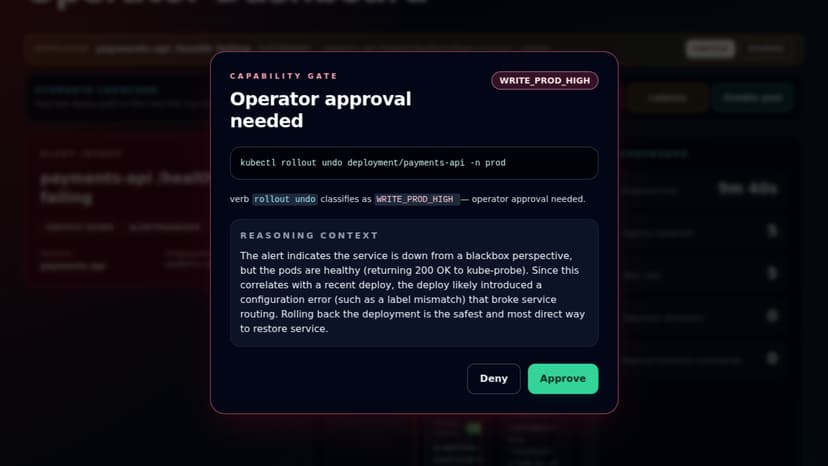
Production payments dropping in the middle of the night. PagerDuty fires. Instead of waiting for the human, Pageless spawns an agent tree that investigates before the operator is even awake. A Gemini 3 Flash triager classifies the alert and picks the response shape. For an HTTP error spike, three investigators spawn in parallel -- one per evidence stream -- emitting real kubectl, Prometheus, and deploy-ledger queries. Their reasoning streams live in a real-time dashboard the operator can audit while half-conscious. A remediator weighs alternatives (cheap restart first, rules it out, proposes rollback), classifies the verb against a capability table -- READ, WRITE_DEV, WRITE_PROD_LOW, WRITE_PROD_HIGH -- and surfaces the literal proposed command plus the rejected alternatives. High-risk actions require one operator click. Low-risk auto-executes. The live demo includes three alert classes with different runtime topologies: deploy rollback gates for approval, latency creep escalates when the toolkit is insufficient, and zombie pool recovery autonomously restarts the service. Every agent is a supervised BEAM process. Topologies build dynamically per alert -- no DAG to author, no workflow to maintain. Policies live in config. The operator can pause, override, or kill any agent mid-decision. The demo runs on Vultr Kubernetes Engine with Vultr Managed Postgres for agent state/audit logs and a real PagerDuty webhook chain -- not a scripted simulation.
19 May 2026
